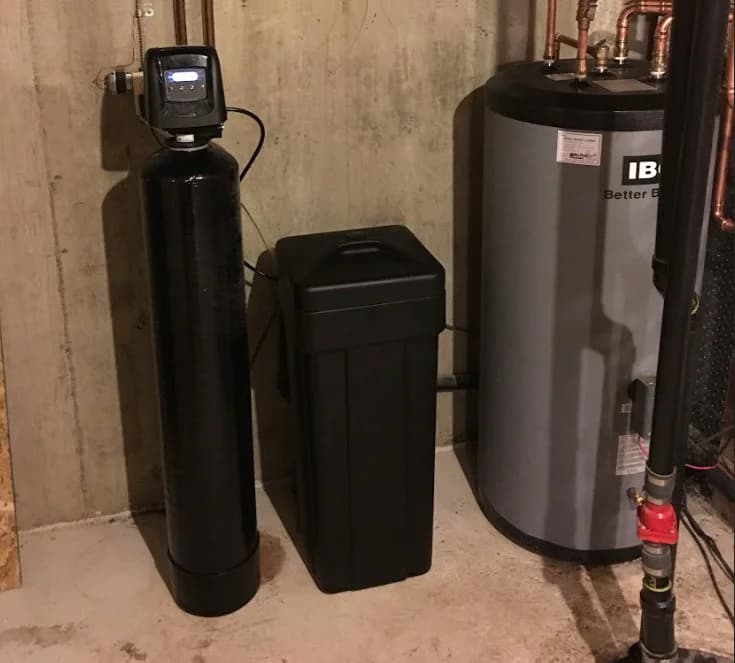
Why is my water softener not using salt? Either it doesn't need much, or something is stopping it from making brine and drawing it through the resin. One question separates the two: is the water at the tap still soft? Pentair's FAQ asks whether there's salt in the tank and whether the softener has been using it. "If no, your softener is not regenerating."
First check: is the water still soft?
Demand softeners meter the water you use. The Kinetico Signature Series owner's manual says such a unit "could regenerate more frequently (if you have a house full of guests, for instance) or not at all (if you're on vacation)." EcoWater's FAQ adds: "you might not go through as much salt as another brand used. If you feel like your water isn't soft, and the level of salt is not decreasing at all, consult your EcoWater Pro."
So:
- Soft water, salt dropping slowly: probably fine.
- Hard water, salt level unchanged: something is wrong.
Two things can mislead you. A salt-level display only knows what you tell it; the Whirlpool WHES40/44 manual says "You must set salt level each time salt is added." And Culligan notes that "Seeing water in the brine tank is normal and does not necessarily mean the softener needs more salt."
Calgary's water also shifts. The City says hardness "varies seasonally and by location", with the north mostly on Bow River water and the south mostly on the Elbow. Its 2025 results ran from 141 to 274 mg/L. For a healthy schedule, see how often a water softener should regenerate.
Bypass, power and settings: it isn't regenerating at all
With the bypass open, water goes around the softener. On a metered unit the meter never counts it, so the softener doesn't regenerate. Bypass gets used during plumbing work and can be left that way.
- The Fleck 5600SXT service manual, under hard water: "By-pass valve is open. Close by-pass valve."
- The Clack WS1 service manual, for a valve that only regenerates when you press REGEN: "Bypass valve in bypass position."
- Kinetico's FAQ: "If your salt levels are good, check the position of your bypass valve".
The display can confirm water is passing through. The Fleck SXT owner's manual: "The Flow Indicator flashes when outlet flow is detected." If a tap is running, the bypass is in service and the indicator stays still, Clack points to a disconnected or stalled meter, which is a service job.
Next, power and the clock. Fleck lists interrupted electrical service and "Power failure. Reset time of day." For a clock showing the wrong time, Clack lists an outlet on a light switch and a tripped breaker or GFI.
Then programming. Clack lists "Incorrect programming." Set hardness too low and the softener thinks it has capacity left, so it regenerates late or not at all. Program it to a measured hardness, not a guess or a factory default.
Salt bridges: the tank looks full but nothing dissolves
Whirlpool: "When the salt 'bridges,' an empty space forms between the water and the salt. Then, salt will not dissolve in the water to make brine." Kinetico's owner's manual names the conditions behind it: "high humidity, low water and salt consumption, or the use of potassium chloride (KCl)." Low use is on that list, so slow salt use and a bridge can go together. Fill level is model-specific: Kinetico says to "fill the brine tank to the halfway point" to reduce bridging.
Whirlpool's check is a broom handle pushed gently straight down into the salt. A hard layer partway down is most likely a bridge, and gentle pushes in a few places break it. It also warns: "Do not use any sharp or pointed objects as you may puncture the brine tank. Do not try to break the salt bridge by pounding on the outside of the salt tank."
If the tank holds too much water, see why your water softener has water in it.
Salt mushing: sludge at the bottom
EcoWater says mushing "is the more serious of the two problems and happens when dissolved salt recrystallizes and forms a sludge on the bottom of the brine tank." Its test: "If you test for a salt bridge but it doesn't break up when pushing on it, salt mushing is probably the cause." Its fix is "Draining the softener of its water, digging out all the old salt and replacing it with fresh salt". If you'd rather not, a technician can. The full clean-out is in how to clean a water softener.
The manuals disagree on salt. Whirlpool recommends "Nugget, pellet or coarse solar salts" and not rock, block or granulated. Fleck: "Do not use granulated or rock salt." Kinetico: "DO NOT USE ROCK SALT OR SOLAR SALT". Use what yours names.
Brine draw faults: salt and water are there, but no brine gets pulled
Hard water, bypass in service, clock right, salt loose? Look at brine draw. Fleck, Clack and Pentair's installation manual each have a troubleshooting entry for a softener that "fails to draw brine" (Clack's wording is "regenerant"). Most causes sit inside the valve, so finding the one that applies belongs to water softener repair.
Injector or venturi
Whirlpool says this small part "creates the suction to move brine from the brine tank, into the resin tank," and if plugged, "hard water will result." It sits inside the valve, and Culligan says: "In most cases, this requires expert support."
Brine line
Culligan says if the brine line "isn't properly attached, it can interfere with the system's ability to draw brine." Check the tube by eye: seated, unkinked, uncracked.
Drain line restriction
Whirlpool lists "Restriction in valve drain, causing a back-pressure (bends, kinks, elevated too high, etc.)". Where pressure is low, it says to avoid drain hose runs over 30 feet or more than 8 feet above the floor. Straighten a kinked hose yourself. Fleck's "Drain line flow control is plugged" is inside the valve.
Float, brine valve and refill
No refill water, no brine. Pentair lists "The valve fails to refill the brine tank" and "Blockage in the brine line or brine valve".
Low water pressure
Minimums differ: Fleck "A minimum of 20 psi (1.4 bar)", Pentair and Clack 20 psi, Kinetico 15 psi. If the whole house is short, start with low water pressure.
Internal valve faults
Fleck lists "Internal control leak"; Clack, "Faulty regenerant piston". Clack: "Service and maintenance should be performed by qualified personnel only."
A safe test: run a manual regeneration
Culligan suggests you "start a manual regeneration to see if the brine tank begins to empty. If the tank remains full, it's best to contact a water treatment professional". Whirlpool's version: once the valve is in the brine position, shine a flashlight into the brinewell for "a noticeable drop in the liquid level. This may take 15 to 20 minutes."
Use only the buttons your manual names, with covers on, and "Avoid using hot water while the softener is regenerating" (Whirlpool). Here's what a normal regeneration sounds like.
Find the model number before you call. On a Whirlpool it's "on the rating decal, typically located on the rim below the salt lid hinges."
What not to do
- Don't open injector, nozzle or valve housings; they're under pressure. Leave the control head closed too.
- Don't clean valve parts with chemicals.
- Don't lubricate anything. Clack: "Do not lubricate the motor or the gears."
- No sharp tools on the salt, no pounding the tank, and no salt your manual excludes.
When to call
Call if the water is hard and the salt still isn't dropping after these checks, or a manual regeneration doesn't lower the brine level. When you phone 587-834-3668, have the brand, model number, a note on whether the water is hard, and what the regeneration test showed. We price the repair before any work starts, and we dispatch from both Calgary and Airdrie. Call and we'll tell you honestly when we can get there. See water softener repair, or in Airdrie.
If the softener is near the end of its life, fixing the valve might cost more than it's worth. Our guide to how long water softeners last helps you weigh that. Replacing it instead? See water softener installation in Calgary or water softeners in Airdrie.