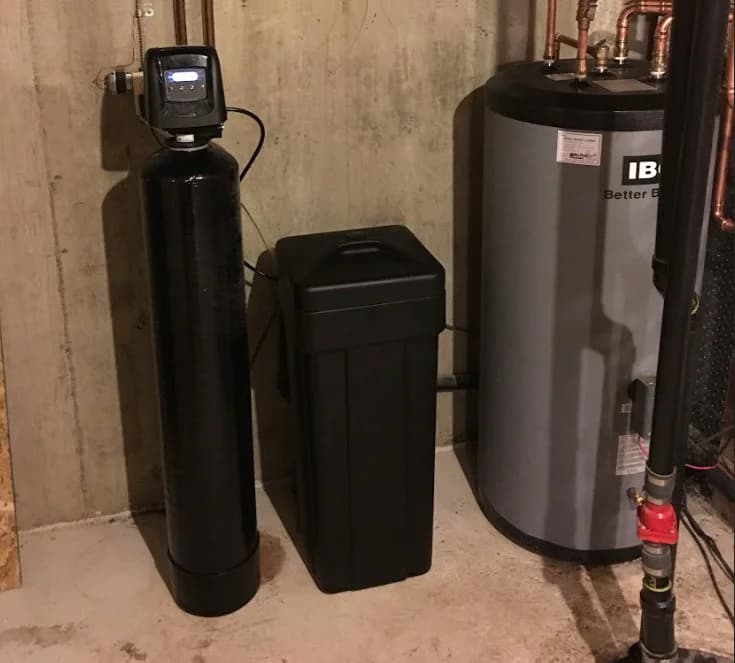
How to clean a water softener depends on which part you mean, because it's three separate jobs: cleaning the brine tank (the salt tank you can reach into), cleaning the resin with a resin cleaner run through a regeneration, and keeping salt bridges from forming. The control valve on top isn't one of them. For what the resin actually takes out of your water, see what water softeners remove.
Start with the model number and the manual
Your manual decides which cleaners the softener can take, how to take it out of service and how to rinse it afterwards. They differ by brand and model. On a Whirlpool, the model number is "on the rating decal, typically located on the rim below the salt lid hinges." Culligan: "Procedures vary by system, so follow the instructions in your model's owner's guide".
Cleaning the brine tank
Signs it needs it
- Sludge on the bottom that won't break up. That's salt mushing: dissolved salt hardening again into a paste.
- Salt that looks dirty, or grit and residue showing as the salt level drops.
- More standing water than usual. Some water is normal; why your water softener has water in it explains when it isn't.
Fleck's SXT manual says: "Empty and clean the tank every three years." That's Fleck's instruction for that unit; check yours.
The clean-out
- Take the softener out of service the way your manual says. On most units that means putting the bypass valve into bypass.
- Scoop out the old salt and any sludge.
- Rinse the tank with plain water.
- Put the brinewell and anything else you moved back in place, then add water and salt to the levels your manual gives.
EcoWater's fix for mushing is the same: "Draining the softener of its water, digging out all the old salt and replacing it with fresh salt". Whirlpool adds a step that's easy to forget: "Be sure the brinewell cover is on."
Plain water is all it needs. No soap, vinegar or household cleaner: whatever stays in that tank gets drawn into the resin on the next regeneration.
Sanitising is a separate step
Culligan says: "A water softener in regular use generally does not need routine sanitizing." It adds that sanitising "may be recommended when the system is first installed, after a period of inactivity", or if unusual tastes or odours develop in well water.
When a manual calls for it, use that manual's procedure. Whirlpool and Pentair both describe bleach-based methods with different amounts and steps, so don't borrow a number from another brand or a forum. Pentair: "Do not pour undiluted bleach into the water conditioner." Kinetico's Signature Series manual goes another way: after something like a municipal boil-water alert, bypass the softener and have your Kinetico dealer sanitise it.
Cleaning the resin with a resin cleaner
Resin cleaner is for fouled resin, usually iron. For reddish staining despite a softener, Pentair's FAQ asks whether you've tried resin cleaner: "If no, try resin cleaner. If yes, it is time to rebed your system." For lost water pressure, the Fleck 5600SXT service manual lists "Iron buildup in water conditioner. Clean control and add mineral cleaner to mineral bed." Cleaning the control is a technician's job; adding the cleaner is yours.
Use only a product your manual names or approves:
- Whirlpool's WHES40/44 manual recommends its WHE-WSC Water Softener Cleanser, used as directed, "every four months", for those models.
- Morton names its System Saver II and Rust Remover salts for cleaning the resin tank.
- Kinetico recommends salt with an iron cleaning additive when the supply contains iron, such as Kinetico Salt with Iron Fighter, which it says "will prevent iron from fouling the resin".
- Clack says its valve "is compatible with a variety of regenerants and resin cleaners". Clack makes the valve, so the product choice still comes from your softener's manual.
In general terms, the cleaner goes down the brinewell, you start a manual regeneration, and the softener rinses it out to drain. EcoWater says to use "the manufacturer's recommended amount"; take the amount and the rinse from the label and your manual. Whirlpool says that if taste, odour or discolouration show up afterwards, regenerate again, then run a cold tap downstream of the softener until the water is normal. This is what a normal regeneration sounds like.
Cleaner clears fouling. It won't revive worn-out resin. If the water stays hard or stained after a cleaner treatment, that's Pentair's rebed point, or time to price a replacement. If you're deciding between repair and replacement, how long water softeners last lays out the factors, and water softener installation covers replacement in Calgary.
Keeping salt bridges from forming
Don't overfill. To limit bridging, Kinetico's manual has you "fill the brine tank to the halfway point". EcoWater says keeping the tank half-full stops older salt sticking to the walls. Whirlpool says that in humid areas it's best to keep the salt level lower and refill more often. Use the salt your manual names; brands disagree.
To check for a bridge, ease a broom handle down through the salt without forcing it. Whirlpool warns: "Do not use any sharp or pointed objects as you may puncture the brine tank. Do not try to break the salt bridge by pounding on the outside of the salt tank." If the salt level isn't moving at all, why your water softener isn't using salt goes through the causes.
Never mix cleaning chemicals
Health Canada: "Never mix household chemical products together." On bleach in particular: "You should never mix bleach products with other cleaning products because this can produce toxic gas." CANUTEC explains why: "when bleach is mixed with an acid, it reacts and releases chlorine gas".
For a softener, that means:
- One product per cleaning. Sanitising and resin cleaning are separate jobs.
- Finish your manual's rinse before anything else goes in.
- Nothing in the brinewell your manual doesn't name, including vinegar and descalers.
- Keep the area ventilated. CANUTEC advises using cleaning products "in well-ventilated areas".
Jobs to leave to a technician
Leave the control valve, injector or venturi, pistons, seals and anything electrical alone. The valve is under water pressure, and a seal or piston put back wrong means a leak or hard water. Clack's manual says: "Service and maintenance should be performed by qualified personnel only." Culligan agrees: "Use professional service for internal cleaning, sanitizing or persistent performance problems." Still misbehaving once the tank and resin are clean? That's water softener repair.
Check the water afterwards
A clean softener should give you soft water, so test it. Pentair's whole-house softener manual says the water "should be tested periodically (2 times a year minimum) with hardness test strips".
The City of Calgary says hardness "varies seasonally and by location". The north mostly gets Bow River water, the south mostly Elbow. Across 2025, the City's readings spanned 141 to 274 mg/L, with the lowest levels typically during spring snowmelt and the highest between December and February. A softener programmed with a spring reading can fall behind in January. If your results don't match how often the unit regenerates, see how often a water softener should regenerate.
When to call
Call 587-834-3668 if the water is still hard after cleaning, the brine tank doesn't draw down during a manual regeneration, or the problem is inside the valve. Have the brand and model number ready, and tell us whether the water is testing hard. We price the repair before any work starts, and we dispatch from both Calgary and Airdrie. Call and we'll tell you honestly when we can get there. The water softener repair page has more detail, with a separate page for repairs in Airdrie. Replacing the unit instead? We install water softeners in Airdrie as well as Calgary.