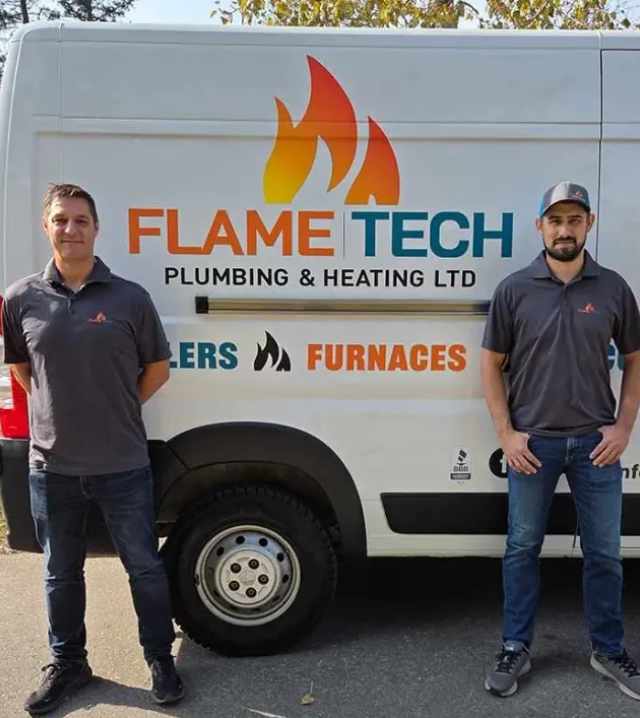

Hot Water Issues in Calgary — Diagnosis & Repair
No hot water, lukewarm showers, popping or rumbling noises, leaks around the base — most Calgary hot water tank problems trace back to one of a small handful of failures, and the right fix depends on figuring out which. FlameTech diagnoses honestly (not parts-swapping) and tells you straight whether to repair, flush, or replace.
Calgary's water is hard. Sediment builds in the bottom of every tank faster than in lower-mineral cities — and that's the root cause of most local failures. A tank that should last 12-15 years often gives up at 8-10 here. We see the same handful of issues across every neighbourhood: sediment-driven popping, failing thermostats and elements (electric tanks), pilot/burner issues (gas tanks), and slow leaks from corroded fittings or a tank that's reached end of life.
We work on every common Calgary setup: gas tanks (Bradford White, John Wood, AO Smith), electric tanks, and tankless units (Navien, Rinnai, IBC). Same crew as our hot water tank replacement, tankless water heater, and emergency plumbing work.
This page is for working out what's wrong. If you already know you want it fixed, our Calgary water heater repair page covers gas and electric tanks, and tankless water heater repair covers error codes, descaling and heat exchanger faults. Call 587-834-3668 and we'll give you a realistic booking time. The usual fixes are thermostats, elements, anode rods, and TPR valves.
No hot water, weird tank noise, or water around the base? Call 587-834-3668 — we'll give you a straight answer on when we can get there.
Call 587-834-3668“Shaun arrived promptly and completed servicing my furnace and water heater.
In addition he installed a new humidifier.
Very professional, knowledgeable and personal service. Highly recommend FlameTech!”

Elaine Cunningham
Calgary · 1 year ago
Common Calgary hot water symptoms (and what they usually mean)
Most hot water issues show up as one of these. The underlying cause varies — and the right repair depends on the cause, not the symptom.
No hot water at all
Gas tanks: usually a pilot light that's gone out (relight + check thermocouple) or a failed gas control valve. Electric tanks: usually a tripped thermal cut-off (reset + check why it tripped) or a failed upper element/thermostat. Either way, we diagnose the root cause — just relighting a pilot that keeps going out means you'll be calling again in a week. See our dedicated no hot water in Calgary page for a try-these-first checklist by tank type.
Hot water runs out faster than it used to
Sediment buildup in the bottom of the tank — Calgary's #1 hot water issue. Sediment reduces the effective tank volume (less hot water available) AND insulates the burner/element from the water above (slower recovery between draws). Annual flushing solves this for tanks not yet damaged; for older tanks the sediment may have damaged the bottom plate and recovery won't fully restore.
Lukewarm or barely warm water
Electric tanks: usually a failed lower element (the upper element still works, so you get a small amount of hot water at the top of the tank, then it goes cold fast). Gas tanks: dip tube failure (cold incoming water mixes with the hot at the top of the tank instead of being delivered to the bottom) or a thermostat stuck low. Both are straightforward to test for.
Popping, rumbling, or banging from the tank
Sediment trapping water under it — when the burner fires, water under the sediment layer boils into steam, then escapes upward in bursts. The popping/rumbling IS the warning sign. Annual flushing prevents it; once it's loud enough to hear from another room, the tank has months left, not years.
Water pooling around the base of the tank
Almost always tank-side corrosion (tank bottom rusting through from the inside) — non-repairable. Could also be TPR valve discharge, fitting leak at supply lines, or a failed drain valve, all of which are repairable. We trace the leak source first. If it's the tank itself, replacement is the only option. See our dedicated leaking water heater in Calgary page for the full source-of-leak diagnostic tree and emergency shutoff guidance.
Discoloured / rusty hot water (cold runs clear)
Anode rod has been consumed (or never was — some tanks ship with one and don't get replaced). Without an anode, the tank itself corrodes. Catching this early — replacing the anode, which is a cheap part — saves you the whole tank. We pull and inspect anode rods during annual service.
Hot water smells like rotten eggs / sulfur
Bacterial reaction in the tank, usually accelerated by an aluminum anode rod reacting with high-sulfur Calgary water. Swap to a powered/aluminum-zinc anode + sanitize the tank — usually resolves within a week. Doesn't damage the tank but is unpleasant.
Why Calgary hot water tanks fail faster than elsewhere
Tanks rated for 12-15 year average lifespan often give up at 8-10 in Calgary. The local water profile is the main reason — knowing why helps explain when to call vs. when to replace.
Hard water = aggressive sediment buildup
Calgary water runs around 150-200 mg/L hardness (most of Canada is 60-120). Calcium and magnesium drop out of solution when heated and settle at the bottom of the tank. Without annual flushing, sediment can be 2-4 inches deep by year 5, insulating the bottom of the tank from the burner/element and accelerating heat-stress corrosion.
Anode rod consumed faster
The sacrificial anode rod is supposed to corrode INSTEAD of the tank itself. Hard water + high mineral content accelerates anode consumption — the rod that's rated for 5-7 years in soft-water cities is gone in 3-4 in Calgary. Once the anode is consumed, the tank itself starts corroding from the inside. Pulling and replacing the anode at 3-year intervals is the single best move for tank longevity.
Cold incoming water = high recovery demand
Calgary's incoming water is cold (4-10°C from the mains, year-round). A tank heating water from 4°C to 49°C is doing more work per litre than one in milder climates. More cycles, more wear, more time spent at higher burner temperatures = faster failure.
Long shower habits + Calgary winter
We see more hot-water demand during 7-month heating seasons — more time indoors, more long showers, more hot-water laundry. Tanks sized for typical demand get pushed harder in Calgary winter. Undersized tanks (40-gallon for 4+ person households) fail noticeably faster.
Older neighbourhoods, older tanks
Pre-2010 builds (Brentwood, Bowness, Inglewood, Mahogany original section, Cranston original section) often still have their first or second tank. Anything past 12 years is on borrowed time in this water — we recommend proactive replacement before the spring/summer reno season when wait times for installers are longest.
Newer high-efficiency tanks: better but not invincible
Post-2015 condensing tanks and high-efficiency models last longer than older atmospheric vented tanks, but still need annual flushing to stay at design life. The high-efficiency gain is real — but we still see ~10-12 year lifespans here vs. the rated 15.
What we do on a hot water service call
Standard diagnosis sequence. Tank replacements get a separate written quote.
1. Symptom + history
What's happening, when it started, when the tank was last flushed/serviced, how old it is. Tank age matters a lot — anything 10+ years gets a different conversation than a 4-year-old unit.
2. Visual inspection — tank, connections, venting
Check for visible corrosion at fittings, water around the base, condition of the TPR valve, gas line connections (gas tanks), electrical connections (electric tanks), venting and draft (gas atmospheric), condensate (high-efficiency).
3. Electrical / gas diagnosis
Electric: measure element resistance, test thermostat continuity at temperature, check incoming voltage. Gas: test thermocouple millivolts, gas pressure at the valve, pilot flame condition. Tankless: pull error code history, check flow sensor, check heat exchanger for scale.
4. Sediment + anode rod check
Open the drain valve to check sediment depth — if it discharges clear water followed by chunks/slurry, the tank is overdue for a flush. Pull the anode rod (5-minute job on most tanks) — if it's down to the core wire, replace it. Both are cheap maintenance items that extend tank life dramatically.
5. Repair OR honest replace-vs-repair quote
Most repairs are quoted in writing on-site after diagnosis — thermostat, single element, anode rod, TPR valve, or gas control valve replacement depending on what failed. Tank replacement is a separate quote when the tank itself has failed (bottom leaks, severe corrosion). Free written quote on the replacement option either way.
6. Maintenance recommendations
If your tank's fine but overdue for service, we'll recommend annual flushing + 3-year anode inspection. Adding a water softener is the strongest single move for tank longevity in Calgary — most of our customers who installed a softener saw their next tank last 14+ years instead of 8-10.
Hot Water Issues Calgary — FAQs
How much does it cost to fix a hot water tank in Calgary?
Depends on what failed. Common repairs include thermostat replacement, electric element swap, anode rod replacement, TPR valve replacement, gas control valve, pilot/thermocouple service. Full tank replacement is the bigger-ticket option when the tank itself has failed (leaks from the bottom, severe corrosion). We diagnose first and quote in writing before any repair, so you always know which bucket you're in.
Should I repair my hot water tank or replace it?
Depends on tank age and what failed. Tank under 8 years old with a single failed component (element, thermostat, anode rod) — repair. Tank 8-10 years old with a major component failure — judgement call; we'll explain the trade-off. Tank 10+ years old leaking from the bottom — replace. Tank of any age with rusty/discoloured hot water — likely anode-related but check for tank-side corrosion. We give honest assessments; if your 7-year-old tank just needs a thermostat, we'll do the repair and tell you so.
Why does my hot water tank pop or rumble?
Sediment buildup in the bottom of the tank. Water gets trapped under a layer of calcium/magnesium deposits and boils to steam when the burner fires; the steam escapes upward in bursts, which is the popping/rumbling you hear. Calgary's hard water makes this happen faster than in most cities. Annual flushing prevents it. Once it's loud enough to hear from another room, the tank has months left, not years — sediment is also insulating the bottom of the tank from the burner, which accelerates failure.
How long should a hot water tank last in Calgary?
Manufacturer ratings are 12-15 years. Calgary's hard water typically cuts that to 8-10 years for a standard tank without annual maintenance. With annual flushing + anode rod replacement every 3 years, we see Calgary tanks reach 12-14 years routinely. Adding a water softener extends this further — most softener customers see 14+ year tank lifespans because the mineral load drops dramatically.
What does it mean when my hot water runs out fast?
Two common causes. (1) Sediment buildup — sediment reduces effective tank capacity and insulates the burner/element from the water, so recovery is slower between draws. (2) Failed lower element (electric tanks) — the upper element still gives you the top portion of the tank but the lower can't reheat the cold incoming water. Diagnosis is quick: test the elements, check sediment depth via drain valve discharge.
My hot water smells like rotten eggs. What's going on?
Bacterial reaction in the tank, usually accelerated by an aluminum anode rod reacting with sulfur compounds in Calgary water. Swap the aluminum anode for a powered (impressed-current) anode OR an aluminum-zinc anode, then chlorine-sanitize the tank. Usually resolves within a week. Doesn't damage the tank but is unpleasant — easy fix once you know the cause.
Can I drain and flush the tank myself?
Technically yes — shut off power/gas to the tank, attach a garden hose to the drain valve, open the TPR valve briefly to break vacuum, and drain. The catch: many tanks have drain valves that haven't been opened in years and will fail to close properly when you try to shut them off — leaving you with a slow-leaking drain valve and a service call to replace it. We recommend professional flushing if your tank is 5+ years old and has never been flushed; for newer tanks DIY is reasonable if you're comfortable with plumbing.
Does a water softener really help my hot water tank?
Yes — measurably. Softeners remove the calcium and magnesium that drive sediment buildup and consume the anode rod. In Calgary, we routinely see tank lifespans go from 8-10 years (no softener) to 14+ years (with softener). The softener also pays back through reduced detergent use, fixture lifespan, and lower water heating costs (less sediment = better heat transfer = less burner runtime). See our water softener page for sizing and install.
Simple, honest, on your schedule.
Call or request a quote
Tell us what's going on. We listen first and ask the right questions before we schedule anything.
Free written estimate
We assess the job and give you an all-in price in writing. No pressure, no surprise add-ons.
Book the work
We give you a realistic booking date up front and confirm it with you before the day.
Clean, code-compliant service
Licensed technicians complete the work to Alberta code, clean up, and walk you through what we did.
Also under Water
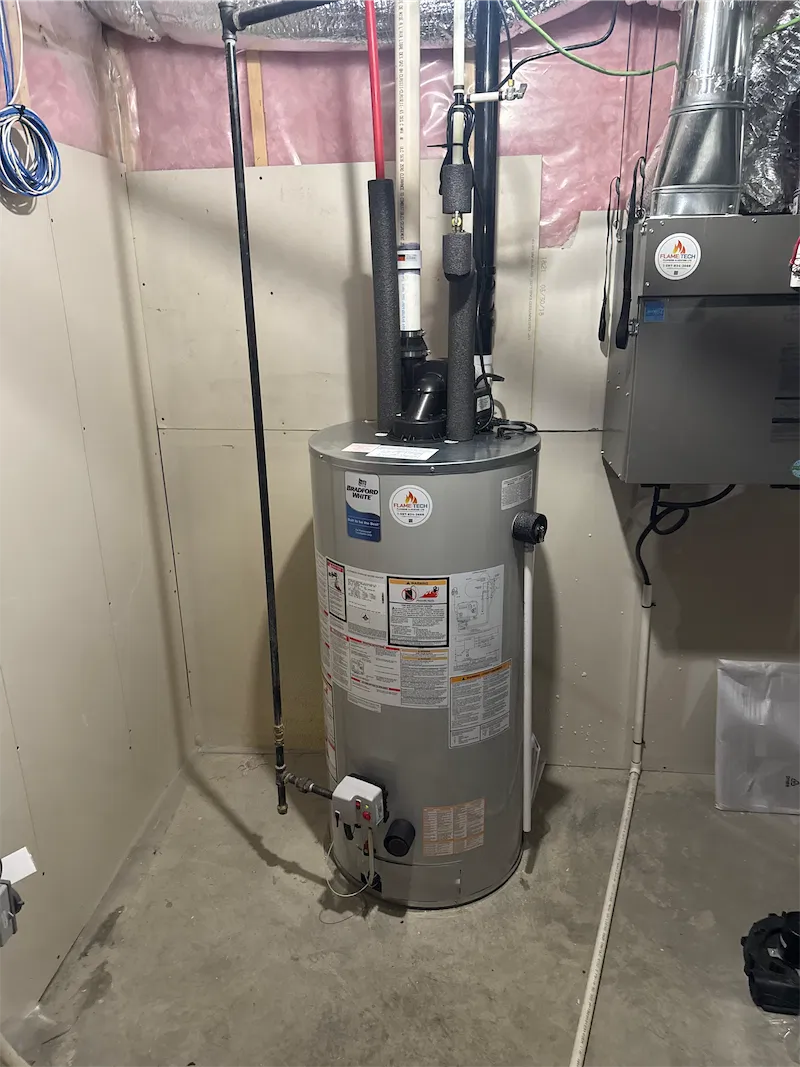
Hot Water Tanks Calgary — Bradford White + John Wood Install, Sized Right
Calgary water hardness (150-200 mg/L) is brutal on hot water tanks — sediment builds in the bottom faster than in lower-mineral cities, and the sacrificial anode rod that's supposed to last 5-7 years is gone in 3-4 — see annual water heater service. The result: tanks rated for 12-15 years typically give up at 8-10 in Calgary unsoftened. FlameTech sizes, installs, and services hot water tanks built for our specific water profile — Bradford White and John Wood are the two brands we've found hold up best — there's a head-to-head on the two if you're deciding. Installed prices by size are in hot water tank replacement cost in Calgary.
Calgary Hot Water Tank Replacement — Red Seal Plumbers
Hot water tanks in Calgary fail at 8-12 years — sooner if you don't have a water softener. When yours goes, FlameTech replaces it with the brands that actually survive our hard water, and the price is agreed in writing before work starts.
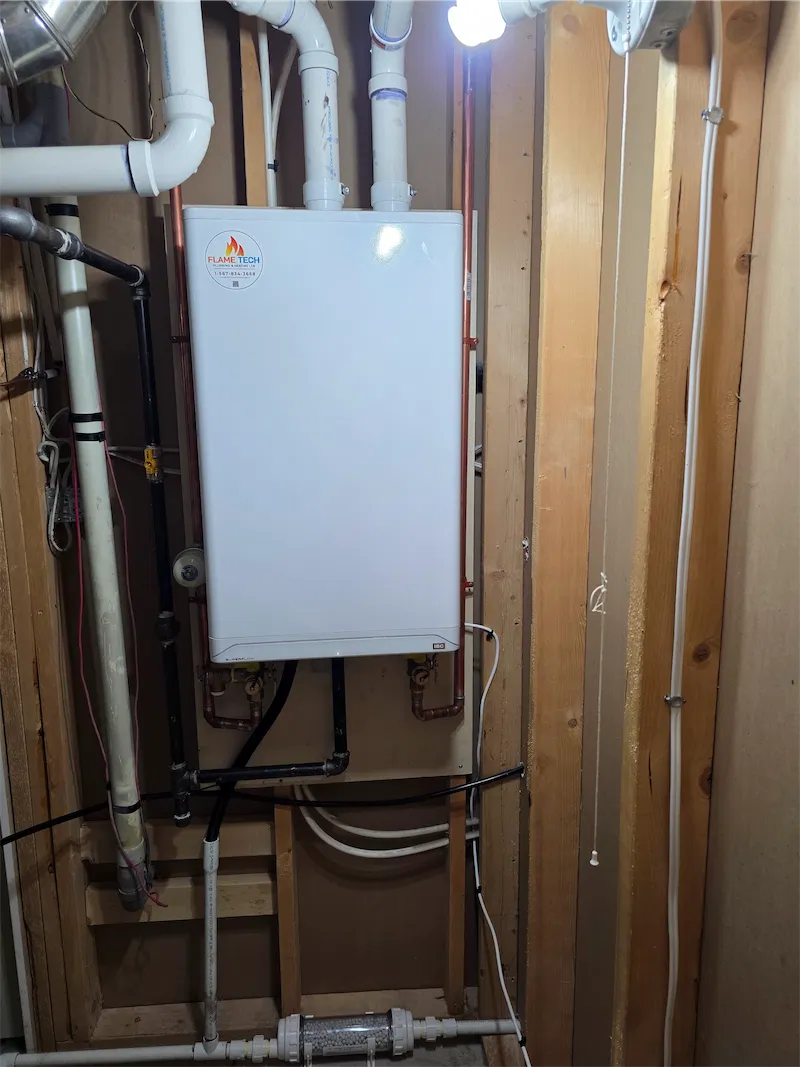
Tankless Water Heaters Calgary — Navien, Rinnai, IBC Install + Service
Tankless water heaters are the right call for some Calgary homes — endless hot water capacity, 20+ year lifespan, big space savings, lower lifecycle operating cost — and the wrong call for others. Calgary's hard water is unusually punishing on tankless heat exchangers (faster scale buildup than tank-style because water passes through narrow internal passages), so annual descaling is non-negotiable and a water softener upstream is strongly recommended. FlameTech installs and services every common brand: Navien NPE-A/S, Rinnai RU/RUR, IBC SL series, Bosch, Noritz. Honest tankless-vs-tank conversation before we quote.
Where we cover Calgary.
We dispatch from Calgary and Airdrie. Find your neighbourhood for area-specific notes on common builds, hard-water patterns, and the systems we see most.
Get a free hot water issue quote.
Tell us what's going on and our dispatch team will call you back with pricing and availability.
Book a Red Seal plumber in Calgary.
Free estimates and upfront pricing, from local technicians who treat your home like their own.
Free estimate · No service charge for quotes · BBB Accredited