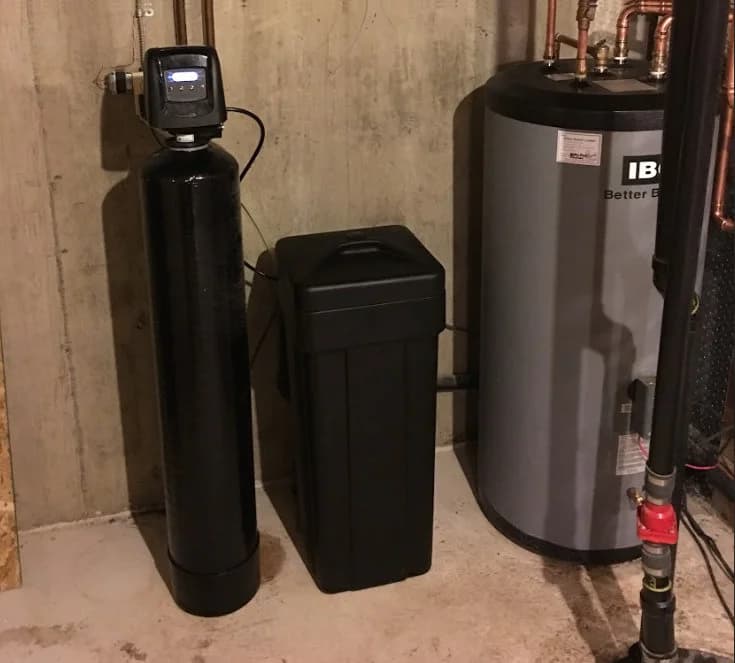

Well Water Treatment Calgary — Iron, Manganese, Hardness & Filtration
Municipal water is a known quantity. Well water isn't — it's specific to your property, it changes with the seasons, and no two acreages west of Calgary have the same problem. Which is why we won't specify treatment without a real water test, and why anyone quoting you a system over the phone is guessing.
The acreage belt around Calgary — Bearspaw, Springbank, the Cochrane and Bragg Creek areas, Rocky View and Foothills County — is well-and-septic country. Wells here commonly run hard, and iron and manganese loads can be significant. Those three are the usual suspects, and each needs different equipment.
The single most expensive mistake we see on acreage properties is a softener installed ahead of iron removal. Iron fouls softener resin, and once it has, the softener stops softening and no amount of salt fixes it. Treatment order matters more than brand, and it's the thing most often got wrong.
Our scope is everything from the wellhead inward — filtration, softening, pressure tanks, pressure switches, check valves and pump-side plumbing. We don't drill wells or pull down-hole submersible pumps; that's specialist work and we'll tell you who to call. Call 587-834-3668.
Orange staining, a rotten-egg smell, or a softener that stopped working? Call 587-834-3668 — we'll test before we quote anything.
Call 587-834-3668“Recommended by a friend Shaun had done work for. Jason arrived on time and quickly worked out what was needed. One of the two fixes needed uncommon parts, so Shaun did a parts drop at my house mid-job — Jason kept working with no second appointment needed. Friendly, efficient, highly recommended.”

Adam S
Calgary · 9 months ago
What the symptoms usually mean
Well water problems announce themselves fairly clearly once you know what you're looking at. This is where we start before the test comes back.
Orange or red staining on fixtures and laundry
Iron, in one of two forms. If the water is clear from the tap and turns orange after standing, that's dissolved ferrous iron — it oxidises on contact with air. If it comes out already rusty, it's ferric iron that has oxidised in the ground or the well. The distinction matters, because they need different filtration.
Black or dark brown staining, black specks
Manganese, usually alongside iron. It stains at far lower concentrations than iron does, and it's the reason a system sized only for iron sometimes leaves you still staining fixtures.
Rotten egg smell
Hydrogen sulphide, either as a dissolved gas or produced by sulphur bacteria in the well or the water heater. Worth noting where you smell it — if it's only on the hot side, the anode rod in your water heater is often the source rather than the well itself.
Reddish slime in toilet tanks
Iron bacteria. Not the same problem as dissolved iron and it doesn't respond to a plain iron filter — it needs the well and the system shocked, and then treatment to stop it re-establishing.
Yellow or tea-coloured water
Tannins from organic matter in the ground water. Common on properties near sloughs or heavily treed land, and they need their own treatment stage rather than being caught by an iron filter.
Sand or grit at the taps
Sediment, often from a shallower well, a failing well screen, or disturbance after recent pump work. Sediment filtration is the first stage of any treatment train, because grit destroys everything downstream of it.
Blue-green staining on fixtures
Acidic water attacking copper pipework. It's a pH problem rather than a mineral one, and left alone it eventually means pinhole leaks in the plumbing rather than just stained sinks.
Scale on kettles, fixtures and inside the water heater
Hardness. Acreage wells around Calgary frequently run harder than city water, which is already hard. See water softener installation and, if yours has stopped keeping up, water softener repair.
The treatment train, in order
Well water treatment is a sequence, not a product. Each stage protects the one after it, and putting them in the wrong order is how expensive equipment fails early.
1. Sediment pre-filtration
Always first. Sand, silt and grit wreck valves, foul media and score seals in everything downstream. On a well with any sediment load this stage pays for itself in equipment it protects.
2. Iron and manganese removal
Before the softener, not after. Oxidising filter media — the air-injection and catalytic types — converts dissolved iron and manganese into particles the filter can trap. Which media suits depends on your concentrations, your pH, and whether you also have hydrogen sulphide, which is exactly what the water test tells us.
3. Softening
Once iron is out, the softener handles calcium and magnesium without being poisoned by iron fouling. Sized against the actual hardness and household demand rather than a default. This is also the stage that protects your water heater and any boiler or in-floor heating downstream.
4. Carbon filtration
For taste, odour and organics. Placed after the mineral stages so it isn't being asked to do work that belongs to a filter designed for it.
5. UV disinfection, last
UV kills bacteria, but only in water clear enough for the light to penetrate. Iron, sediment or tannins shadow organisms and let them through, which is why UV belongs at the end of the train and is close to useless at the start of it.
Point-of-use reverse osmosis
Separate from the whole-home train. An RO system at the kitchen tap handles dissolved solids and contaminants that whole-home treatment isn't designed for, and it's the sensible answer for drinking and cooking water specifically.
Testing — why we insist on it
Every acreage well is its own water supply. Two properties on the same road can need completely different equipment, so a recommendation without a test is a guess dressed up as advice.
- 01A useful test covers hardness, iron, manganese, pH, total dissolved solids, and bacteria — at minimum.
- 02Bacterial and potability testing goes to an accredited lab. Alberta Health Services publishes current guidance on how and where to submit samples, and that's the route to take for anything health-related.
- 03Retest for bacteria at least annually, and any time the well is opened, the pump is pulled, or the property floods.
- 04Retest after spring runoff if your water noticeably changes with the season — a lot of acreage water does.
- 05If you've just bought an acreage, test before you commit to any equipment. Inheriting someone else's treatment train is not the same as inheriting one that suits your water.
- 06Nitrates matter in agricultural areas and don't announce themselves — no taste, no smell, no staining. They only show up in a lab result.
- 07Bring us a recent test if you have one, or we'll arrange sampling as part of the quote.
Where our scope starts and stops
Worth being explicit, because acreage plumbing crosses trades and it saves everyone time to know who does what.
- 01In scope: sediment, iron and manganese filtration, softening, carbon, UV, and reverse osmosis.
- 02In scope: pressure tanks, pressure switches, check valves, pump short-cycling diagnosis, and the plumbing from the wellhead through the house.
- 03In scope: water heaters, boilers, in-floor heating and everything else on the treated side of the system.
- 04Not our work: drilling new wells, deepening existing ones, or pulling and replacing down-hole submersible pumps. That's a licensed well contractor and we'll point you to one rather than take it on.
- 05Not our work: septic field design and installation. We handle plumbing to the tank, not the field beyond it.
- 06Freeze protection is worth raising while we're there — wellhead lines and pressure tanks in unheated spaces are a common winter failure. See frozen pipe repair.
Acreage areas we work
Well-and-septic country ringing the city, where municipal water stops and treatment starts mattering.
- 01Bearspaw — almost entirely well-and-septic west of the city limits, and the area where we see the heaviest iron and hardness loads.
- 02Springbank and the acreages west of Calgary, along with Cochrane Lake and the land around Cochrane.
- 03Foothills County south and east of Okotoks, outside the town's municipal supply.
- 04MD of Mountain View around Carstairs, where wells commonly run hard with significant iron and manganese.
- 05Acreage east of the city toward Chestermere and into Rocky View County.
- 06If you're on a well anywhere in the ring around Calgary and you're not sure what you've got, that's the call to make.
Calgary Well Water Treatment FAQs
Why won't you quote a system over the phone?
Because the number would be meaningless, and the equipment might be wrong.
Every well is its own water supply. Two acreages on the same road can have completely different iron concentrations, different hardness, different pH, and one might have bacteria while the other doesn't. There is no typical acreage water in this region.
A water test costs very little compared with installing a treatment train that doesn't suit what's actually coming out of the ground. Bring us a recent test if you have one, or we'll arrange sampling as part of the quote — either way, the recommendation comes after the result, not before.
My water softener stopped working on well water. Why?
The most likely answer is iron fouling, and it's the most common well water mistake we're called to.
Softener resin is designed to exchange calcium and magnesium. Iron binds to it and doesn't release properly during regeneration, so the resin gradually loses capacity. Add more salt and nothing improves, because salt isn't the problem.
The fix is two-part: deal with the iron ahead of the softener with proper filtration, and then either clean or replace the fouled resin depending on how far gone it is. On acreages around Airdrie this is the single most common softener failure — see water softener repair in Airdrie. Installing a softener without iron removal on a well with any meaningful iron load is a system with a countdown on it.
What's the orange staining in my sinks and toilets?
Iron, and which type matters for the fix.
If water is clear at the tap and turns orange in a glass or in the toilet bowl after standing, that's dissolved ferrous iron oxidising on contact with air. If it comes out of the tap already rusty-looking, it's ferric iron that oxidised before it reached you.
If you're finding reddish slime in the toilet tank rather than staining, that's iron bacteria — a different problem again, which needs the well shocked rather than just filtered.
The test tells us which, and the treatment differs for each.
Do I need UV disinfection?
It depends entirely on your bacteriological test results, which is why testing comes first.
If coliform bacteria are present, UV is the usual answer for ongoing protection. What matters is placement: UV only works in water clear enough for the light to reach the organisms. Iron, sediment or tannins shadow bacteria and let them straight through, so UV goes at the end of the treatment train, never at the start.
For anything relating to whether your water is safe to drink, Alberta Health Services publishes current guidance on testing and interpreting results, and that's the right source rather than us.
Do you drill wells or replace well pumps?
No, and we'd rather be clear about that upfront.
Drilling new wells, deepening existing ones, and pulling or replacing down-hole submersible pumps is licensed well contractor work. We'll point you toward someone who does it.
What we do is everything from the wellhead inward: pressure tanks, pressure switches, check valves, diagnosing a pump that's short-cycling, all the treatment equipment, and the plumbing through the house. In practice that covers most of what goes wrong on an acreage water system.
How often should I test my well water?
Bacteria at least annually, and more often if anything changes.
Always retest after the well has been opened, after the pump has been pulled, after flooding on the property, and if the taste, smell or appearance of the water shifts.
If your water changes noticeably with the seasons — and plenty of acreage water does, particularly through spring runoff — it's worth testing at the point in the year when it's at its worst rather than its best, so the treatment is sized for the harder case.
And test before buying an acreage. Existing equipment on the property tells you what the last owner thought the problem was, not necessarily what it is.
Why does my hot water smell like rotten eggs but the cold doesn't?
That points at the water heater rather than the well.
The sacrificial anode rod inside a tank can react with sulphates in the water and produce hydrogen sulphide, which is the rotten egg smell. Because it happens inside the tank, the cold side is unaffected.
Swapping to a different anode material usually resolves it. If both hot and cold smell, then it's coming from the well or the ground water, and that's a treatment question instead. Either way it's worth diagnosing rather than living with — see hot water tanks.
Will treatment fix hard water on an acreage too?
Yes, and hardness is usually part of the picture out here — acreage wells around Calgary frequently run harder than city water, which is already hard.
The softener goes into the train after iron and manganese removal, sized to your measured hardness and the household's demand rather than a default setting.
That matters for more than the taps. Everything downstream benefits: the water heater, a boiler, in-floor heating loops, and fixture cartridges all last longer on softened water.

Monthly Financing Available
Spread the cost into manageable monthly payments.
Spread the cost of a full treatment train into flexible monthly payments via our Financeit partner.
Simple, honest, on your schedule.
Call or request a quote
Tell us what's going on. We listen first and ask the right questions before we schedule anything.
Free written estimate
We assess the job and give you an all-in price in writing. No pressure, no surprise add-ons.
Schedule at your convenience
Pick a day and window that works for your home — we'll confirm dispatch and arrival time.
Clean, code-compliant service
Licensed technicians complete the work to Alberta code, clean up, and walk you through what we did.
Also under Water
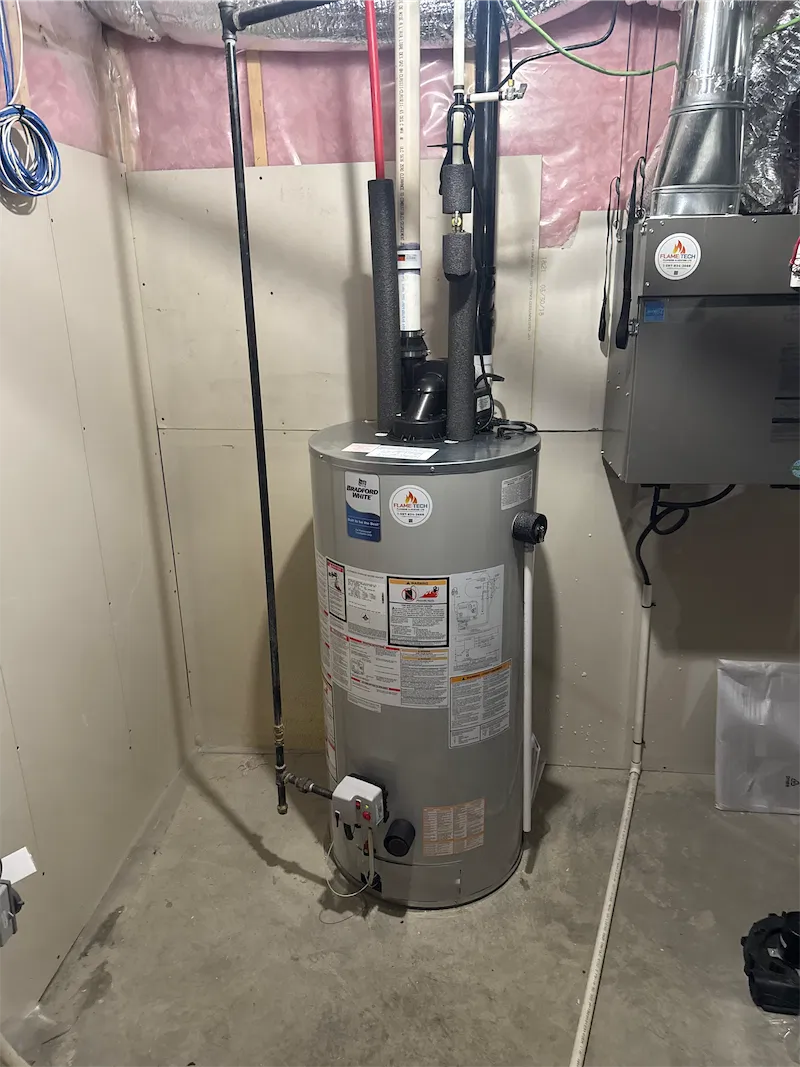
Hot Water Tanks Calgary — Bradford White + John Wood Install, Sized Right
Calgary water hardness (150-200 mg/L) is brutal on hot water tanks — sediment builds in the bottom faster than in lower-mineral cities, and the sacrificial anode rod that's supposed to last 5-7 years is gone in 3-4 — see annual water heater service. The result: tanks rated for 12-15 years typically give up at 8-10 in Calgary unsoftened. FlameTech sizes, installs, and services hot water tanks built for our specific water profile — Bradford White and John Wood are the two brands we've found hold up best — there's a head-to-head on the two if you're deciding. Installed prices by size are in hot water tank replacement cost in Calgary.
Calgary Hot Water Tank Replacement — Same-Day Service
Hot water tanks in Calgary fail at 8-12 years — sooner if you don't have a water softener. When yours goes, FlameTech has stocked trucks rolling for same-day replacement, with the brands that actually survive our hard water.
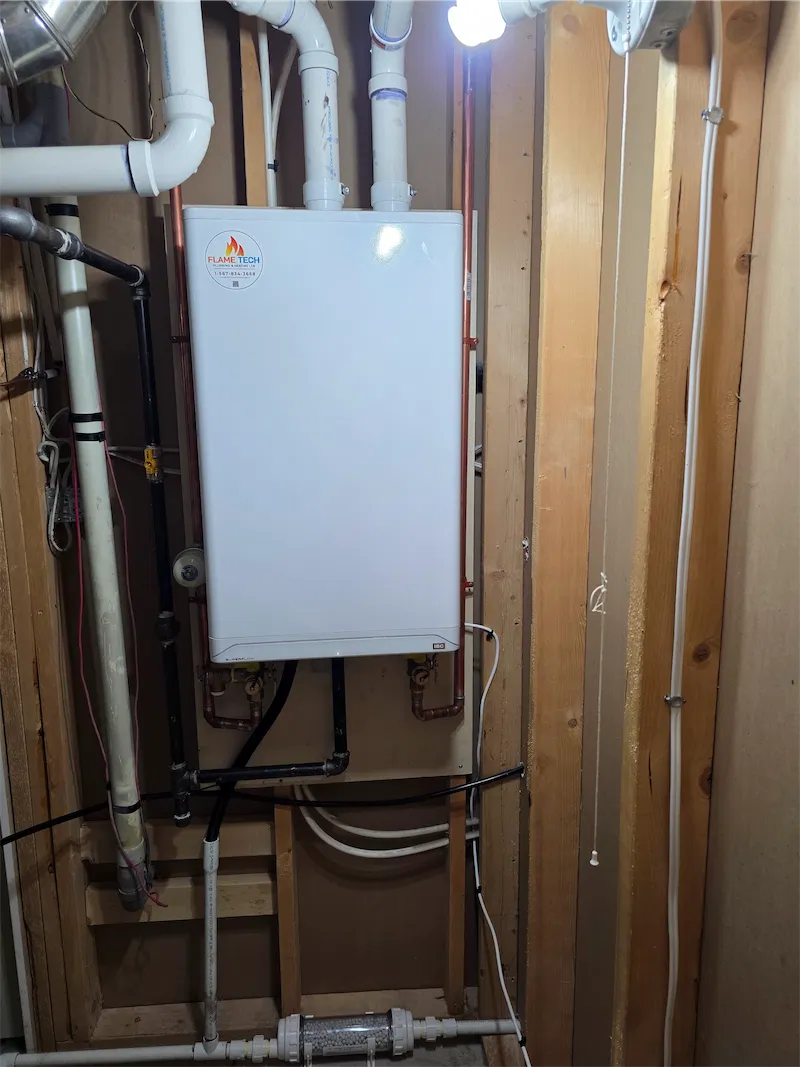
Tankless Water Heaters Calgary — Navien, Rinnai, IBC Install + Service
Tankless water heaters are the right call for some Calgary homes — endless hot water capacity, 20+ year lifespan, big space savings, lower lifecycle operating cost — and the wrong call for others. Calgary's hard water is unusually punishing on tankless heat exchangers (faster scale buildup than tank-style because water passes through narrow internal passages), so annual descaling is non-negotiable and a water softener upstream is strongly recommended. FlameTech installs and services every common brand: Navien NPE-A/S, Rinnai RU/RUR, IBC SL series, Bosch, Noritz. Honest tankless-vs-tank conversation before we quote.
Where we cover Calgary.
Same-day dispatch across Calgary and Airdrie. Find your neighbourhood for area-specific notes on common builds, hard-water patterns, and the systems we see most.
Get a free well water treatment quote.
Tell us what's going on and our dispatch team will call you back with pricing and availability.
Book a Red Seal plumber in Calgary.
Free estimates, upfront pricing, and a satisfaction guarantee — local technicians who treat your home like their own.
Free estimate · No service charge for quotes · BBB Accredited