

Leaking Water Heater in Calgary — Emergency Repair
Water heater leaking? Two questions matter first: where is the leak coming from, and is your basement getting wet right now? A drip from the top of the tank is usually a small repair. A puddle spreading from the bottom is a tank-replacement emergency — and water damage adds up fast. FlameTech handles both, and walks you through emergency shutoff on the phone if you need it tonight.
Before we get there, two things matter: containing the leak (shut off the water and gas/electric — covered below) and not panicking about an explosion (tanks have safety valves; water-damage is the real risk, not a blast). If your leak is small and from a top fitting, you have hours to days. If water is pooling around the base, the tank itself is failing and the smart move is to shut off the supply and call. Either way, we'll triage on the call and tell you honestly when we can get there.
We work on every common Calgary setup: gas tanks (Bradford White, John Wood, AO Smith), electric tanks, power-vent and direct-vent tanks, and tankless units (Navien, Rinnai, IBC). Same crew handles our broader hot water issues and no hot water diagnostic work, plus hot water tank replacement and emergency plumbing more broadly.
A leak at a fitting is a Calgary water heater repair. A leak from the tank body is not repairable by anyone, and means replacement — this page explains how to tell which one you're looking at. Call 587-834-3668. Top-fitting leaks (dielectric union, supply line, drain valve, TPR) are usually small parts. Bottom-of-tank leaks mean replacement, quoted in writing before any work starts.
Water heater leaking right now? Call 587-834-3668. We'll walk you through emergency shutoff on the call if you need it.
Call 587-834-3668“Friends recommended FlameTech for a pipe leak. They were fast, transparent on pricing, and thorough — found a second leak we didn't know about and repaired both. Looked at our older hot water tank too and walked us through pricing options. Detailed quotes, no surprises. We're moving forward with the tank replacement based on the level of service.”

Amanda Howlett
Calgary · 9 months ago
If your tank is actively leaking — do this first
Before anything else, slow the water down. Containing the leak limits property damage and gives us time to do the right diagnosis rather than the rushed one. Two minutes of shutoff prep can save thousands in basement repair.
1. Shut off the cold-water inlet to the tank
Find the cold-water supply line at the top of the tank — it's usually one of two pipes entering the top, typically a 3/4" copper or PEX line with a shutoff valve nearby (ball valve handle or round gate-valve wheel). Turn it OFF (ball valve handle perpendicular to the pipe, gate valve fully clockwise). This stops new water entering the tank. If you can't find the tank shutoff, shut the WHOLE HOUSE off at the main shutoff (usually in the front basement near the water meter).
2. Shut off the gas (gas tank) or breaker (electric tank)
Gas tank: the gas control valve at the bottom of the tank has a dial — turn it to OFF (or PILOT if you can't find OFF). For added safety, shut the gas line shutoff just upstream of the tank (handle perpendicular to the line). Electric tank: find the dedicated 240V breaker in your electrical panel (usually a double-pole breaker labelled "hot water" or "water heater") and turn it OFF. This prevents the burner/element from continuing to heat a tank that's losing water.
3. Contain water and limit spread
Towels around the base, buckets under the worst drip, shop vac if you have one. If the tank is in a finished basement, move anything valuable away from the area. Open the drain valve at the bottom of the tank ONLY if you have a hose to direct water to a floor drain — otherwise you're just adding to the puddle. The pressure relief discharge tube (the rigid copper or PEX line running from the TPR valve down toward the floor) sometimes points at a drain — make sure it's clear.
4. Call us
Call and we'll triage based on where the leak is coming from, and give you a realistic booking time. If the leak is small (top fittings, TPR drip), that's usually a small repair. If the bottom of the tank is leaking, the tank itself has failed and needs replacing. Don't keep using hot water in the meantime — every gallon out the tap is a gallon of cold incoming water filling the leak.
Where the leak is coming from determines the fix
Where you see water tells you almost everything. Top of the tank vs bottom of the tank means a different parts list and a different conversation about repair vs replacement.
Drip from a top fitting (cold or hot supply connection)
Usually a failed dielectric union (the brass-and-galvanized fitting that connects copper supply lines to the tank's steel nipples — these corrode after years in Calgary water and start weeping), or a failed flex line connector, or a loose threaded joint. Repairable — dielectric unions and flex lines are universal parts. Often a 30-minute fix. Tank itself is fine; this is a wear-part replacement.
Drip from the TPR valve discharge tube
TPR (temperature/pressure relief) valves dump water as a safety when system pressure or temperature exceeds limits. A few drops occasionally during heating cycles is normal. A continuous drip means either (a) the TPR itself has failed and won't reseat — replace the valve (cheap part), or (b) system pressure is too high and the TPR is doing its job — root cause is almost always a failed expansion tank. We diagnose root cause AND replace the leaking TPR. Don't just replace the TPR without checking the expansion tank or it'll leak again in a week.
Drip from the drain valve at the bottom
Many builder-grade tanks ship with a plastic drain valve that cracks or loosens over time. Replace with a brass full-port drain valve — universal part. Quick fix. Tank itself fine. Worth flushing the tank while we're there since the drain is already opened.
Drip from the anode rod port (top of tank)
Sometimes the anode rod hex plug at the top of the tank loosens slightly over years of thermal cycling. Re-tightening with thread sealant is usually all it takes. Worth pulling and inspecting the anode rod while we're at it — if it's down to the core wire, replace it (Calgary tanks consume anodes fast). Tank itself fine.
Water pooling around the base of the tank — bottom-of-tank leak
Almost always tank-side corrosion — the steel tank has rusted through from the inside, usually because the sacrificial anode rod was consumed years ago and never replaced. Non-repairable. The tank itself is the failed component, and the only honest answer is replacement. We don't patch corroded tank bottoms — patches fail in weeks, sometimes days, and the next leak is bigger. We'll show you the failure on inspection, and give you a written replacement quote — nothing goes in until you've said yes. If you want the numbers before we arrive, replacement costs by tank size are published.
Water from the condensate line (power-vent + condensing tanks)
Power-vent and condensing high-efficiency tanks produce acidic condensate that drains through a small plastic line — usually 1/2" or 3/4" PVC, often routed to a floor drain or condensate pump. If this line is frozen (Calgary cold-snap classic — happens when the line runs through unheated space or exits outdoors), blocked with sediment, or disconnected at a joint, condensate backs up and can appear as water around or under the tank. We reroute the line and add heat trace where needed.
Water under the tank but no visible drip — tank pan or sweating
Newer installs sometimes include a leak-detection drain pan under the tank — water collecting in the pan without an obvious source could mean (a) a very slow tank-bottom leak you can't see, (b) condensation from cold pipes sweating in a humid basement, or (c) a leak from elsewhere (overhead pipe, washing machine) landing under the tank. We trace the source — sometimes a 10-minute diagnostic, sometimes a 30-minute one with moisture testing.
Combustion-chamber water (gas tanks — serious)
Water dripping or pooling inside the burner area at the bottom of a gas tank is almost always a sign the tank itself is leaking internally and water is reaching the combustion chamber. Continuing to fire the burner risks damage and combustion issues. Shut the tank off and call us — this is a tank-replacement situation, not a repair.
Why Calgary water heaters leak when they do
Tanks rated for 12-15 year lifespan typically give up at 8-10 in Calgary. The water profile drives most of it — knowing why helps explain when a leak is a fluke and when it's a sign the whole tank is at end of life.
Hard water consumes the anode rod fast
Calgary water hardness (150-200 mg/L) accelerates anode consumption. The sacrificial anode rod that's rated for 5-7 years in soft-water cities is gone in 3-4 here. Once the anode is consumed, the tank itself starts corroding from the inside — eventually rusting through the bottom and leaking. Pulling and replacing the anode every 3 years is the single best move for tank longevity.
Sediment damages the tank bottom
Hard water sediment (calcium + magnesium) settles at the bottom of the tank. Over years, this sediment layer traps superheated water under it, weakening the tank floor through repeated thermal stress. By year 8-10 in unsoftened Calgary water, many tank bottoms are damaged enough to leak. Annual flushing dramatically slows this.
Dielectric unions corrode at the top fittings
Where copper supply lines meet the tank's steel nipples, dielectric unions prevent galvanic corrosion — but they're a wear part. In Calgary water, they start weeping at 8-12 years. Common cause of "sudden" top-fitting leaks. Universal replacement, 30-minute fix.
Expansion tanks fail and overpressurize the system
Modern Calgary builds usually have a small expansion tank near the water heater to absorb thermal expansion (water expands as it heats). When the expansion tank's internal bladder fails, system pressure swings wildly, the TPR valve starts dumping water, and the whole system runs higher pressure. Common cause of "sudden" TPR drips. Expansion tank replacement is a 30-minute job.
Plastic drain valves crack over time
Builder-grade tanks often ship with cheap plastic drain valves. After years of thermal cycling, the plastic cracks or the seal fails. Common cause of slow drips from the bottom of the tank that look alarming but are actually just the drain valve. Brass replacement is the right fix.
Frozen condensate lines in cold snaps
Power-vent and condensing tanks produce condensate that drains through PVC lines — if any section runs through unheated space or exits outdoors without proper insulation, it can freeze during Calgary's deep cold snaps. Frozen condensate backs up, appears as water around the tank, and the tank may also lock out on a safety. Reroute + heat trace fixes it permanently.
Repair or replace — how the decision actually breaks down
Leak source + tank age = the answer. Some leaks are wear-part replacements; others are signs the whole tank is at end of life. We give honest assessments, not push the bigger ticket.
Top-fitting leak, tank under 10 years → repair
Dielectric union, supply line, TPR valve, drain valve, or anode rod port leaks are wear-part replacements. If the tank itself is in good shape (no sediment damage, anode still has material left), repair makes sense. A small repair in most cases.
TPR valve leaking + tank age irrelevant → repair valve + diagnose root cause
Replace the TPR valve (cheap) but ALSO diagnose WHY it's relieving — usually a failed expansion tank or, less commonly, a high system pressure issue. If you just replace the valve without fixing the root cause, the new valve will leak again in days or weeks.
Bottom-of-tank leak, any age → replace
Tank-side corrosion is non-repairable. Patching is throwing good money after bad — the next leak is days or weeks away, and the next leak is bigger. Replacement is the only honest answer. You get a written replacement quote before anything is removed.
Tank 10+ years old + any leak → strong replace lean
Even repairable leaks at this age are usually signs the whole tank is at end of life. Calgary tanks past 10 years are statistically on borrowed time. Paying to repair a fitting on a tank that'll fail anyway in 6-12 months rarely makes sense. We'll quote both options and walk through the math — most homeowners choose replacement at this age.
Tank 6-8 years + repairable leak → judgement call
Edge of the decision. We look at: anode rod condition (if it's gone, the tank itself is corroding even if the current leak is just a fitting), sediment depth, whether you have a water softener (extends remaining life dramatically), and your appetite for proactive replacement. We quote both options, you decide.
Pair tank replacement with a water softener
If you're replacing a Calgary tank and don't have a water softener, the conversation about adding one happens now. Most softener customers see 14+ year tank lifespans vs 8-10 unsoftened. The math on softener payback over a tank lifecycle is usually strongly positive in this water.
What we do on a leaking water heater call
Standard diagnostic sequence. Tank replacements get a separate written quote.
1. Phone triage + emergency shutoff guidance
We'll ask where the leak appears to be coming from (top, bottom, around the base), how fast it's leaking (drip, steady stream, pool), and how old the tank is. If it's actively flooding, we'll walk you through cold-water and gas/electric shutoff before we get there.
2. Source-of-leak diagnosis on site
Dry the area around the tank with a towel, then watch carefully. Where the first new drop appears tells us almost everything. Top fitting (repair), TPR (replace + check expansion tank), drain valve (replace), bottom of tank (replace tank), condensate line (clear + reroute). Finding the source is usually the quick part of the job.
3. Tank age + condition check
Check the rating plate for manufacture date (first 2-4 digits of serial usually code the year). Pull the anode rod — if it's down to the core wire, the tank is at end of life even if the current leak is repairable. Check sediment depth via drain valve. All this informs the repair-vs-replace conversation.
4. Repair on the spot or quote replacement
Top-fitting leaks, TPR replacements, drain valve swaps, condensate line clears — universal parts, small repairs. Bottom-of-tank failures get a written replacement quote with both like-for-like swap and any upgrade options (tankless conversion, softener pairing). Free written quote on replacement either way.
5. Insurance documentation if you need it
Failed-tank water damage is a common insurance claim. We provide written diagnosis, photos of the failure, install date if on the rating plate, and replacement quote — formatted for your adjuster on request. Doesn't slow down the repair; just paper we add to the file.
6. Tank swap once you've approved the quote
Bradford White and John Wood tanks in common sizes (40, 50, 60 gallon — gas + electric) are the usual like-for-like swap. Larger or specialty units may need to be ordered in. We tell you upfront which bucket you're in before quoting.
Leaking Water Heater in Calgary — FAQs
Is a leaking water heater an emergency?
Depends on where it's leaking. A drip from a top fitting or the TPR valve is not flooding-emergency territory — you have hours to days to schedule a repair. A pool spreading from the BOTTOM of the tank is emergency territory — the tank itself is failing, water damage adds up fast, and the smart move is to shut off the cold-water inlet to the tank and call. For active flooding, we'll walk you through shutoff on the phone before we get there.
Can a leaking water heater explode?
Almost never. Tanks have a TPR (temperature/pressure relief) safety valve that dumps water if temperature or pressure exceeds limits — exactly to prevent the catastrophic explosions that were possible 100 years ago. The real risk from a leaking tank in 2025 is water damage to your basement, not an explosion. That said, if you smell gas anywhere near the tank, that's a separate emergency — leave the house and call your gas utility's emergency line first.
Can I still use my hot water while waiting for service?
Try not to. Every gallon of hot water you draw at the tap pulls a gallon of cold water into the tank — which means more water going out the leak. If the leak is small and from a top fitting, occasional light use is OK until we arrive. If water is pooling around the base, shut off the cold-water inlet to the tank entirely and stop using hot water until we're there. The faster you slow the leak, the less basement damage you'll have to deal with.
How do I shut off my water heater myself?
Three steps. (1) Cold-water inlet: find the shutoff valve on the cold-water line entering the top of the tank — turn it fully off (ball valve handle perpendicular to pipe, gate valve fully clockwise). (2) Gas tank — turn the gas control dial at the bottom of the tank to OFF or PILOT. Electric tank — flip the dedicated 240V breaker in your electrical panel to OFF. (3) If you can't find the tank-side shutoff, shut the WHOLE HOUSE off at the main shutoff valve (usually in the front basement near the water meter). We can walk you through it on the phone if you call.
Why is my water heater leaking from the top?
Almost always a top-fitting issue — usually a dielectric union (the brass-and-galvanized fitting connecting copper supply lines to the tank's steel nipples) that's corroded after years in Calgary water, or a failed flex-line connector, or a loose threaded joint. Repairable — universal parts, often a 30-minute fix. The tank itself is usually fine. Less common but possible: leaking anode rod port (re-tighten with thread sealant) or a failed temperature/pressure relief (TPR) valve discharge line.
Why is my water heater leaking from the bottom?
Almost always tank-side corrosion — the steel tank has rusted through from the inside, usually because the sacrificial anode rod was consumed years ago and never replaced. This is non-repairable; the tank itself is the failed component. The only honest answer is replacement. We don't patch corroded tank bottoms — patches fail in days or weeks and the next leak is bigger. We'll quote the replacement in writing before anything comes out.
Why is the TPR valve dripping water?
Two possibilities. (1) The TPR valve itself has failed and won't reseat properly — replace the valve (cheap part, 15-minute fix). (2) System pressure is exceeding safe limits and the TPR is doing its job — root cause is almost always a failed expansion tank. We diagnose root cause AND replace the leaking valve. Don't just replace the TPR without checking the expansion tank or the new valve will leak again within days. A few drops occasionally during heating cycles is normal; a continuous drip is not.
How long can a leaking water heater last?
Depends on where it's leaking. Top-fitting leaks can persist for weeks or months as slow drips without catastrophic failure — but they damage the area around the tank cumulatively. Bottom-of-tank leaks accelerate fast: a slow weep this morning can become a steady stream by tonight as the corrosion hole opens up under pressure. If the bottom is leaking, treat it as urgent — shut off the supply and call.
Does home insurance cover a leaking water heater?
Most home insurance policies cover the water damage caused by a tank failure (basement repair, ruined flooring/drywall) but NOT the replacement of the tank itself (that's wear and tear). Coverage varies by policy — we provide written diagnosis, photos of the failure, install date from the rating plate, and replacement quote suitable for your adjuster on request. Doesn't slow down the repair; just paper we add to the file. Talk to your adjuster about the specifics of your policy.
How much does it cost to fix a leaking water heater in Calgary?
Depends entirely on the source. Top-fitting repairs (dielectric union, supply line, drain valve, TPR valve) are the smaller end. Bottom-of-tank failures mean full tank replacement, which is the larger end. We diagnose first, then quote in writing on-site — you always know which bucket you're in before any work starts.
How soon can you come?
It depends on the schedule, and we won't promise a time we can't keep. Call 587-834-3668 — we triage based on where the leak is coming from and give you a realistic booking time. For actively flooding tanks we'll walk you through emergency shutoff on the phone.
Should I just replace the tank if it's leaking?
Depends on leak source + tank age. Top-fitting leak, tank under 10 years — repair. Bottom-of-tank leak, any age — replace (not repairable). Tank 10+ years old with any leak — strong replace lean (the whole tank is at end of life). We give honest assessments; if your 7-year-old tank just needs a dielectric union, we'll do the repair and tell you so. If your 13-year-old tank is leaking from the bottom, the replacement conversation is honest, not a sales pitch.
Simple, honest, on your schedule.
Call or request a quote
Tell us what's going on. We listen first and ask the right questions before we schedule anything.
Free written estimate
We assess the job and give you an all-in price in writing. No pressure, no surprise add-ons.
Book the work
We give you a realistic booking date up front and confirm it with you before the day.
Clean, code-compliant service
Licensed technicians complete the work to Alberta code, clean up, and walk you through what we did.
Also under Water
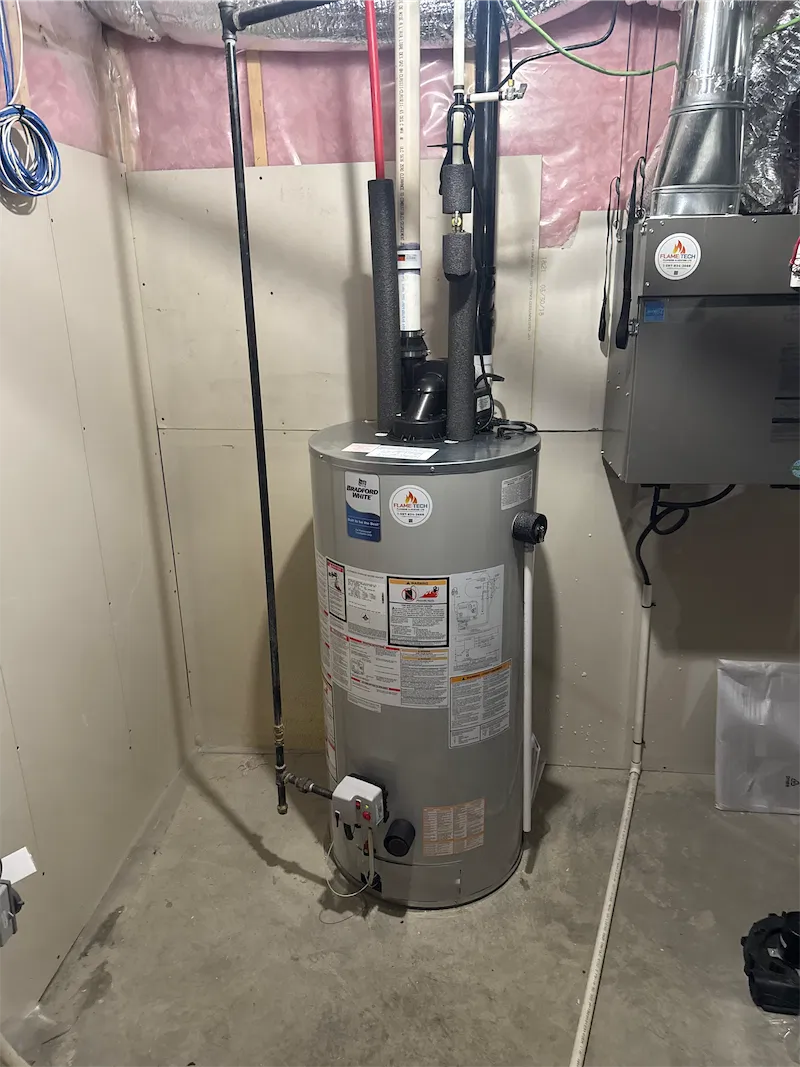
Hot Water Tanks Calgary — Bradford White + John Wood Install, Sized Right
Calgary water hardness (150-200 mg/L) is brutal on hot water tanks — sediment builds in the bottom faster than in lower-mineral cities, and the sacrificial anode rod that's supposed to last 5-7 years is gone in 3-4 — see annual water heater service. The result: tanks rated for 12-15 years typically give up at 8-10 in Calgary unsoftened. FlameTech sizes, installs, and services hot water tanks built for our specific water profile — Bradford White and John Wood are the two brands we've found hold up best — there's a head-to-head on the two if you're deciding. Installed prices by size are in hot water tank replacement cost in Calgary.
Calgary Hot Water Tank Replacement — Red Seal Plumbers
Hot water tanks in Calgary fail at 8-12 years — sooner if you don't have a water softener. When yours goes, FlameTech replaces it with the brands that actually survive our hard water, and the price is agreed in writing before work starts.
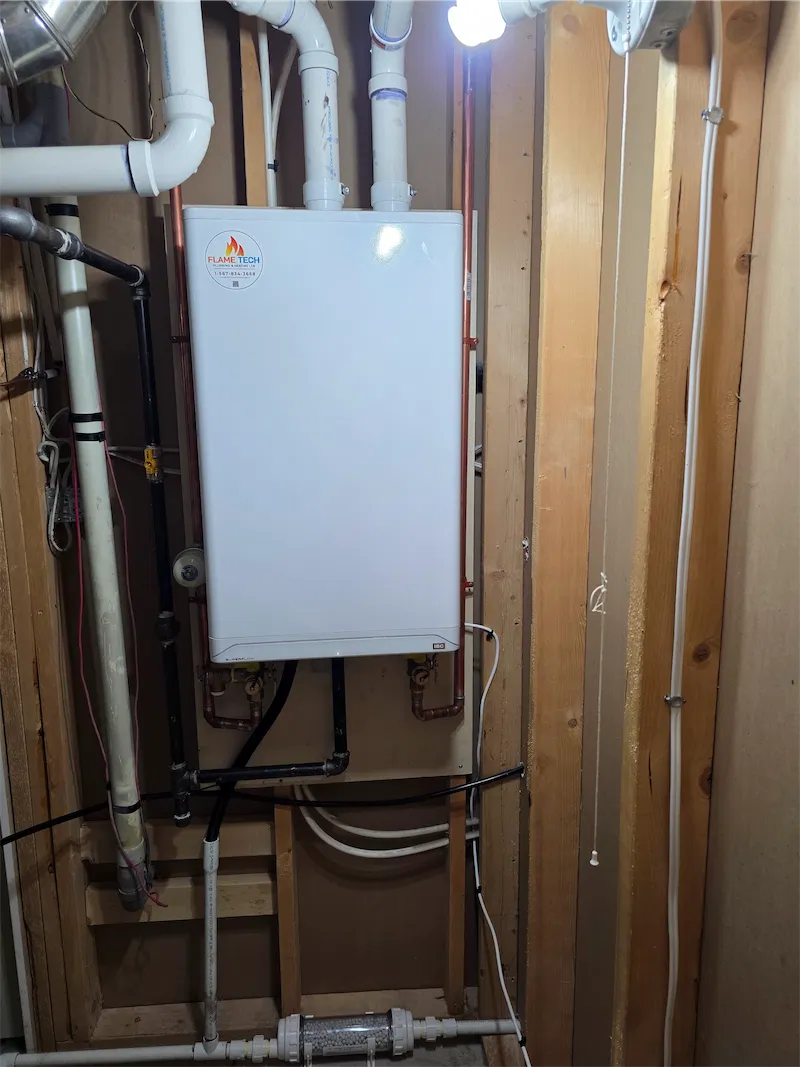
Tankless Water Heaters Calgary — Navien, Rinnai, IBC Install + Service
Tankless water heaters are the right call for some Calgary homes — endless hot water capacity, 20+ year lifespan, big space savings, lower lifecycle operating cost — and the wrong call for others. Calgary's hard water is unusually punishing on tankless heat exchangers (faster scale buildup than tank-style because water passes through narrow internal passages), so annual descaling is non-negotiable and a water softener upstream is strongly recommended. FlameTech installs and services every common brand: Navien NPE-A/S, Rinnai RU/RUR, IBC SL series, Bosch, Noritz. Honest tankless-vs-tank conversation before we quote.
Where we cover Calgary.
We dispatch from Calgary and Airdrie. Find your neighbourhood for area-specific notes on common builds, hard-water patterns, and the systems we see most.
Get a free leaking water heater quote.
Tell us what's going on and our dispatch team will call you back with pricing and availability.
Book a Red Seal plumber in Calgary.
Free estimates and upfront pricing, from local technicians who treat your home like their own.
Free estimate · No service charge for quotes · BBB Accredited