
Boiler Replacement Calgary — Honest Repair-or-Replace Advice
Replacing a boiler isn't the same job as installing one. You're inheriting an existing system — old radiators, old pipework, decades of sludge — and getting that part right is what decides whether the new boiler lasts twenty years or five.
Most Calgary homeowners land here mid-decision: the boiler is old, it's been repaired once or twice, and someone has said the word replacement. Before you spend anything, you should know whether you actually need to — and if you do, what a proper swap involves beyond hanging a new unit on the wall.
We'll come out, look at the whole system rather than just the appliance, and give you a straight answer. Sometimes that answer is that your boiler has years left and a repair is the right call. When it genuinely is time, we handle the full replacement — removal, disposal, system flush, new unit, commissioning. Monthly financing is available via Financeit.
Jason has spent twenty years on hydronics specifically, which matters more on a replacement than on a new build. Retrofitting a modern condensing boiler onto a 1970s radiator system has real pitfalls, and most of them are invisible until the second winter.
Not sure whether to repair or replace? Call 587-834-3668 — we'll assess it on site and give you a straight answer at no charge.
Call 587-834-3668“probably the best boiler guy i have ever deal with. figured out the issue right away and he had parts on his van. honestly do not get service like this anymore. Would strongly recommend.”

Brandon Mandel
Calgary · 1 year ago
Should You Repair It or Replace It?
This is the whole question, and it deserves a real answer rather than a sales pitch. Here's the framework we use on site — the same one we'd apply to our own homes.
Under about 12 years, single failed part — repair it
A boiler this age has plenty of service life left. Replacing a pump, a control board, or an ignition component is straightforward and the rest of the system is nowhere near its end. Throwing out a working boiler because one part failed is a waste of a good appliance. See boiler repair.
12 to 18 years — it depends on what failed
The grey zone. A cheap part on an otherwise healthy boiler is worth fixing. A major component — heat exchanger especially — on a unit this age is where the arithmetic turns, because the rest of the parts are all the same age as the one that just died. We'll price both options and let you decide with real numbers in front of you.
Over 18-20 years with a major failure — replace
At this point you'd be putting an expensive component into a system whose every other original part is on the same clock. The next failure is already on its way. Our guide on how long boilers last in Calgary covers why our hard water and freeze-thaw cycles pull that number down.
A cracked heat exchanger, at any age — replace
This one isn't a cost calculation. A cracked exchanger is a safety issue and there's nothing to weigh against it.
Three repairs in two heating seasons — replace
One repair is bad luck. The third call in two winters is the system telling you something, and the money spent chasing faults is money that isn't going toward a boiler that just works.
Parts no longer available — replace
Some older units are past the point where manufacturers still supply components. When we can't get the part, the decision has already been made for you — the only question left is whether it happens on your schedule or in a January cold snap.
What Makes a Replacement Different From a New Install
On a new build, the boiler and the distribution system are designed together. On a replacement you're marrying a modern appliance to whatever the last fifty years left behind — and that mismatch is where replacements go wrong. These are the four things we check before we quote.
System sludge is the number one heat exchanger killer
Decades of steel radiators and iron pipework produce magnetite — a fine black iron oxide that settles through the loop. An old cast-iron boiler had wide waterways and tolerated it. A modern condensing boiler has narrow, precision heat exchanger passages that block, hot-spot, and fail. A power flush and a magnetic filter before commissioning is not optional on a retrofit, and any quote that doesn't mention it is a quote that's cheaper for a reason.
Will the system actually condense?
A condensing boiler only reaches its advertised efficiency when return water comes back cool enough to condense the flue gases. Old radiator systems were designed to run hot — if the boiler never sees a low return temperature, you've bought a condensing unit and are running it as a conventional one. We check whether the radiators can heat the house at lower water temperatures and set an outdoor reset curve so the system runs as cool as it can while still heating the house. Sometimes that means the honest recommendation is to upsize a couple of radiators.
The old chimney usually can't be re-used
Many Calgary homes vented an atmospheric boiler into a masonry chimney. Condensing boilers produce acidic condensate and cool exhaust, and they need sealed plastic venting — typically a new sidewall penetration. That's real work, and worse, removing the boiler sometimes orphans a water heater that was sharing the same flue. We look at the whole venting picture before quoting, not on install day.
Gas line capacity and near-boiler piping
Gas lines in older homes were sized for the appliance of the day and may not carry a higher-input unit. Near-boiler piping often needs rebuilding too — primary/secondary arrangements, a proper air separator, and an expansion tank sized for the system volume rather than whatever was there. We assess both at quote stage so they're priced, not discovered.
Replacing a Cast-Iron Boiler in an Older Calgary Home
Inner-city Calgary has a lot of these — heavy cast-iron units in Mount Royal, Bridgeland, Elbow Park, Britannia, Hillhurst, Inglewood, Altadore and Killarney basements, some of them running past fifty years. They're remarkable machines and they're also spectacularly inefficient.
- 01They often still work, which makes the decision harder. A running cast-iron boiler at 60% efficiency is burning far more gas than it needs to across Calgary's seven-month heating season.
- 02Parts availability is usually the forcing event rather than outright failure.
- 03Physical removal can be a genuine project — some units have to be broken down to get them out of the basement. We factor that into the quote rather than raising it on the day.
- 04The efficiency gain is the largest of any replacement scenario, because you're starting from the lowest baseline.
- 05These are the systems where the condensing-retrofit questions above matter most — high-temperature radiator design, masonry flue, oversized original sizing.
- 06Sometimes an orphaned hot water tank is part of the picture, and pairing an indirect tank with the new boiler is the cleaner solution.
What Drives the Cost of a Boiler Replacement
We don't quote boilers over the phone, because a number given sight-unseen is a number that changes on install day. Here's what actually moves the price, so you can read any estimate — ours or a competitor's — and know what you're comparing.
The unit itself
Entry-tier single-stage condensing through premium fully-modulating units is a wide range. Output should match what the house needs, not the badge on the old boiler.
Straight swap or full rebuild
Re-using compatible gas line, venting and near-boiler piping is the cheapest version of this job. Re-piping a mechanical room, adding zones, or rebuilding the distribution is a different scope entirely.
Venting and gas line retrofit
A new sidewall vent, or upsizing a gas run that was fine for the old appliance, adds real labour and material. On chimney-vented replacements this is frequently the biggest single variable.
Flush, filtration, and system remediation
A power flush, a magnetic filter, and occasionally a chemical clean on a badly sludged system. This protects the warranty on the appliance you just bought.
Removal and disposal of the old unit
Usually routine. On heavy cast-iron units in tight basements it isn't, and we'd rather price it honestly than discover it mid-job.
Free written estimate, and financing
We come out, assess the system, and give you the model, the efficiency rating, the full scope and the all-in price in writing at no charge. Financeit monthly payments are available with a soft credit check.
Plan It Before You Need It
The worst time to replace a boiler is the week it dies, and in Calgary that week is usually in January. A planned replacement is a better job at a better price.
- 01Shoulder season — spring through early fall — means no rush, no working around a freezing house, and a proper look at the whole system.
- 02You get time to compare quotes and choose the unit rather than taking whatever is in stock during a cold snap.
- 03Emergency replacements are a real service we provide, but they cost more and they limit your options. Doing it deliberately is always the cheaper path.
- 04If your boiler is past 18 and still running, that's the ideal moment to get an assessment — not to replace immediately, but to know what it will involve and budget for it.
- 05Once the new unit is in, annual boiler service is what gets it to the top of its lifespan range instead of the bottom.
- 06A water softener upstream protects the new heat exchanger from Calgary's hard water — the single most effective thing you can do for its longevity.
Calgary Boiler Replacement FAQs
The questions Calgary homeowners actually ask when they're weighing a boiler replacement. If yours isn't here, call 587-834-3668 and ask.
How much does boiler replacement cost in Calgary?
It depends on the unit tier, the output your home actually needs, and what's already in your mechanical room — and we won't quote it over the phone, because a sight-unseen number is one that changes on install day.
The variables that move it most: the boiler itself, whether the existing gas line and venting can be re-used or need replacing, how much near-boiler piping has to be rebuilt, whether the system needs a power flush, and how difficult the old unit is to physically remove.
We come out, assess the whole system, and give you the model, the efficiency rating, the full scope and the all-in price in writing at no charge. Financeit monthly payments are available if you'd rather spread it out.
Should I repair my boiler or replace it?
The short framework we use on site:
Under about 12 years with one failed part — repair it. The boiler has years left.
Between 12 and 18 years — it depends what failed. A minor part is worth fixing; a heat exchanger usually isn't.
Over 18-20 years with a major failure — replace. You'd be putting an expensive component into a system where every other original part is the same age.
A cracked heat exchanger at any age — replace. That's a safety issue, not a cost calculation.
We'll assess it on site at no charge and tell you honestly which side of the line you're on. If a repair is the right answer, that's what we'll quote.
How long does a boiler replacement take?
A straight swap — new unit onto compatible existing gas line, venting and piping — is typically a single day, and you'll have heat that evening.
Add a new sidewall vent, a gas line upgrade, or a near-boiler piping rebuild and it becomes one to two days. Replacing a heavy cast-iron unit that has to be broken down to get it out of the basement can add time on its own.
We give you a realistic timeline with the written estimate, and if the job needs to span two days we plan the heat-off window rather than leaving you guessing.
Can I put a new condensing boiler on my old radiators?
Usually yes, but it needs checking rather than assuming — this is the most commonly skipped step in a boiler replacement.
A condensing boiler only hits its advertised efficiency when the water returning from your system is cool enough to condense the flue gases. Older radiator systems were designed to run hot. If your radiators are undersized for a lower operating temperature, the boiler simply never condenses, and you've paid for efficiency you'll never see.
We check whether the radiators can heat the house at lower water temperatures, set the outdoor reset curve to run the system as cool as it can while still heating properly, and tell you if upsizing a radiator or two would materially change the result. Old iron systems also need a power flush and a magnetic filter first — sludge from decades of steel and iron will block a modern heat exchanger.
Do I need a new flue or vent when I replace my boiler?
Often, yes — and it's the variable that surprises people most.
Older Calgary boilers were commonly vented into a masonry chimney. Condensing boilers can't use one: their exhaust is cool and acidic, and it needs sealed plastic venting, usually through a new sidewall penetration.
There's a knock-on effect worth knowing about. If your boiler and your hot water tank shared that chimney, removing the boiler can leave the water heater orphaned on a flue that no longer drafts properly. We look at both appliances together at quote stage so the venting plan covers the whole mechanical room, not just the new boiler.
Should I replace my boiler before it fails?
If it's past 18 years, getting an assessment is worth doing even if you're not ready to replace.
A planned replacement in spring or early fall is a better job than an emergency one in January — you compare quotes, choose the unit rather than taking what's in stock, and nobody is working around a freezing house. Emergency replacement is a service we provide, but it costs more and narrows your options.
That said, we won't tell you to replace a boiler that's running well just because of its birthday. Age alone isn't a reason. Age plus rising gas bills, plus repairs starting to cluster, is.
What do you do with my old boiler?
We drain it, disconnect it, remove it from the property and dispose of it. That's included in the replacement scope — you're not left with an old unit in the basement or a disposal bill afterwards.
On heavy cast-iron boilers in older Calgary homes, removal occasionally means breaking the unit down in place to get it up the stairs. We assess that at quote time so it's priced in rather than raised as a surprise on the day.
Is it worth switching from a boiler to a furnace?
Rarely, and we'd usually talk you out of it.
If your home already has radiators, baseboards or in-floor loops, that distribution system is an asset. Converting to forced air means installing ductwork throughout a finished house — a major renovation, far beyond the cost of a boiler replacement, and you'd be giving up the even, quiet heat that hydronic systems deliver.
The conversation is different if you're gutting the house anyway, or if you want central air and are weighing a heat pump or furnace as part of a larger project. Short of that, replacing the boiler and keeping the hydronics is almost always the better value.

Monthly Financing Available
Spread the cost into manageable monthly payments.
Spread the cost of a boiler replacement into flexible monthly payments via our Financeit partner.
Simple, honest, on your schedule.
The difference between a replacement and a new install is everything that was already in the house. Here's how we work through it.
Assessment — including whether to replace at all
We look at the boiler's age, what's failed, what it would cost to fix, and the condition of the wider system. If repair is the better call, that's what we'll tell you. No charge either way.
Sized to the house, not the badge
We size the new boiler to what your home actually needs. Old boilers were routinely oversized, so copying the number off the old badge just repeats someone else's mistake for another twenty years.
Old unit out, system flushed
We drain and remove the old boiler, take it away, then power flush the loop and fit a magnetic filter before the new unit goes anywhere near the system water.
New boiler in, commissioned, explained
Hung, piped, vented, gas-tested, combustion-analysed. Then we set the outdoor reset curve, walk you through the controls, register the warranty, and book the first annual service.
Old unit out, new system in.
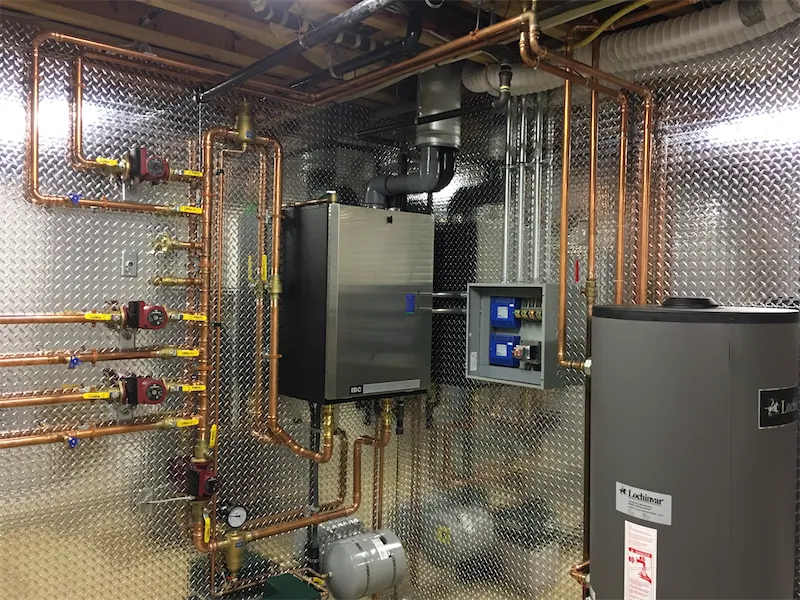
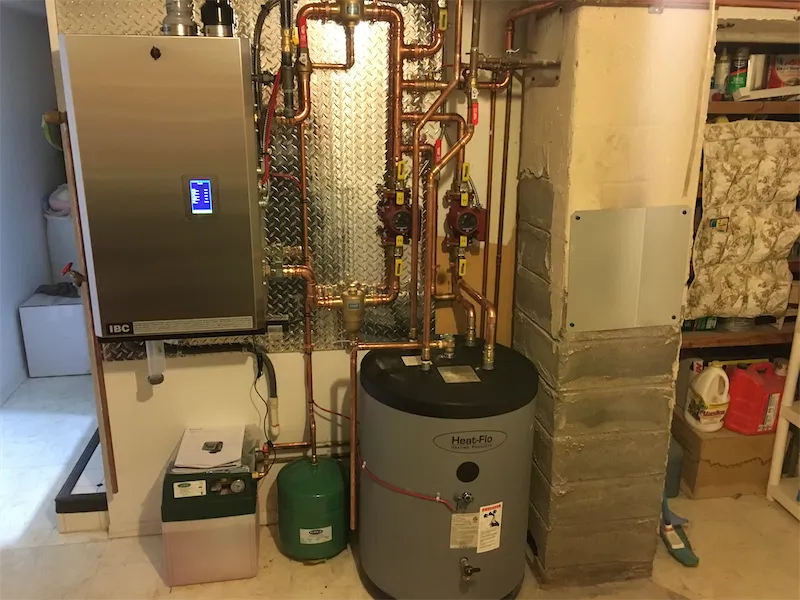
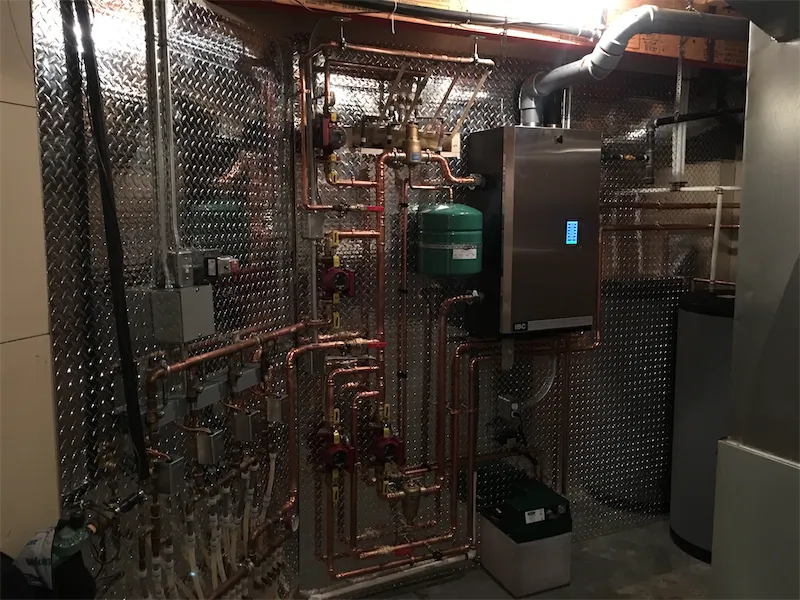
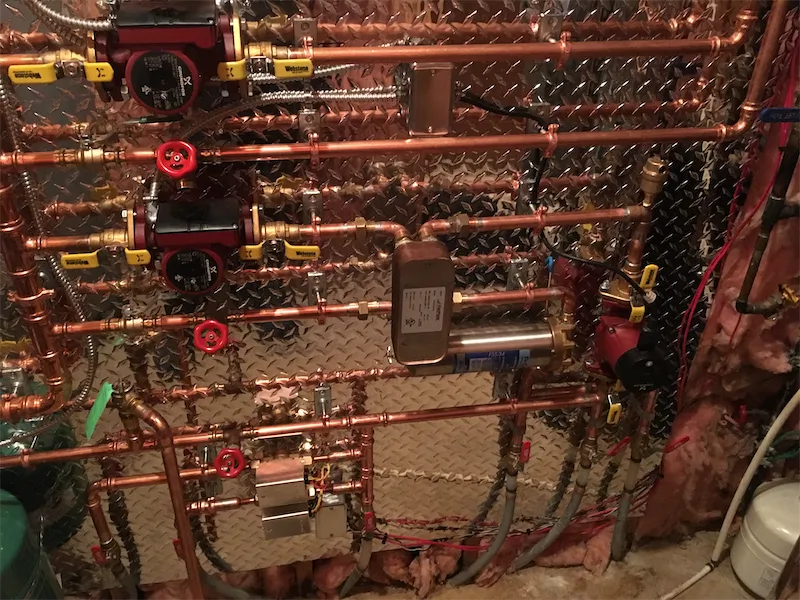
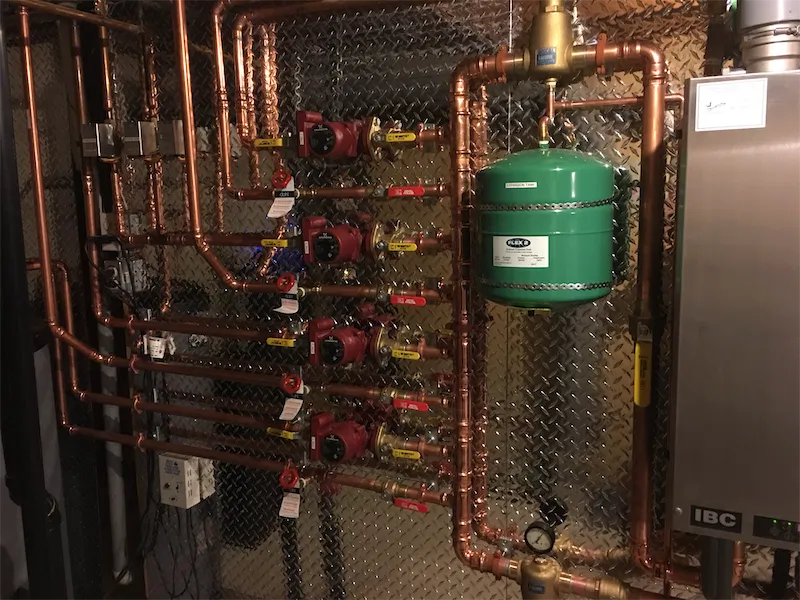
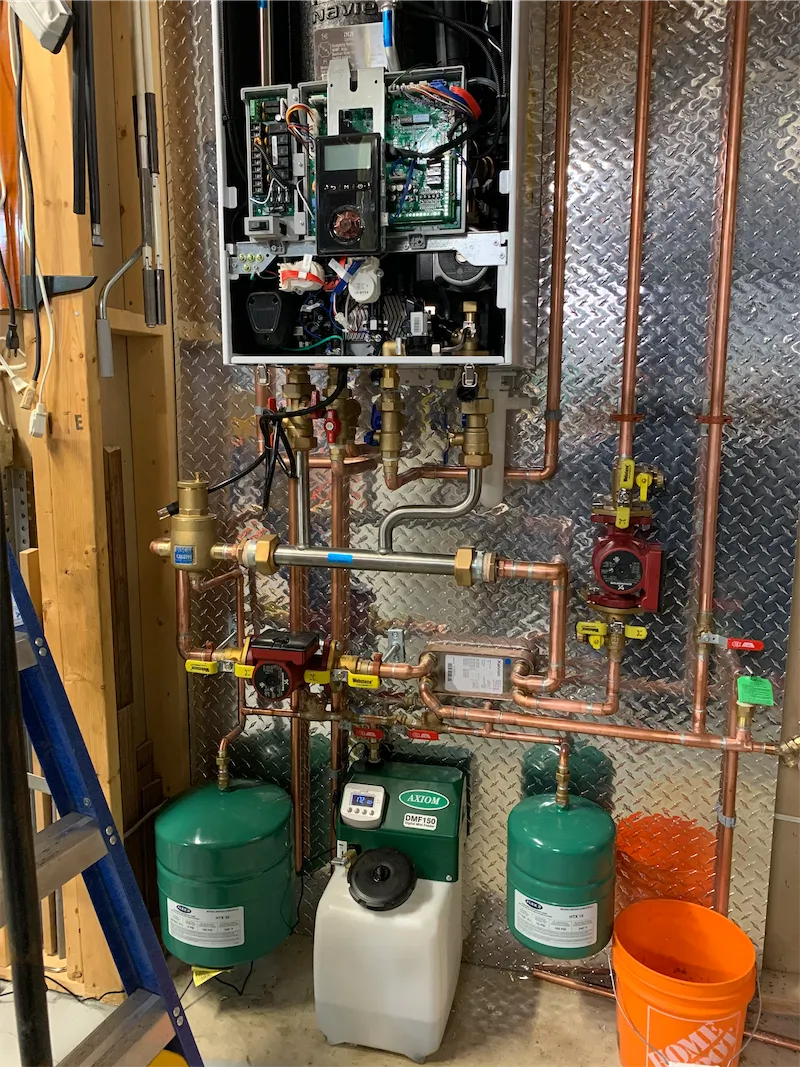
A few Calgary mechanical rooms before and after a boiler replacement — including the piping and venting work that comes with a proper retrofit.
Also under Heating
Expert Boiler Installation in Calgary
Most Calgary boilers fail at 18-22 years. When yours is on the way out, FlameTech replaces it without the cold-snap scramble — correctly sized, manufacturer-matched system, full install and commission in a single day for a straight swap.
Combi Boiler Installation Calgary
One wall-hung unit for both your heat and your hot water — no storage tank, no second appliance. FlameTech sizes, installs, and commissions combi boilers across Calgary, and we'll tell you straight if your home isn't a good fit for one.
Boiler Repair Calgary | Expert Heating System Services
Calgary's unforgiving winters demand reliable heating, and when your boiler fails, FlameTech Plumbing delivers the expert repair services you need to restore warmth to your home.
Where we cover Calgary.
We dispatch from Calgary and Airdrie. Find your neighbourhood for area-specific notes on common builds, hard-water patterns, and the systems we see most.
Get a free boiler replacement quote.
Tell us what's going on and our dispatch team will call you back with pricing and availability.
Book a Red Seal plumber in Calgary.
Free estimates and upfront pricing, from local technicians who treat your home like their own.
Free estimate · No service charge for quotes · BBB Accredited