
Tankless Water Heaters Calgary — Navien, Rinnai, IBC Install + Service
Tankless water heaters are the right call for some Calgary homes — endless hot water capacity, 20+ year lifespan, big space savings, lower lifecycle operating cost — and the wrong call for others. Calgary's hard water is unusually punishing on tankless heat exchangers (faster scale buildup than tank-style because water passes through narrow internal passages), so annual descaling is non-negotiable and a water softener upstream is strongly recommended. FlameTech installs and services every common brand: Navien NPE-A/S, Rinnai RU/RUR, IBC SL series, Bosch, Noritz. Honest tankless-vs-tank conversation before we quote.
Three scenarios drive most Calgary tankless calls: (1) replacing an aging tank with a tankless upgrade (most common — tank at end of life, owner wants endless hot water + space savings + longer lifespan), (2) new build or major renovation where tankless is being spec'd from the design phase, or (3) basement suite / secondary suite where space constraints favor a compact wall-mounted tankless. We handle all three with permits, gas-line sizing, venting, and code-compliant condensate routing.
Tankless isn't always the right call. Higher upfront cost (often 2-3x a tank install when gas line upsizing is required — most tankless units need 200,000+ BTU vs a tank's 40,000), higher maintenance burden (annual descaling required to keep manufacturer warranties valid in Calgary water), and the cold-inlet reality of Calgary winters means tankless output drops as inlet temp drops. We tell you straight when a tank is the better fit. See hot water tanks Calgary for the tank path or tank replacement for like-for-like swaps.
Still deciding between the two? Our honest tankless vs tank comparison for Calgary runs the real numbers. Already own one and it isn't working? Go straight to tankless water heater repair — error codes, descaling and heat exchanger diagnosis. If something's actively wrong with your existing tankless (error code, lukewarm output, no hot water at the taps), these also help: no hot water and hot water issues cover the common tankless error codes + descaling-related failures. North of the city, see tankless water heaters Airdrie for local Airdrie dispatch from our Coopers Crossing base. Call 587-834-3668 for a free in-home tankless assessment. Monthly financing available.
Planning a tankless install or replacing an aging tank? Call 587-834-3668 for a free in-home assessment — honest tank-vs-tankless comparison upfront.
Call 587-834-3668What we install + service on Calgary tankless calls
Common tankless configurations across Calgary. We talk through trade-offs before quoting — brand, condensing vs non-condensing, combi vs DHW-only, recirculation, gas-line capacity.
Navien NPE-A / NPE-S — most common Calgary install
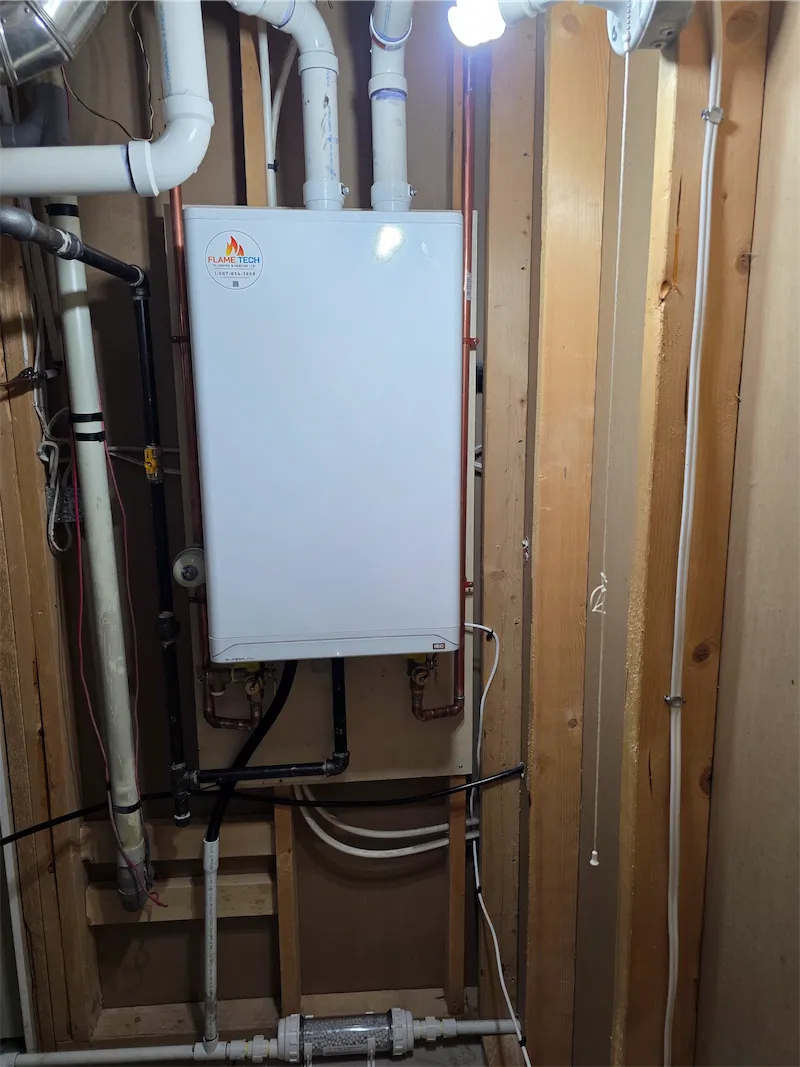
Navien NPE-A (condensing, high efficiency, built-in recirculation buffer tank) and NPE-S (condensing, no buffer) are the most common tankless units we install in Calgary. Reliable, well-supported by Calgary parts distributors, strong warranty (typically 15 years on heat exchanger when registered + descaled annually). Common sizes: NPE-A 240 (240,000 BTU, 7.5 GPM at 35°F rise) for 3-4 person households; NPE-A 199 / 180 for smaller households or suite applications.
Rinnai RU / RUR — premium alternative
Rinnai RUR (recirculation-built-in) and RU (non-recirculation) condensing tankless units. Quieter operation than Navien, slightly higher upfront cost, equally reliable in our experience. RUR models include built-in recirculation pump for instant hot water at distant fixtures (worth considering in larger homes). Common sizes: RU199 / RUR199 (199,000 BTU) for typical Calgary homes.
IBC SL series — combi capability
IBC SL-series units are tankless heaters that also support full hydronic heating (combi units) — heat your house AND your domestic hot water from a single piece of equipment. Best for: homes converting from boiler to combi, new builds where mechanical room space is at a premium, in-floor radiant systems with modest heat-load. See boiler not working Calgary for combi DHW issues + scaling on the heat exchanger (a Calgary-specific concern).
Bosch + Noritz — niche brand alternatives
Bosch (Greentherm series) and Noritz (NRCP / NRCB) are reliable alternatives we install when a specific feature or parts-availability situation makes them the right call. Less common in Calgary than Navien or Rinnai but well-supported.
Tank-to-tankless retrofit (most common scenario)
Old tank at end of life, owner wants endless hot water capacity, space savings, and the longer lifespan. We size the gas line (most homes need 3/4" upsized to 1" for tankless), install or relocate vent (sidewall direct-vent typical), route condensate drain (HE condensing units only), wall-mount the unit, and commission. Typical retrofit: 1-2 days depending on gas line + vent complexity.
Combi setup (heat + DHW from one unit)
Combi tankless units (IBC SL, Navien NCB series, others) handle BOTH space heating AND domestic hot water from a single appliance — eliminates the separate boiler + tank in a hydronic-heated home. Best for: homes with modest heat-load (~80-100k BTU/h heating demand), basement suites, and renovations where mechanical room space is at a premium. Calgary hard water hits the DHW heat exchanger especially hard — annual descaling + softener pairing critical.
Recirculation loop for instant hot water
Tankless without recirculation: turn on a faucet, wait 5-30 seconds for hot water to arrive (depending on distance from the unit). Recirculation loop: a small pump circulates hot water through a dedicated return line back to the heater, so hot water is instantly available at every fixture. Common upgrade in larger Calgary homes or when the tankless is far from the master bath / kitchen. Rinnai RUR has recirculation pump built in.
Annual descaling service (Calgary required)
Pump a citric-acid descaler through the heat exchanger for 30-45 minutes to dissolve scale buildup. Required to keep manufacturer warranties valid in Calgary's hard water. Best done in late summer / early fall before peak winter demand. Pair with annual filter clean + flame sensor check.
Tankless vs tank — the honest Calgary comparison
Tankless is right for some homes, wrong for others. Here's how the comparison actually breaks down for Calgary.
Tankless wins: endless hot water capacity
Tankless heaters produce hot water as long as the tap is open — never run out, even during peak simultaneous demand (multiple showers, dishwasher, laundry). Tank capacity is finite: a 50-gallon tank delivers ~40 gallons of usable hot water before recovery, then you're waiting on the burner. For families with multiple bathrooms or back-to-back morning showers, tankless wins clearly.
Tankless wins: 20+ year lifespan (vs 8-10 for Calgary tanks)
Tankless heat exchangers don't accumulate sediment in the same way tank bottoms do. With annual descaling + a water softener, Calgary tankless units routinely hit 20+ years. Tanks here typically give up at 8-10 years unsoftened. Total-cost-of-ownership math over 20 years often favors tankless even with higher install cost.
Tankless wins: space savings
Wall-mounted tankless units take roughly the footprint of a small briefcase. Tank takes 24"x24" of floor space + 60" of vertical. Big deal in finished basements, small mechanical rooms, basement suites, and luxury rebuilds where every square foot matters.
Tank wins: lower install cost
Tank installs in a few hours; tankless often takes 1-2 days with gas line upsizing, venting modifications, and condensate routing. Tankless install cost is often 2-3x a comparable tank install. If you're 5+ years from selling and budget matters more than lifecycle math, tank is the better near-term call.
Tank wins: simpler maintenance
Tankless requires annual descaling (mandatory in Calgary water to keep warranties valid). Tank requires annual flushing (recommended but skipped by many homeowners without immediate consequences). Tankless maintenance burden is higher; if you won't commit to annual service, tankless is a worse choice.
Tank wins: cold-inlet performance margin
Tankless output drops as inlet water temperature drops. Calgary's groundwater is 4°C in winter — a tankless rated for 7.5 GPM at 35°F temperature rise will only deliver maybe 4-5 GPM in deep winter (heating from 4°C to 49°C is a bigger rise than spec). Tank doesn't have this problem; the 50 gallons of stored water is always there. For homes pushing peak demand in deep winter, tank's storage buffer matters.
Why Calgary tankless installs need extra attention
Calgary's water, climate, and gas infrastructure shape what makes a good tankless install. Knowing the local context separates a good install from a barely-functional one.
Hard water destroys tankless heat exchangers without intervention
Calgary water hardness (150-200 mg/L) scales tankless heat exchangers aggressively. Internal passages are narrow (helps efficiency) and water flows through quickly (helps efficiency) — but those same features mean scale accumulates fast. Without annual descaling, a tankless unit can scale to the point of failure within 5-7 years. With annual descaling + a water softener, the same unit hits 20+ years routinely.
Gas line upsize is almost always required
Most existing Calgary home gas lines are 3/4" — fine for a 40,000 BTU tank but insufficient for a 200,000+ BTU tankless. Upsizing to 1" (sometimes 1-1/4" for larger units or long runs) is part of most retrofit installs. We size the line to the specific tankless model and pull required permits. Done wrong, the unit starves for gas in peak demand and lockouts cascade.
Cold inlet temperature shrinks rated capacity
Tankless GPM ratings assume a specific temperature rise (typically 35°F). Calgary's 4°C groundwater in winter requires a bigger rise to reach 49°C output (~80°F rise instead of 35°F). Real-world winter flow rate is often 50-60% of nameplate spec. We size to actual Calgary inlet temps, not the marketing spec — usually means sizing one model up from what a generic tankless calculator would recommend.
Condensate drain on high-efficiency condensing units
Condensing tankless (most modern installs — Navien NPE, Rinnai RU, IBC SL) produces acidic water condensate that drains through a small PVC line. In Calgary winters, lines routed through unheated space or exiting outdoors can FREEZE — unit locks out as a safety. Permanent fix: route through heated space + heat trace where outdoor exit is required. Common cold-snap call wave for tankless units installed poorly.
Power-vent sidewall is the standard
Tankless units vent horizontally through the side wall, not vertically through a chimney. Concentric direct-vent (intake + exhaust in one pipe) or twin-pipe configurations. We position vent terminations per code (clear of windows, fresh-air intakes, and operable openings) and ensure proper slope back to the unit for condensate management.
Build-era housing matters for retrofit complexity
Pre-2000 Calgary homes (heritage, Brentwood, Glendale, Bowness): smaller gas lines, often chimney-vented water heating, more retrofit work to convert. Post-2010 builds (Mahogany, Auburn Bay, Cranston): newer infrastructure typically supports tankless retrofit cleanly. Luxury rebuilds (Mount Royal, Bel-Aire, Aspen Woods): often already speccing tankless or combi from the design phase, modern infrastructure makes install straightforward.
Suite applications popular in Calgary
Basement suites, garage suites, and secondary suites benefit from tankless: compact, no flue requirements (with direct-vent), endless hot water for a small footprint, no need to dedicate floor space. Smaller-capacity tankless models (NPE-A 180 / RU160) suit single-bathroom suites well.
How a Calgary tankless install actually runs
Typical 1-2 day install for tank-to-tankless retrofit; new-build install often coordinated with broader plumbing rough-in.
1. In-home assessment + sizing + brand recommendation
Check household demand profile (fixture count, simultaneous-use pattern, hot-water habit), available wall space for the unit, gas line size + run length, vent termination options, condensate drain options. Recommend brand + size based on the specific install. Run a real GPM calculation against Calgary winter inlet temps — usually one size up from the marketing-spec recommendation.
2. Tank-vs-tankless honest conversation + written quote
Walk through tank-vs-tankless trade-offs for your specific home and demand pattern. If a tank is the better call, we'll tell you and quote that path instead. If tankless is the right call, written quote covers unit cost, gas line modifications, venting, condensate drain, permits, and removal of old tank. Softener pairing quoted separately as a recommendation.
3. Gas line + vent + condensate prep
Permit pull (plumbing + gas). Upsize gas line where required (most retrofits need this). Run new vent path through the wall to terminate at code-required clearances. Route condensate drain to a floor drain or condensate pump. Run 120V power to the unit location.
4. Remove old tank, mount + plumb tankless
Drain and remove old tank, recycle. Mount tankless unit on the wall with manufacturer-required clearances. Connect cold + hot water lines (with isolation valves for future descaling), gas line, condensate drain, vent, electrical, control wiring. If recirculation: install pump + dedicated return line back to the tankless cold-water inlet.
5. Commission + parameter setup
Pressure-test gas line, fill water side and bleed air, power on, set output temperature (typically 49°C — Alberta code recommendation), set unit parameters (recirculation schedule if applicable, high-altitude adjustment if needed). Run a full hot-water draw at the most distant fixture to verify performance + temperature stability.
6. Walkthrough + registration + inspection
Walk you through: pilot/igniter behavior (modern tankless has electronic ignition — no standing pilot), error code basics (capture + call if displayed), recommended descaling schedule (annually in Calgary, mandatory for warranty), softener pairing if not done. Register with manufacturer for warranty (Navien 15-year heat exchanger, Rinnai similar — require registration). Schedule code inspection if required.
Tankless Water Heaters Calgary — FAQs
Is a tankless water heater worth it in Calgary?
For some homes, yes. For others, no. Tankless wins on: endless hot water capacity, 20+ year lifespan, space savings, lifecycle operating cost. Tank wins on: lower upfront cost, simpler maintenance (no mandatory descaling), better cold-inlet performance margin in deep winter, less complexity. For Calgary specifically, the hard-water reality means tankless requires annual descaling + ideally a water softener — non-negotiable to keep warranties valid. We walk through the honest comparison before quoting.
How long does a tankless water heater last in Calgary?
With annual descaling + a water softener, 20+ years is realistic — and we routinely see Calgary tankless units hitting that. Without descaling, scale buildup can cause heat exchanger failure within 5-7 years. The longevity advantage over tanks (8-10 year Calgary average) is genuine, but it depends entirely on annual maintenance.
Which tankless brand is best for Calgary?
Navien NPE-A is the most common install — reliable, well-supported by Calgary parts distributors, strong 15-year heat exchanger warranty when registered + descaled annually. Rinnai RU/RUR is a premium alternative, quieter, slightly higher cost. IBC SL is the right call when combi (heat + DHW) is needed. We pick based on the specific install, not a single dealer relationship.
Do I need to descale my tankless every year?
In Calgary, yes — non-negotiable. Calgary's hard water (150-200 mg/L) scales tankless heat exchangers aggressively because of the narrow internal passages. Annual descaling is REQUIRED to keep manufacturer warranties valid. Without it, you'll see capacity loss, error codes, and eventual heat exchanger failure within 5-7 years.
Will my existing gas line support a tankless?
Usually no — most existing Calgary home gas lines are 3/4" sized for tank water heaters. Tankless units typically need 200,000+ BTU input (vs ~40,000 for a tank), which requires upsizing to 1" (sometimes 1-1/4" for larger units or long runs from the meter). Gas line upsize is part of most retrofit installs — we size correctly and pull permits.
Does tankless really give me endless hot water?
Yes — but with a caveat for Calgary. Tankless heats water on demand as long as the tap is open, so capacity is genuinely unlimited. The caveat: tankless output (GPM) drops as inlet water temperature drops. Calgary's 4°C winter groundwater requires a bigger temperature rise than spec, so real winter flow rate is often 50-60% of nameplate GPM. We size for Calgary inlet temps, not the marketing spec — usually one size up from a generic calculator.
Should I get a water softener with my tankless?
Strongly recommended. Calgary's hard water is the #1 cause of premature tankless failure. A water softener upstream of the tankless dramatically reduces mineral load through the heat exchanger, extends life from 10-12 years (no softener, descaled) to 20+ years (softened + descaled), and protects every other water-using appliance + fixture in the home. The math on softener payback over a tankless lifecycle is strongly positive.
How much does tankless installation cost in Calgary?
Most tankless installs in Calgary run $5,400 to $6,500 as of September 2026 — roughly 2-3x a comparable tank swap, which is the trade-off for endless hot water and a longer service life. Where you land in that range comes down to gas line upsizing, vent complexity, condensate routing, and brand. We quote in writing after the in-home assessment so you see the full cost upfront. Our tankless water heater cost guide breaks down what moves the number. Sometimes a tank is the better economic answer if budget is tight; we'll tell you so. Monthly financing available via Financeit for full installs.
Can I retrofit a tankless into my existing home?
Almost always yes, with caveats. Pre-2000 Calgary homes often need: gas line upsize, new sidewall vent path, condensate drain run, electrical run if no existing 120V at the location. Post-2010 builds typically retrofit cleanly with less infrastructure work. We assess in-home and quote the full scope upfront — no surprise costs mid-install.
What's a combi unit? Should I consider one?
Combi units (IBC SL, Navien NCB, others) heat BOTH your domestic hot water AND your house's space heating from a single appliance — replaces separate tank + boiler. Best for: homes with modest heat-load, basement suites, mechanical-room-constrained installs. Calgary hard water hits the DHW heat exchanger especially hard, so annual descaling + softener pairing are critical. See boiler not working Calgary for combi DHW issues we see.
What does it mean if my tankless throws an error code?
Modern tankless units self-diagnose and display error codes when something fails. Common Calgary error codes: E03 (flame failure — gas supply or ignition), E10/E11 (overheat — usually scale-related, needs descaling), E16 (water flow sensor — blocked or failed), E26/E32 (vent or intake blocked, sometimes frozen condensate). Photograph the code and call us — it tells us exactly which component failed and lets us bring the right part. See no hot water Calgary for the tankless-specific diagnostic walkthrough.
Are you available for emergency tankless repair in Calgary?
Yes. Call 587-834-3668 with the error code — we'll triage on the phone and give you a realistic booking time. Same crew that handles our hot water diagnostic and emergency plumbing work. Common tankless repairs include heat exchanger descaling, flow sensor swaps, igniters and control boards.
Pick the right water-heating service.
Tank, tankless, replacement, softener pairing — here's how each one fits.
Hot Water Tanks
Conventional tank install + replacement — Bradford White + John Wood for Calgary's hard water.
See serviceWater Softener
Critical pairing for tankless in Calgary — protects the heat exchanger from aggressive scaling.
See serviceHot Water Tank Replacement
Like-for-like swaps when the existing tank fails.
See serviceWater Heater Installation
New-build + addition installs — tank, tankless, or combi, gas + venting + condensate.
See serviceNo Hot Water
Tankless throwing error codes? What to check before you call.
See serviceLeaking Water Heater
Tankless leak or condensate drain issue — emergency shutoff guidance on the call.
See serviceHot Water Issues
Broader symptom triage across tank + tankless — lukewarm, popping, discoloured, smell.
See serviceWater Heater Repair
Gas, electric, and tankless repair — and a straight answer on repair versus replace.
See service
Monthly Financing Available
Spread the cost into manageable monthly payments.
Spread the cost of a tankless install into monthly payments via our Financeit partner.
Simple, honest, on your schedule.
Call or request a quote
Tell us what's going on. We listen first and ask the right questions before we schedule anything.
Free written estimate
We assess the job and give you an all-in price in writing. No pressure, no surprise add-ons.
Book the work
We give you a realistic booking date up front and confirm it with you before the day.
Clean, code-compliant service
Licensed technicians complete the work to Alberta code, clean up, and walk you through what we did.
Also under Water
Hot Water Tanks Calgary — Bradford White + John Wood Install, Sized Right
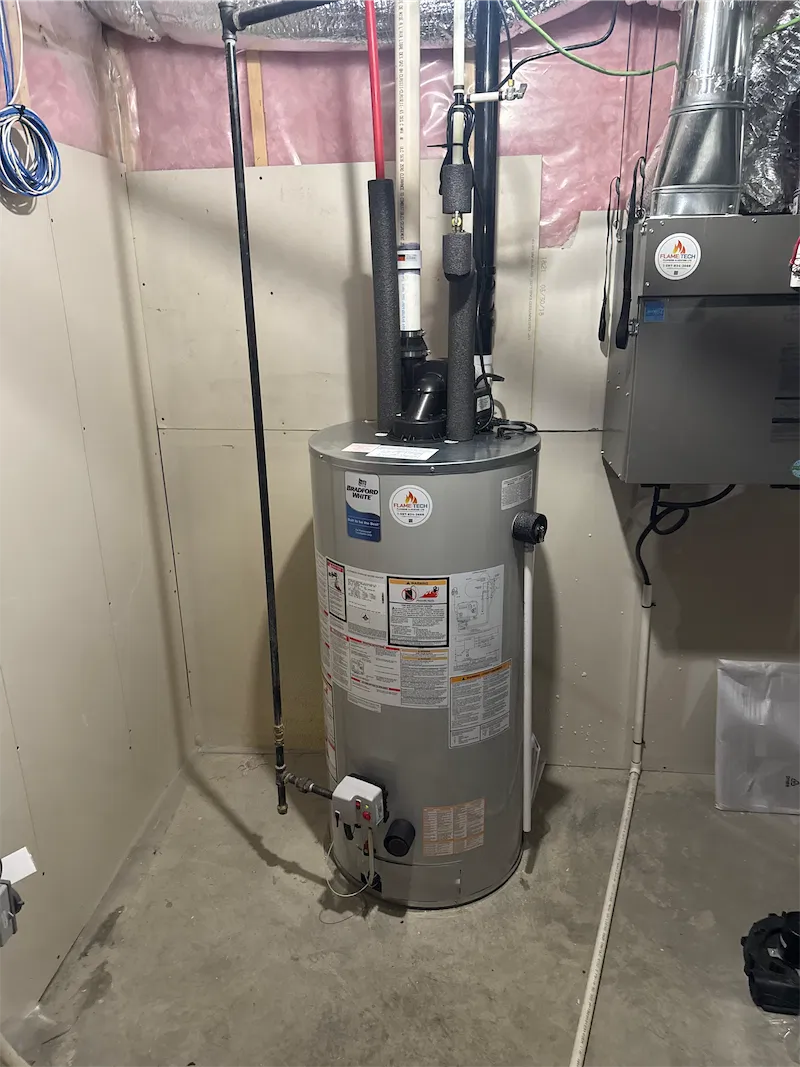
Calgary water hardness (150-200 mg/L) is brutal on hot water tanks — sediment builds in the bottom faster than in lower-mineral cities, and the sacrificial anode rod that's supposed to last 5-7 years is gone in 3-4 — see annual water heater service. The result: tanks rated for 12-15 years typically give up at 8-10 in Calgary unsoftened. FlameTech sizes, installs, and services hot water tanks built for our specific water profile — Bradford White and John Wood are the two brands we've found hold up best — there's a head-to-head on the two if you're deciding. Installed prices by size are in hot water tank replacement cost in Calgary.
Calgary Hot Water Tank Replacement — Red Seal Plumbers
Hot water tanks in Calgary fail at 8-12 years — sooner if you don't have a water softener. When yours goes, FlameTech replaces it with the brands that actually survive our hard water, and the price is agreed in writing before work starts.

Tankless Water Heater Repair in Calgary
Tankless repair across Calgary on Rinnai, Navien, Noritz, IBC, Rheem and Bosch. Error codes read properly, scale diagnosed rather than guessed at, and an honest answer on whether the heat exchanger is worth saving.
Where we cover Calgary.
We dispatch from Calgary and Airdrie. Find your neighbourhood for area-specific notes on common builds, hard-water patterns, and the systems we see most.
Get a free tankless water heater quote.
Tell us what's going on and our dispatch team will call you back with pricing and availability.
Book a Red Seal plumber in Calgary.
Free estimates and upfront pricing, from local technicians who treat your home like their own.
Free estimate · No service charge for quotes · BBB Accredited