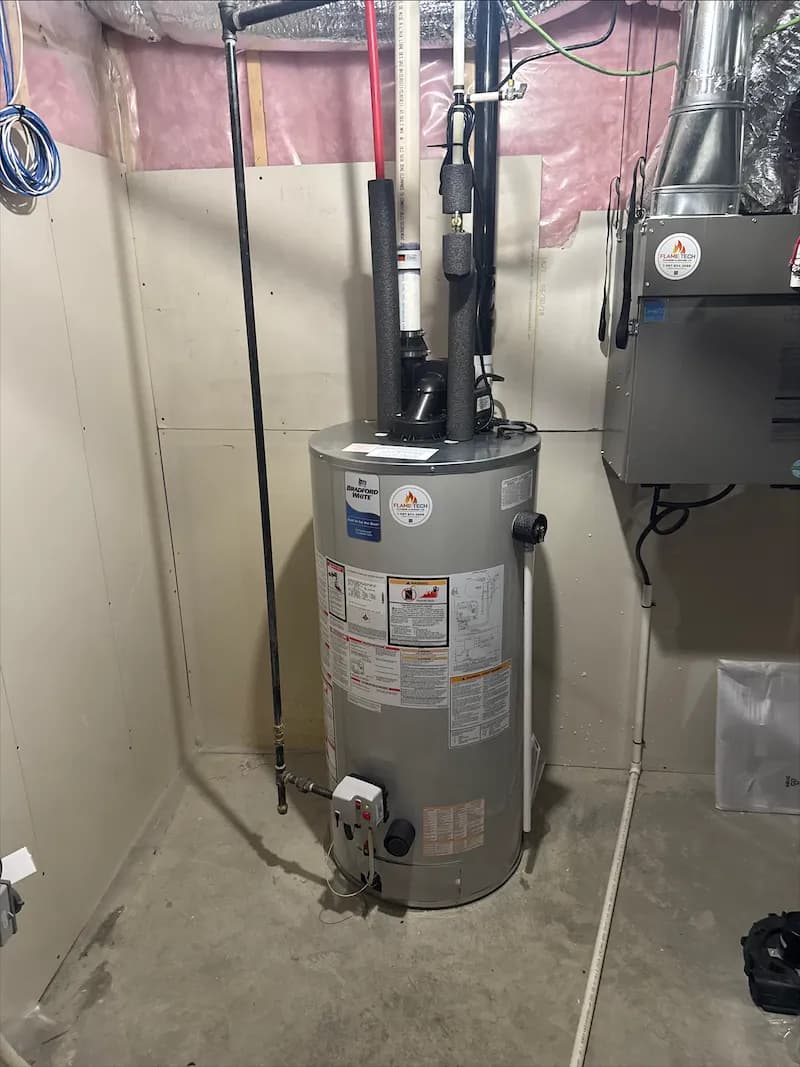

Hot Water Tanks Calgary — Bradford White + John Wood Install, Sized Right
Calgary water hardness (150-200 mg/L) is brutal on hot water tanks — sediment builds in the bottom faster than in lower-mineral cities, and the sacrificial anode rod that's supposed to last 5-7 years is gone in 3-4 — see annual water heater service. The result: tanks rated for 12-15 years typically give up at 8-10 in Calgary unsoftened. FlameTech sizes, installs, and services hot water tanks built for our specific water profile — Bradford White and John Wood are the two brands we've found hold up best — there's a head-to-head on the two if you're deciding. Installed prices by size are in hot water tank replacement cost in Calgary.
Three scenarios drive most Calgary tank calls: (1) tank at end of life and needs replacement (typically 8-10 years in unsoftened Calgary water — sometimes 12-14 with a water softener upstream), (2) new-build or addition needing a first-time install with permits + gas + venting, or (3) annual maintenance to extend tank life (flush + anode rod inspection at 3-year intervals). We handle all three with permits pulled and inspections arranged.
If your tank just failed and you need a replacement today, see hot water tank replacement Calgary — common-brand tanks ride on the truck for same-day swap. If something's actively wrong (no hot water, leaking, lukewarm), the diagnostic pages cover it: no hot water, leaking water heater, hot water issues.
Already have a tankless unit that is playing up? See tankless water heater repair. Considering tankless instead? Compare against tankless water heaters — endless hot water, longer lifespan (20+ years), space savings, but higher install cost and brutal on hard water without proper softening. North of the city, see hot water tanks Airdrie. Call 587-834-3668 for a free in-home assessment.
Tank end-of-life, planning a new install, or due for annual service? Call 587-834-3668 for a free in-home assessment — honest brand and sizing recommendations.
Call 587-834-3668“Friends recommended FlameTech for a pipe leak. They were fast, transparent on pricing, and thorough — found a second leak we didn't know about and repaired both. Looked at our older hot water tank too and walked us through pricing options. Detailed quotes, no surprises. We're moving forward with the tank replacement based on the level of service.”

Amanda Howlett
Calgary · 8 months ago
What we install + service on Calgary hot water tank calls
Common configurations across Calgary. We talk through trade-offs before quoting — fuel type, vent type, brand, and sizing all matter.
Bradford White + John Wood — preferred brands
Bradford White (American-made, vitreous-glass-lined tanks, magnesium or aluminum-zinc anode options, robust Honeywell or White-Rodgers gas valves) and John Wood (Canadian-made, strong parts distribution, reliable build quality) are our two recommended brands for Calgary's water. Both consistently outlast cheap big-box-store brands by 1-3 years here. Common sizes (40, 50, 60, 75 gallon — gas + electric) ride on the truck.
Gas tanks — atmospheric vent (older homes)
Standard atmospheric-vent gas tanks use natural draft through a B-vent chimney for exhaust. Common in pre-2000 Calgary homes with masonry or pre-fab metal chimneys. Lower install cost than power-vent. Limitation: vent must be sized correctly + cleared of obstructions; mid-efficiency atmospheric tanks are being phased out in favor of higher-efficiency power-vent and direct-vent designs.
Gas tanks — power-vent (most common modern install)
Power-vent tanks use a small fan to push exhaust horizontally out the side wall (no chimney needed). Standard for most modern Calgary installs — works in mechanical rooms without chimney access, eliminates draft-related backdraft risk. Slightly higher install cost but more flexible placement options. Most Bradford White installs in Calgary basements are power-vent.
Direct-vent and condensing — high-efficiency
Direct-vent (sealed combustion, intake + exhaust through the wall) and condensing (95%+ efficiency, condensate drain required) tanks reduce energy bills and are required by some new-build codes. Higher upfront cost; payback varies based on usage. Suit luxury rebuilds where running-cost optimization matters more than install cost.
Electric tanks
Higher operating cost than gas in Alberta (gas is cheap here) but the only option in homes without gas service. Two heating elements (upper + lower) + dedicated 240V breaker. Simpler install (no gas, no venting), often slightly cheaper upfront. Best for: small condos, suites, or homes without natural gas. Common sizes: 40, 60 gallon.
Same-day replacement when tanks fail
When a tank fails (bottom leak, dead element, end-of-life), we replace same-day with common-brand stock. Bradford White and John Wood 40/50/60 gallon gas + electric ride on the truck. Larger or specialty units may need next-day order. See hot water tank replacement Calgary for the dedicated replacement page.
Annual flushing + 3-year anode rod service
Single best move for Calgary tank longevity. Annual flush removes sediment buildup before it damages the tank bottom. Anode rod inspection every 3 years — if it's down to the core wire, replace it. The rod is a cheap part, and it's the only thing standing between Calgary's water and the tank itself. Calgary's hard water consumes anodes fast; routine replacement extends tank life by 3-5 years on average.
First-time installs for new builds + additions
Building out or adding a suite? We handle the full install: gas line sizing + connection, venting (power-vent or direct-vent based on the install location), expansion tank, TPR valve and discharge line, drain pan if needed, permits + inspection coordination, and commissioning. Coordinate timing with the broader build schedule.
Why Calgary hot water tanks fail faster than elsewhere
Tanks rated for 12-15 year average lifespan often give up at 8-10 in Calgary. The local water profile is the main reason — knowing why helps explain when to call vs when to replace, and what to do during install to extend life.
Hard water consumes the anode rod fast
Calgary water hardness (150-200 mg/L) accelerates anode rod consumption. The sacrificial anode that's rated for 5-7 years in soft-water cities is gone in 3-4 here. Once the anode is consumed, the tank itself starts corroding from the inside. Pulling and replacing the anode every 3 years is the single best move for tank longevity in this water — but most homeowners never do it because they don't know to.
Sediment buildup damages the tank bottom
Calcium and magnesium drop out of solution when heated and settle as sediment at the bottom of the tank. Calgary tanks accumulate sediment 2-4x faster than soft-water cities. Sediment insulates the burner from the water above (slower recovery, higher energy use) AND traps superheated water that flashes to steam — causing the popping/rumbling noises and slowly weakening the tank floor through thermal stress.
Cold incoming water = high recovery demand
Calgary's incoming water is cold (4-10°C from the mains, year-round). A tank heating water from 4°C to 49°C is doing more work per litre than one in milder climates. More cycles, more wear, more time at higher burner temperatures = faster failure. Slightly oversized tanks reduce recovery demand and last longer here.
Long winter heating season = more total runtime
Calgary's heating season runs October through April — 7 months of cold incoming water and high indoor hot-water demand (long showers, hot laundry, longer dish washing). Tanks rated for southern-Canada usage profiles see more hours per year of operation here.
Build-era housing context matters
Pre-2000 Calgary homes often still have original or 2nd-gen tanks. Anything 12+ years old is on borrowed time in this water. Mid-2000s builds (Cranston original section, McKenzie Towne core, Auburn Bay early phases) commonly have original tanks now hitting end of life. Post-2015 builds typically have higher-efficiency tanks that last slightly longer but still benefit from annual flushing.
Water softener is the single biggest longevity move
Installing a water softener on the cold-water feed dramatically reduces mineral load through the tank. Customers who install a softener typically see their NEXT tank last 14+ years instead of 8-10. The softener also protects every other water-using fixture in the home (washing machine, dishwasher, faucets, shower valves, combi DHW exchangers).
Newer high-efficiency tanks: better, not invincible
Post-2015 condensing tanks and high-efficiency power-vent models last longer than older atmospheric-vent tanks — but still need annual flushing to stay at design life. The high-efficiency gain is real, but we still see ~10-12 year lifespans here vs the rated 15. Annual maintenance is non-negotiable in this water.
Code requirements: expansion tank + TPR + drain pan
Modern Calgary code requires a thermal expansion tank on systems with a backflow preventer (most homes), a TPR (temperature/pressure relief) valve with proper discharge piping to the floor, and a drain pan under tanks installed where leaks would cause damage. Older tanks sometimes lack these; install or replacement is the right time to bring them up to current code.
Talk to us about your hot water tank
Free in-home assessment, honest recommendation, and the price in writing before any work starts.
Sizing your tank for actual Calgary household demand
Tank sizing is about peak simultaneous demand, not house square footage. Get this right and your tank reliably keeps up; get it wrong and you run out of hot water mid-shower for the next decade.
1-2 people, 1 bathroom: 40-gallon usually sufficient
Small household, modest demand. 40-gallon gas (with reasonable recovery rate) keeps up with back-to-back showers + dishwasher. Electric needs to be slightly larger (50-60 gallon) due to slower recovery.
3-4 people, 1-2 bathrooms: 50-gallon gas is the workhorse
Most common Calgary household configuration. 50-gallon gas tank with good recovery rate handles morning shower rush + same-day laundry without running out. Electric: bump to 60 gallon.
4-5 people OR 2.5-3 bathrooms: 60-75 gallon
More fixtures + more people = more simultaneous demand potential. 60-gallon gas or 75-gallon for larger homes / luxury bathrooms with soaker tubs (which can drain a 50-gallon tank in a single fill). Heat pump water heater also becomes worth considering at this size.
Big homes + multiple soakers + multi-shower: 75+ gallon or tankless
Luxury homes, large families, or multiple shower-bath simultaneous demand often exceeds what a single tank can handle. Options: 75+ gallon tank with high recovery, twin 50-gallon tanks plumbed in series, or tankless water heater for truly endless hot water capacity. We walk through the math.
Recovery rate matters as much as tank size
A 50-gallon tank with high recovery (faster reheat between draws) often outperforms a 60-gallon tank with low recovery. High-recovery models are gas with high BTU input or electric with both elements running simultaneously. We factor recovery rate into sizing recommendations — bigger isn't always better.
How a Calgary hot water tank install actually runs
Typical 3-4 hour install for like-for-like replacement; first-time install in a new build or major upgrade (electric→gas, atmospheric→power-vent) takes longer.
1. In-home assessment + sizing conversation
Check current tank (capacity, age, condition), household routine (peak demand pattern, fixture count, soaker tub presence), space constraints (mechanical room access, ceiling height for clearances), gas line + venting options. Discuss tank vs tankless if relevant.
2. Brand + sizing + fuel-type recommendation
Walk through Bradford White vs John Wood vs AO Smith for your specific situation. Confirm sizing based on the household demand conversation. Discuss anode rod material options for Calgary water. Quote in writing — fuel, brand, sizing, install scope, permits, code-required components (expansion tank, drain pan if needed).
3. Shut off + drain + remove old tank
Shut off cold-water inlet, gas (or breaker), and disconnect supply lines. Drain the old tank — often slow due to sediment buildup; we use a transfer pump to speed it. Remove old tank, recycle properly. Protect floors and walkways during the swap-out.
4. Set new tank + plumbing + gas + venting
Position new tank, level it, connect cold + hot supply lines with dielectric unions (preventing galvanic corrosion at the steel-to-copper transition), install or replace expansion tank, install TPR valve + discharge line. Gas: sized supply line + flex connector + shutoff. Power-vent: PVC vent through the wall with proper slope and termination clearances.
5. Permits + inspection coordination
Pull required permits (gas + plumbing). Schedule inspection. Stay through the inspection visit if needed. We don't leave permit paperwork in your hands — that's our job.
6. Fill + commission + walkthrough
Open cold-water inlet, fill the tank (open a hot tap to bleed air during fill), light pilot or activate electric, set thermostat to 49°C (Alberta code recommendation — reduces scald risk while preventing legionella). Walk you through pilot relight (gas), reset button (electric), TPR valve test, recommended flush schedule, anode rod inspection at 3 years.
Hot Water Tanks Calgary — FAQs
What size hot water tank do I need for my Calgary home?
Depends on household size + fixture count + peak simultaneous demand, not square footage. 1-2 people, 1 bathroom: 40 gallon usually fine. 3-4 people, 1-2 bathrooms: 50 gallon is the workhorse. 4-5 people OR 2.5+ bathrooms: 60-75 gallon. Bigger luxury homes with soaker tubs and multiple shower demand may need twin tanks or tankless. Recovery rate matters as much as tank size — we factor both into recommendations.
How long should a hot water tank last in Calgary?
Manufacturer ratings are 12-15 years. Calgary's hard water typically cuts that to 8-10 years for a standard tank without annual maintenance. With annual flushing + anode rod replacement every 3 years, we see Calgary tanks reach 12-14 years routinely. Adding a water softener extends this further — most softener customers see 14+ year tank lifespans because the mineral load drops dramatically.
Should I choose gas or electric in Calgary?
Gas almost always — Alberta natural gas is cheap and gas tanks recover faster than electric. Electric makes sense in: condos without gas service, small suites where install simplicity matters, homes where running a new gas line would be expensive, or specific code constraints. Electric tanks need a dedicated 240V breaker and slightly larger capacity to compensate for slower recovery.
Bradford White or John Wood — which is better for Calgary?
Both excellent. Bradford White is American-made with vitreous-glass-lined tanks and a strong reputation — we install a lot of these in basements with power-vent. John Wood is Canadian-made with strong parts distribution + reliable build quality. Both consistently outlast cheap big-box brands by 1-3 years in Calgary's water. We recommend based on availability and the specific install — performance difference between them is small.
What are signs my tank needs replacement vs repair?
Replace: leak from the bottom of the tank (non-repairable corrosion), tank 12+ years old with major component failure, severely scaled bottom that flushing can't recover, rusty/discoloured hot water (anode-related but check for tank-side failure). Repair: leak from top fittings, failed thermostat or element on a younger tank, TPR valve replacement, drain valve swap, pilot/thermocouple service. See leaking water heater for the full source-of-leak diagnostic tree.
What's the difference between power-vent and atmospheric-vent?
Atmospheric-vent uses natural draft through a chimney for exhaust — works in older homes with masonry or B-vent chimneys. Power-vent uses a small fan to push exhaust horizontally out a side wall — works in any home, even without chimney access. Most modern Calgary installs are power-vent for placement flexibility. Power-vent costs slightly more upfront but is the standard for new installs and replacements where chimney isn't available.
Do I need a water softener with my new tank?
Strongly recommended for Calgary tank longevity. Softener customers typically see their NEXT tank last 14+ years vs 8-10 unsoftened — the math on softener payback over a tank lifecycle is usually strongly positive. Also protects every other water-using appliance + fixture in the home. See water softener Calgary for the install conversation. Sometimes worth pairing softener + tank install for one mechanical-room project.
How often should I flush my hot water tank?
Annually in Calgary, period. Hard water sediment accumulates fast here — without annual flushing, sediment can be 2-4 inches deep by year 5, insulating the burner from the water above and accelerating heat-stress corrosion on the tank floor. Annual flushing also gives us a chance to inspect the anode rod (every 3 years — replace if down to the core wire). Single best move for tank longevity.
Should I consider tankless instead of a tank?
Worth comparing. Tankless: endless hot water capacity, 20+ year lifespan, big space savings, lower operating cost over the lifecycle. Downside: higher install cost, brutal on hard water without proper softening, slightly higher maintenance burden. Tank: lower install cost, simpler maintenance, well-understood technology, plenty of capacity for typical Calgary households. See tankless water heaters Calgary for the full comparison.
What permits and code requirements apply?
Calgary requires plumbing + gas permits for tank installs, proper venting (power-vent or B-vent), a TPR (temperature/pressure relief) valve with proper discharge piping to the floor, a thermal expansion tank on systems with a backflow preventer (most modern homes), and a drain pan under tanks installed in locations where leaks would cause damage. We pull permits, schedule inspections, and install to current code so the work passes first time.
What's the AirEase 12-year warranty I see mentioned elsewhere?
AirEase warranty applies to qualifying furnaces, ACs, and heat pumps — not hot water tanks. For tanks: Bradford White, John Wood, and AO Smith each have their own warranty (typically 6-10 years on tank + 1 year on labor, varying by model + maintenance compliance). We register every install on your behalf and document maintenance to keep warranties valid.
How much does hot water tank installation cost in Calgary?
Depends on tank size, fuel type, brand, venting type (atmospheric vs power-vent vs direct-vent), code-required additions (expansion tank, drain pan if missing), and any upgrades like brand-new gas line or electrical service. We quote in writing after the in-home assessment so you see the full cost upfront. Same-day replacement on common-brand stock often available when you need it fast.
Pick the right water-heating service.
Tank, tankless, replacement, or new install — each one runs a different way.
Hot Water Tank Replacement
Same-day swaps with Bradford White, AO Smith, and Rheem stocked on every truck.
See serviceTankless Water Heaters
On-demand hot water, 20+ year lifespan, big space + efficiency wins.
See serviceWater Heater Installation
Tank, tankless, or replacement — gas + venting + expansion tank done right.
See serviceWater Softeners
Protect your tank from Calgary's hard water with a properly-sized softener.
See serviceReverse Osmosis
Under-sink + whole-home drinking-water filtration. Pairs with softener.
See serviceNo Hot Water
Cold shower right now? Same-day dispatch with common parts on the truck — gas, electric, and tankless.
See serviceLeaking Water Heater
Drip from a top fitting or pool spreading from the bottom? Same-day dispatch with emergency shutoff guidance on the call.
See serviceHot Water Issues
Lukewarm, popping noises, discoloured water — broader diagnosis across every tank type.
See serviceSimple, honest, on your schedule.
Call or request a quote
Tell us what's going on. We listen first and ask the right questions before we schedule anything.
Free written estimate
We assess the job and give you an all-in price in writing. No pressure, no surprise add-ons.
Schedule at your convenience
Pick a day and window that works for your home — we'll confirm dispatch and arrival time.
Clean, code-compliant service
Licensed technicians complete the work to Alberta code, clean up, and walk you through what we did.
Also under Water
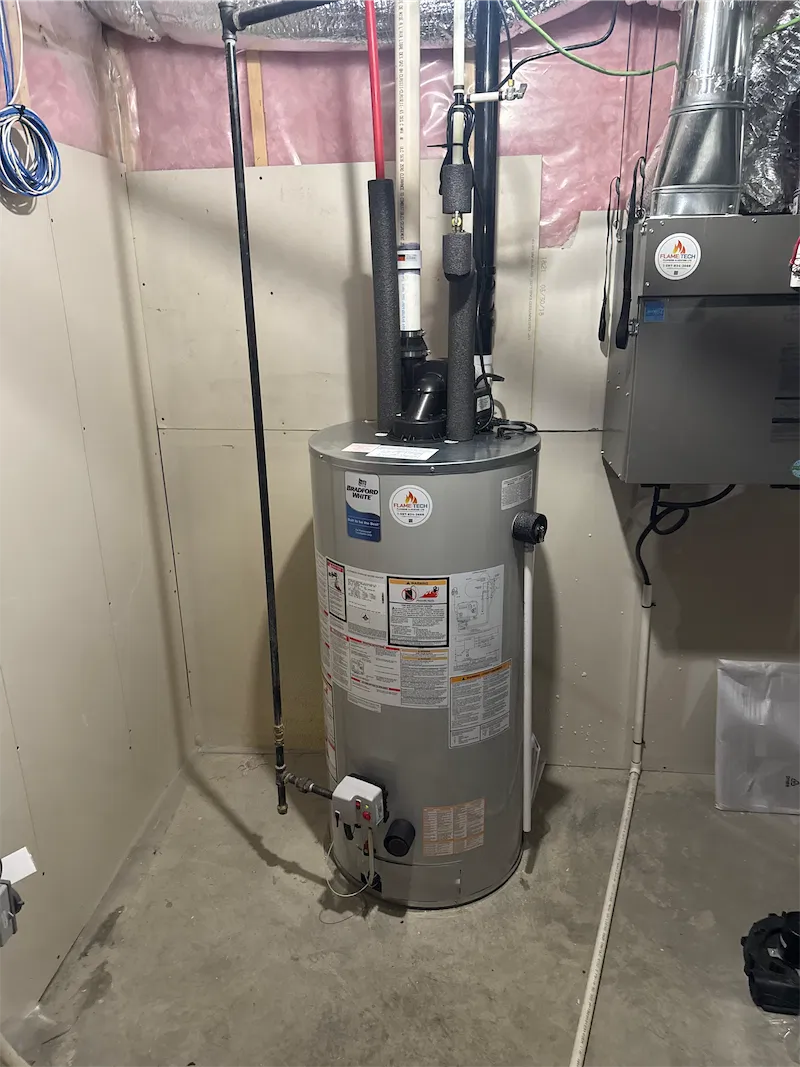
Calgary Hot Water Tank Replacement — Same-Day Service
Hot water tanks in Calgary fail at 8-12 years — sooner if you don't have a water softener. When yours goes, FlameTech has stocked trucks rolling for same-day replacement, with the brands that actually survive our hard water.
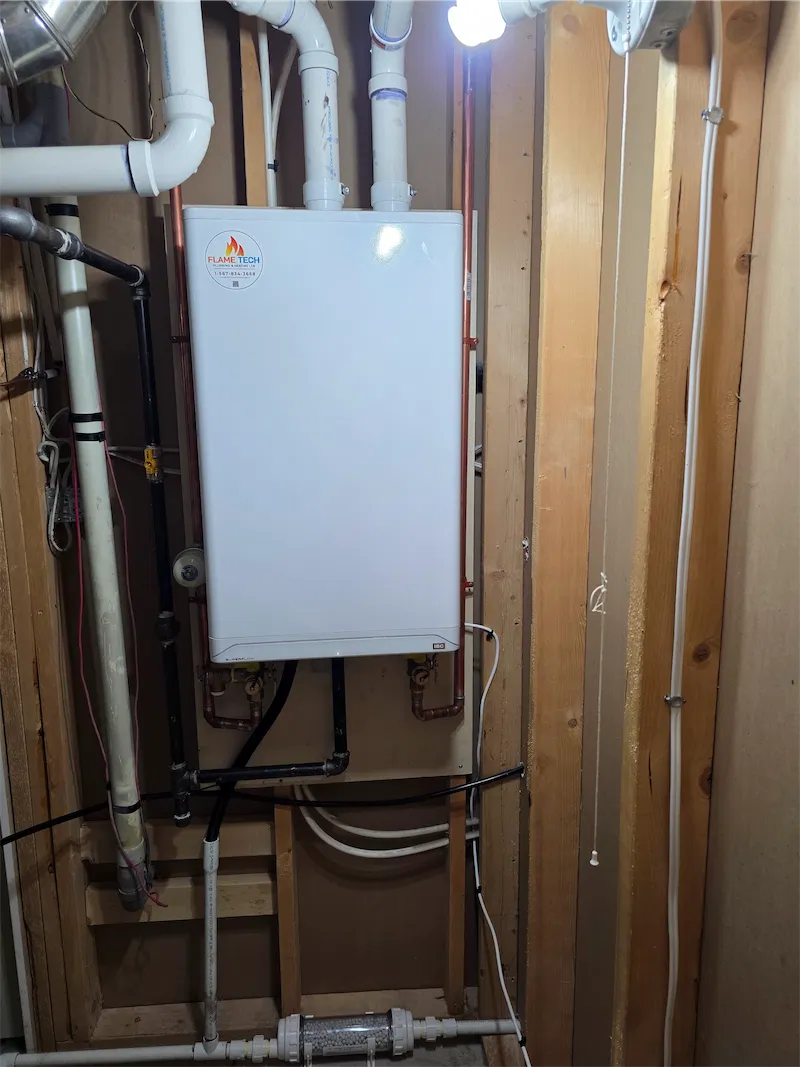
Tankless Water Heaters Calgary — Navien, Rinnai, IBC Install + Service
Tankless water heaters are the right call for some Calgary homes — endless hot water capacity, 20+ year lifespan, big space savings, lower lifecycle operating cost — and the wrong call for others. Calgary's hard water is unusually punishing on tankless heat exchangers (faster scale buildup than tank-style because water passes through narrow internal passages), so annual descaling is non-negotiable and a water softener upstream is strongly recommended. FlameTech installs and services every common brand: Navien NPE-A/S, Rinnai RU/RUR, IBC SL series, Bosch, Noritz. Honest tankless-vs-tank conversation before we quote.

Tankless Water Heater Repair in Calgary
Same-day tankless repair across Calgary on Rinnai, Navien, Noritz, IBC, Rheem and Bosch. Error codes read properly, scale diagnosed rather than guessed at, and an honest answer on whether the heat exchanger is worth saving.
Where we cover Calgary.
Same-day dispatch across Calgary and Airdrie. Find your neighbourhood for area-specific notes on common builds, hard-water patterns, and the systems we see most.
Get a free hot water tank quote.
Tell us what's going on and our dispatch team will call you back with pricing and availability.
Book a Red Seal plumber in Calgary.
Free estimates, upfront pricing, and a satisfaction guarantee — local technicians who treat your home like their own.
Free estimate · No service charge for quotes · BBB Accredited