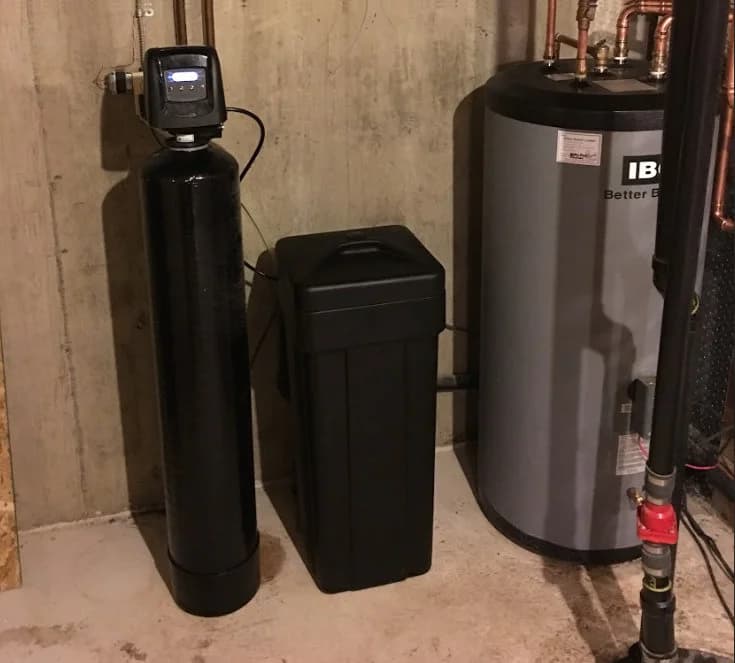

Water Softener Repair Calgary — Diagnosis, Service & Honest Advice
A fair share of the water softener calls we take turn out to be an empty salt tank or a salt bridge — a five-minute fix we'll show you how to handle yourself. The rest are genuine faults, and almost all of them are repairable. FlameTech diagnoses what's actually wrong before anyone starts talking about a new unit.
Softeners fail in a small number of predictable ways: the control valve stops initiating a regeneration, the injector that draws brine clogs, the resin bed wears out or gets fouled, or seals in the valve give up and it runs continuously. Each has a distinct symptom, and each has a different answer.
What matters in Calgary is that a softener here works harder than in most of the country, and how much harder depends on where you live. City data puts hardness in the north around 126–198 mg/L and in the south and southeast around 181–262 mg/L. A softener in SE Calgary regenerates more often than the identical unit in the northwest — more cycles, more wear on the moving parts, and a resin bed that ages faster.
We service Fleck, Autotrol, Clack and the other common valve platforms regardless of who installed the unit, in Calgary and Airdrie. If a repair is the right answer, that's what we'll quote. If it isn't, we'll say so plainly — see water softener installation. Call 587-834-3668.
Water gone hard again, or the brine tank full of water? Call 587-834-3668 — we'll diagnose it properly before quoting anything.
Call 587-834-3668“Great experience working with Jason and Shaun on the installation of my water softener and RO system. Professional, knowledgeable, and took the time to explain the setup and answer all my questions. The installation was completed neatly and efficiently, and the quality of workmanship was excellent. Highly recommend Flame Tech for any plumbing or water treatment needs.”
Aditya Prashar
Calgary · 3 months ago
Work out the symptom first
Softeners fail in a handful of predictable ways, and the symptom narrows it quickly. Here's what each one usually means.
The water has gone hard again
Start with the simple things, because they're the most common. Is there salt in the tank? Is there a salt bridge — a hard crust spanning the tank so salt looks full but isn't reaching the water beneath it? Is the bypass valve open after some other plumbing work? Beyond that, it's a control valve that isn't initiating regeneration, an injector too clogged to draw brine, or a resin bed at the end of its life.
The brine tank is full of water
Usually a clogged injector or venturi — the part that draws brine out of the tank during regeneration. It can also be a restricted drain line, a stuck safety float, or a failed brine valve. It's one of the most common calls we get, and it's almost always repairable. We've written it up in detail: why your water softener has water in it.
It regenerates constantly, or won't stop running
Water running to drain continuously points at the control valve — worn piston seals or spacers letting water bypass internally, or a timer or board stuck mid-cycle. Left alone this runs your water bill up quietly, so it's worth dealing with rather than living with.
The water tastes salty
Too much brine is reaching the house, which typically means a restricted drain line preventing a proper rinse, a brine valve not sealing, or settings drawing far more brine than the unit needs. Not dangerous, but it means the system isn't rinsing properly and salt is going somewhere it shouldn't.
Water pressure has dropped through the house
A fouled resin bed restricts flow. So does a bed that has started to break down. Check the aerators on your taps — if you find tiny amber or brown beads, resin is escaping into your plumbing, which means a cracked distributor tube or a failed screen inside the tank.
It's leaking
Usually bypass valve o-rings or control valve seals, both routine parts. A leak from the tank body itself is a different conversation, because a cracked tank isn't repairable and that's one of the few cases where replacement is the only answer.
What we do on a service call
Diagnosis before parts. We'd rather spend twenty minutes establishing what's actually wrong than replace something that wasn't the problem.
- 01Test the water at the tap — hard or soft — to confirm whether the unit is actually failing or something else is going on.
- 02Check the salt level, break up any bridge, and look for mushing at the bottom of the brine tank.
- 03Confirm the bypass valve is in service position and not left open from previous work.
- 04Run a manual regeneration and watch each stage, which is the fastest way to find where the cycle is failing.
- 05Clean or replace the injector and venturi screen — the most common single repair on any softener.
- 06Inspect control valve seals, spacers and the piston for wear, and check the drain line for restriction.
- 07Verify the programming against your actual water hardness and household size, rather than whatever default it shipped with.
- 08Clean and sanitise the brine tank where it needs it, and check the safety float operates freely.
Repair or replace — how we decide
Most softeners are worth fixing. A few genuinely aren't, and we'll tell you which one you have rather than defaulting to the bigger sale.
Under about 8 years — repair it
Control valve internals, injectors, brine valves, floats and timers are all serviceable. The tank and resin have plenty of life left, and replacing the whole system to fix a worn seal is throwing away a working unit.
8 to 12 years — it depends what failed
A cheap part on an otherwise healthy softener is worth doing. A failed control valve on a unit this age is where the arithmetic shifts, because the resin bed is heading toward the end of its life at the same time. We'll price both and let you decide with real numbers.
Resin bed exhausted or fouled
Resin can be replaced on its own, and on a newer unit with a sound valve that's often the right call. On an older softener, the cost of new resin plus the labour to swap it starts to look like a meaningful fraction of a new system with a warranty.
A cracked tank
Not repairable. This is the one case where replacement isn't a judgement call.
Chlorine damage is the Calgary factor
Chlorine in the municipal supply gradually breaks down softener resin, which is why beds here often don't reach the fifteen years the spec sheet implies. If yours has aged out early, a carbon pre-filter on the new bed protects it and is worth discussing at the same time.
Undersized from the start
Occasionally the unit isn't faulty at all — it was sized for a smaller household or softer water than it actually has, so it runs out before the next regeneration. No repair fixes that. See water softener installation for how we size them.
Why a working softener matters here
It isn't just about scale on the taps. In Calgary the softener is protecting several expensive things downstream of it.
- 01Water heaters scale on the tank bottom and at the element, which costs efficiency and shortens life. See hot water tanks.
- 02Tankless units are especially sensitive — narrow heat exchanger passages scale quickly and need descaling far more often on hard water. See tankless water heaters.
- 03Boiler heat exchangers scale the same way, which is the single biggest reason boilers here fail earlier than the manufacturer's figure suggests. See boiler replacement.
- 04Combi boilers take it worst, because the domestic hot water exchanger has the narrowest passages of anything in the house.
- 05Fixture cartridges, dishwasher and washing machine valves all wear faster in hard water.
- 06So a softener that has quietly stopped working isn't a cosmetic problem — everything downstream starts accumulating scale from the day it failed, usually without anyone noticing for months.
Calgary Water Softener Repair FAQs
My water has gone hard again. Is the softener broken?
Often not, and it's worth checking the simple things before booking anything.
Is there actually salt in the brine tank? Is there a salt bridge — a hard crust spanning the tank so the salt looks full but isn't dissolving into the water underneath? Push a broom handle down through it and see whether it gives way. And has anyone done plumbing work recently that might have left the bypass valve open?
If all three check out, then you're looking at a real fault: a control valve not initiating regeneration, a clogged injector, or a resin bed at the end of its life. We'll test the water, run a manual regeneration, and find out which.
Why is my brine tank full of water?
Most commonly a clogged injector — the venturi that draws brine out of the tank during regeneration. If it can't pull, the water that went in doesn't come back out.
Other causes: a restricted or kinked drain line, a safety float stuck in the up position, or a brine valve that has failed to seal.
All of those are repairable, and none of them mean you need a new softener. It's one of the most frequent calls we take. There's more detail in our guide on why your water softener has water in it.
Is it worth repairing a water softener or should I replace it?
Under about eight years, repair it. Control valve internals, injectors, brine valves and timers are all serviceable parts, and the tank and resin have years left.
Between eight and twelve, it depends what failed. A minor part is worth fixing. A failed control valve on a unit that age is where it gets closer, because the resin is heading toward the end of its life anyway.
A cracked tank is the one clear replace — that isn't repairable at any age.
We'll price both options where there's a genuine choice and let you decide. We're not going to push a new system to avoid a repair.
How long does softener resin last in Calgary?
Less than the spec sheet suggests, and chlorine is why.
Resin is often quoted at ten to fifteen years. Chlorine in the municipal supply gradually breaks the beads down, so in practice Calgary beds frequently age out toward the lower end of that range or below it.
The symptoms are gradual rather than sudden — softness fades, regenerations stop keeping up, and you may see tiny amber beads in your tap aerators as the bed breaks apart. If you're replacing resin, a carbon pre-filter ahead of it protects the new bed and is worth doing at the same time.
There are little brown beads in my tap aerators. What are they?
That's resin escaping from the softener into your plumbing, and it means something inside the tank has failed — usually a cracked distributor tube or a broken screen at its base.
It needs dealing with rather than ignoring. Loose resin travels through the house and clogs aerators, fills fixture cartridges, and can find its way into appliance valves.
The repair is opening the tank, replacing the failed component, and flushing the beads out of the affected fixtures. On an older unit we'd weigh that against replacement and give you both numbers.
Do you service softeners you didn't install?
Yes, and most of the ones we service we didn't install.
We work on Fleck, Autotrol, Clack and the other common control valve platforms. Those valves are used across a wide range of brands, so the badge on the front matters much less than what's inside it.
If we can't get parts for something unusual, we'll tell you that upfront rather than after the visit.
How often should a water softener be serviced?
For most Calgary households, a professional service every two to three years is sensible, with a few things you can do yourself in between.
Yours: check the salt monthly and break up any bridge, keep an eye out for mushy sludge at the bottom of the brine tank, and note if softness starts fading.
Ours: injector and screen cleaning, control valve inspection, brine tank clean and sanitise, drain line check, and confirming the programming still matches your hardness and household. Our water is hard enough that units here run more cycles than the manual assumes, so intervals should be shorter here than the generic advice suggests.
My softener uses a lot of salt. Is something wrong?
Possibly, and it's worth looking at rather than just buying more salt.
The usual causes are settings that were never matched to your actual hardness and household size, a unit regenerating far more often than it needs to, or a control valve fault causing extra or incomplete cycles. A leaking brine valve will also quietly consume salt.
We test your water, check what the unit is programmed for, and reset it to reality. Reprogramming alone often cuts salt and water use noticeably, and it's the cheapest thing we do.

Monthly Financing Available
Spread the cost into manageable monthly payments.
Spread the cost of a replacement softener into flexible monthly payments via our Financeit partner.
Simple, honest, on your schedule.
Call or request a quote
Tell us what's going on. We listen first and ask the right questions before we schedule anything.
Free written estimate
We assess the job and give you an all-in price in writing. No pressure, no surprise add-ons.
Schedule at your convenience
Pick a day and window that works for your home — we'll confirm dispatch and arrival time.
Clean, code-compliant service
Licensed technicians complete the work to Alberta code, clean up, and walk you through what we did.
Also under Water
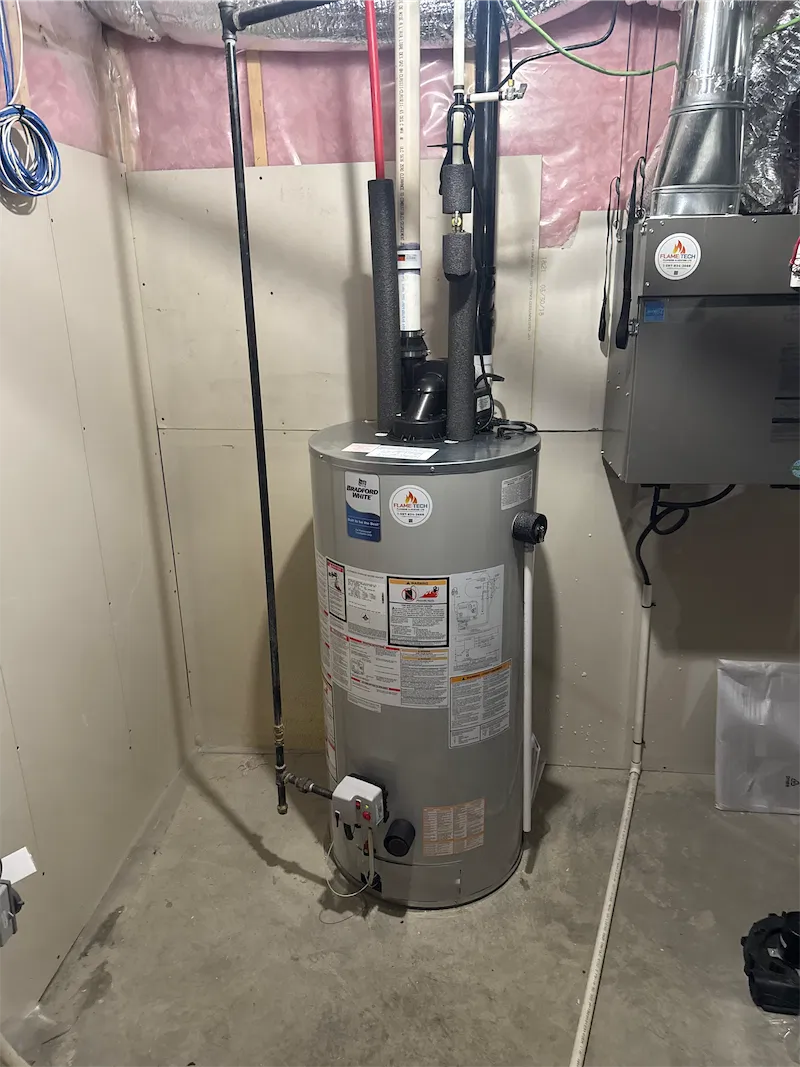
Hot Water Tanks Calgary — Bradford White + John Wood Install, Sized Right
Calgary water hardness (150-200 mg/L) is brutal on hot water tanks — sediment builds in the bottom faster than in lower-mineral cities, and the sacrificial anode rod that's supposed to last 5-7 years is gone in 3-4 — see annual water heater service. The result: tanks rated for 12-15 years typically give up at 8-10 in Calgary unsoftened. FlameTech sizes, installs, and services hot water tanks built for our specific water profile — Bradford White and John Wood are the two brands we've found hold up best — there's a head-to-head on the two if you're deciding. Installed prices by size are in hot water tank replacement cost in Calgary.
Calgary Hot Water Tank Replacement — Same-Day Service
Hot water tanks in Calgary fail at 8-12 years — sooner if you don't have a water softener. When yours goes, FlameTech has stocked trucks rolling for same-day replacement, with the brands that actually survive our hard water.
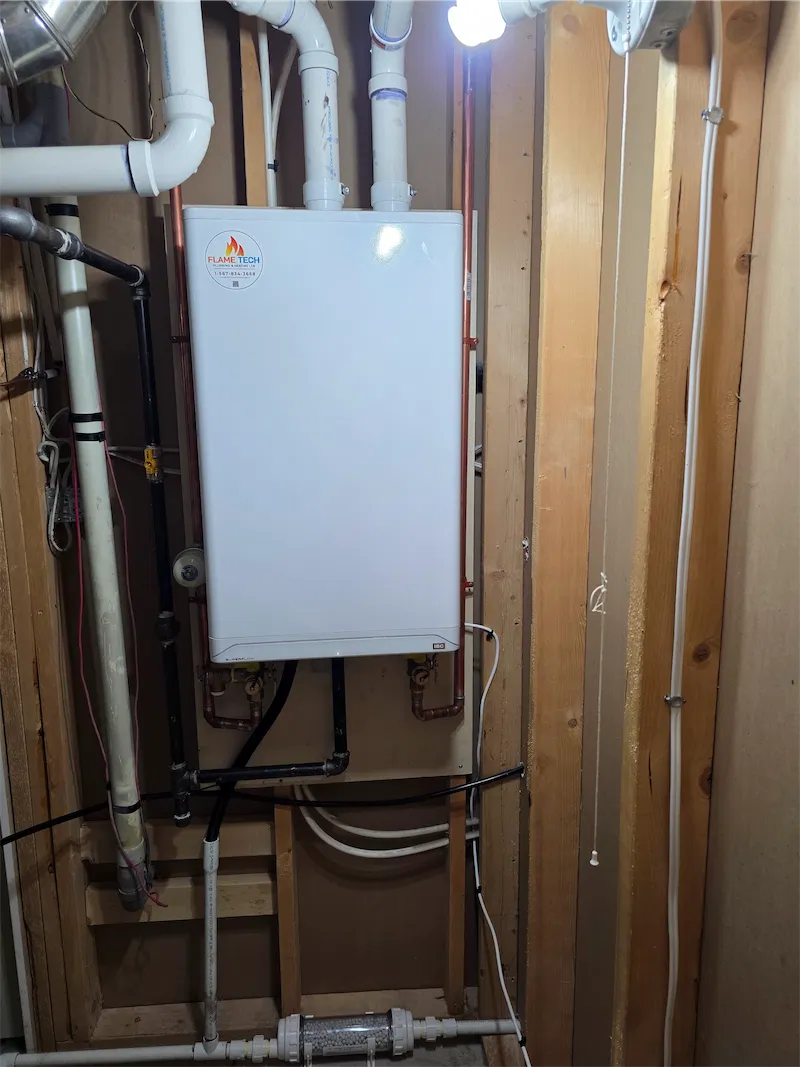
Tankless Water Heaters Calgary — Navien, Rinnai, IBC Install + Service
Tankless water heaters are the right call for some Calgary homes — endless hot water capacity, 20+ year lifespan, big space savings, lower lifecycle operating cost — and the wrong call for others. Calgary's hard water is unusually punishing on tankless heat exchangers (faster scale buildup than tank-style because water passes through narrow internal passages), so annual descaling is non-negotiable and a water softener upstream is strongly recommended. FlameTech installs and services every common brand: Navien NPE-A/S, Rinnai RU/RUR, IBC SL series, Bosch, Noritz. Honest tankless-vs-tank conversation before we quote.
Where we cover Calgary.
Same-day dispatch across Calgary and Airdrie. Find your neighbourhood for area-specific notes on common builds, hard-water patterns, and the systems we see most.
Get a free water softener repair quote.
Tell us what's going on and our dispatch team will call you back with pricing and availability.
Book a Red Seal plumber in Calgary.
Free estimates, upfront pricing, and a satisfaction guarantee — local technicians who treat your home like their own.
Free estimate · No service charge for quotes · BBB Accredited