The installed heat pump cost in Calgary with us is $6,200 to $8,800, as of September 2026, and heat pumps in Airdrie are priced on the same range.
The spread has less to do with the outdoor unit than people expect. Two houses can get the same heat pump and land far apart, because what the house already has sets the price: ducts that can carry the airflow, a panel with room for another big circuit, and a furnace that can work alongside a heat pump. When those aren't in good shape, the extra work is where the money goes.
What the range covers, and what's priced separately
What sits inside the number depends on the house, so the written quote itemizes it. You see every line before work starts.
Two things are separate jobs with their own prices:
- A new furnace. If yours can't work with a heat pump, or is close to done anyway, replacing it runs $4,500 to $9,600 installed. Our furnace replacement cost guide explains that number.
- A ductless mini split. Heating and cooling one room or zone without ducts is a different install, $3,500 to $5,000 with us. See mini split AC in Calgary.
As for the electrical panel, we check whether it can take a heat pump before we quote. If it needs work, you see that on the written quote before anything starts.
Ducted, dual-fuel or all-electric
Adding a heat pump to the furnace you have
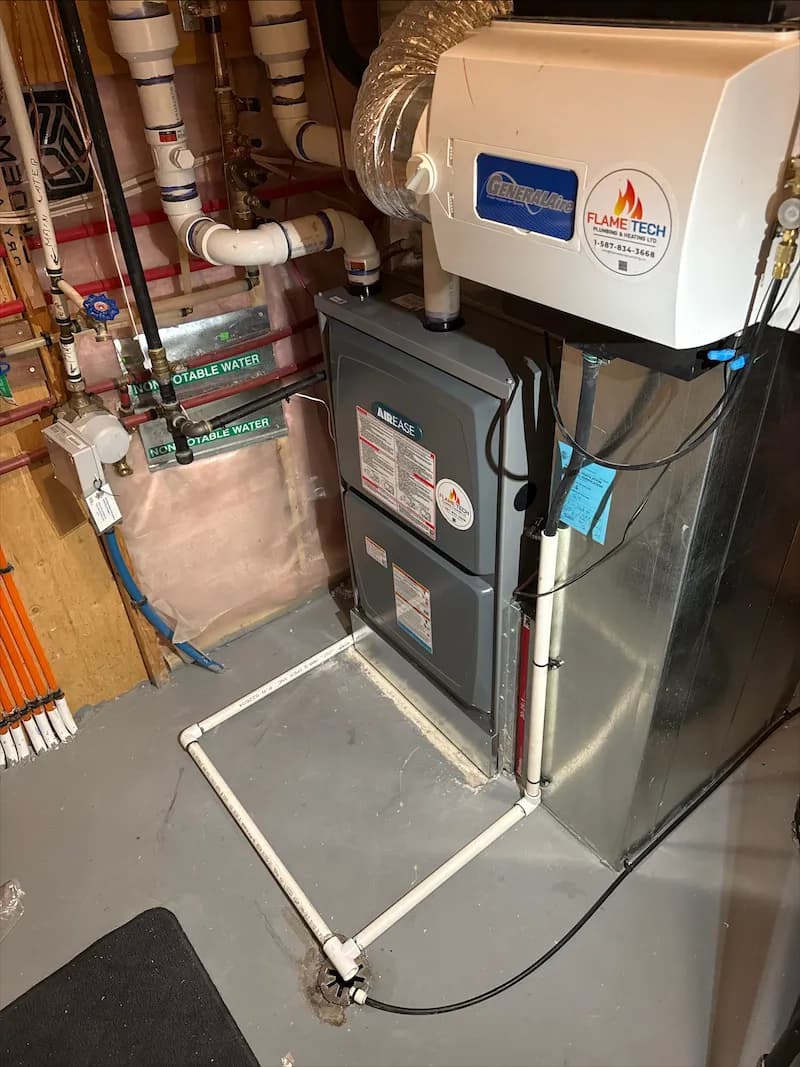
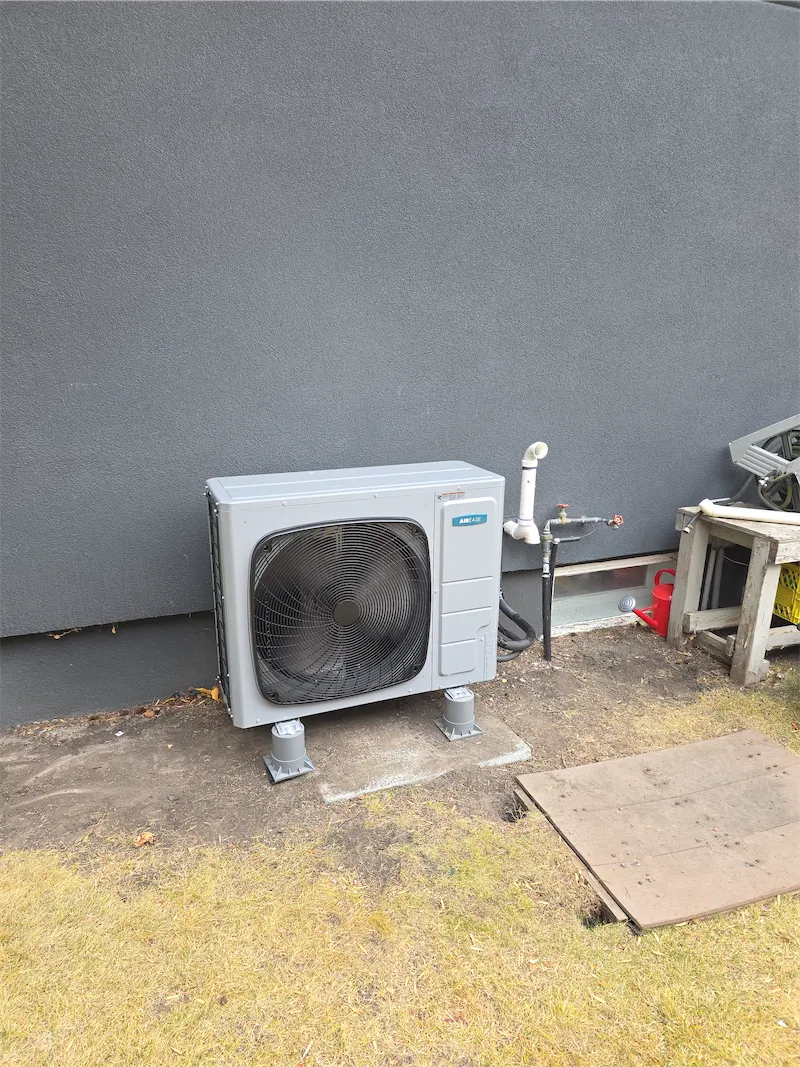
This is dual-fuel, sometimes called a hybrid. The heat pump sits outside where an air conditioner would, a coil goes on the furnace, and the thermostat picks which one heats the house based on the outdoor temperature. The heat pump carries the milder days, the furnace carries the deep cold, and the same outdoor unit cools the house in summer.
For most gas-heated houses here, this is the setup that makes sense, as long as the furnace suits it. Its blower has to move the air a heat pump needs, its controls have to work with a dual-fuel thermostat, and the ducts have to carry that air without whistling.
Heat pump plus a new furnace
If the furnace is due anyway, doing both at once can make sense. They're still two jobs with two prices: the heat pump at $6,200 to $8,800, and the furnace at $4,500 to $9,600. You get one disruption and equipment chosen as a pair, and the quote should still show each separately.
Heat pump with electric backup
An all-electric setup uses electric resistance heat when the heat pump can't keep up. For a Calgary house with gas, it's rarely the right call. Electric backup heat is expensive to run, it can run for long stretches in a cold snap, and it adds a large load to the panel.
Ductless for one zone
If the problem is one space, like an addition that was never tied into the ducts, a ductless mini split heats and cools it and leaves the rest of the system alone. It's priced on its own range, above.
Electrical work
A ducted heat pump needs a dedicated circuit to the outdoor unit, with a disconnect beside it. That part is routine. The question is whether the panel has room.
Room means two things: space for another breaker, and enough capacity in the service to carry the heat pump as well as whatever else runs on a cold evening, like the dryer, the oven or an EV charger. Houses that have added big loads over the years tend to run short.
A service upgrade isn't the only answer. A load management device holds off one large load, an EV charger for example, while the heat pump runs, so the two never peak together. Where it suits the house and code allows it, that can avoid an upgrade. Where it doesn't, the panel needs work.
Sizing for Calgary's cold
Two shortcuts get sizing wrong: going by floor area, and matching the air conditioner coming out. Neither tells you how much heat the house loses on a cold night, and Calgary needs far more heating than cooling, so a unit matched to the old AC was picked for the wrong job.
Proper sizing starts with a heat-loss calculation on the house as it stands: walls, attic, windows, air leakage. Then we check the manufacturer's published data for how much heat a given unit delivers at low temperatures. Every air-source heat pump makes less heat the colder it gets, and the label capacity is measured on a mild day. Putting those side by side decides the size, and in a dual-fuel setup it shows roughly where the furnace takes over.
Bigger isn't safer. An oversized heat pump short-cycles, running in short bursts. That's harder on the compressor, wastes power and leaves the house swinging between warm and cool.
What it costs to run
We don't publish a running-cost figure, because any single number would be wrong for most houses. These are the assumptions that decide it.
Gas is cheap here. In Alberta, natural gas is cheap compared with electricity per unit of heat. A heat pump's edge is biggest in mild weather and shrinks as it gets colder. In the deep cold, gas is usually the cheaper way to heat a Calgary house.
The switch-over point should come from your bills. A dual-fuel thermostat hands heating from the heat pump to the furnace at a set outdoor temperature, the balance point. That setting should be worked out from what you actually pay for gas and electricity, delivery charges included, not left at a factory default.
Electric backup is the expensive part. Thermostats often label it Auxiliary or Emergency Heat, and every hour it runs is resistance heating at full electricity price. If yours sits there a lot outside a cold snap, something is undersized or set up wrong.
Deep overnight setbacks work against a heat pump. A heat pump recovers slowly from a big setback, so many thermostats bring on backup heat to catch up. Small setbacks, or none, work better.
For the wider comparison, see heat pump vs furnace in Calgary. If the house feels cool with one already running, our post on a heat pump not warming the house goes through the usual causes.
What keeps the price down
- A furnace and ducts that already suit a heat pump
- Room on the panel for the new circuit
- A short line-set run to an easy outdoor spot
- A thermostat that already handles dual-fuel
What adds to the price
- Panel work, or a load management device to avoid it
- Duct changes, such as a larger return
- A long or awkward line-set route, through finished ceilings or around the house
- A furnace that needs changes before it can work with a heat pump
- A thermostat that has to be replaced
The quote should name which of these apply to your house.
Rebates, as of October 2026
Plan as if there are none. Where things stand as we write this:
- Canada Greener Homes. Both federal programs, the Grant and the Loan, are closed to new applicants.
- Oil to Heat Pump Affordability. This federal program stopped taking applications on 31 July 2026, and it never covered homes heated by natural gas.
- The City of Calgary's Clean Energy Improvement Program. Financing, not a rebate. The City says residential CEIP is closed until winter 2026/2027, and heat pumps are eligible when it reopens.
- Alberta. We didn't find a current provincial heat pump rebate.
- Utilities. Programs open and close without much notice.
We check what's open when we quote, but our price never assumes a rebate. If timing is the problem, Financeit monthly payments are available.
What a good heat pump quote shows
Hold any quote, ours included, against this list:
- Make and model of the outdoor unit and the indoor coil, not just "cold-climate heat pump"
- Low-temperature heating capacity, and how the size was worked out. No heat-loss calculation behind it? Ask why.
- Backup heat type, and the switch-over setting
- Electrical scope: circuit, disconnect, and any panel work or load management
- Duct changes, or a note that none are needed
- Line set route and outdoor placement, raised clear of the snow
- The thermostat
- Drainage for condensate and defrost meltwater, so it isn't freezing on a step or path
- Permits
- Removal of the old air conditioner, if there is one
- The manufacturer warranty and its conditions
We're an authorized AirEase dealer, and AirEase, for example, wants the unit registered within 60 days and serviced by a professional every year, or the coverage lapses. Between visits, cleaning the outdoor coil is the part you can do yourself.
When two quotes are far apart, the cheaper one often has fewer lines on it.
Questions we get
Can you quote it over the phone? Only roughly: $6,200 to $8,800. A firm number needs someone to see the furnace, ducts, panel and outdoor spot. Quoting is free, and that includes coming out to look.
Can a heat pump go on my existing furnace? Usually. That's a dual-fuel retrofit, and it works if the furnace and ducts suit it. We check both on the visit, and if yours don't, we'll say so.
How long is a heat pump install? One to two days for a ducted or hybrid install. Electrical or duct work pushes it toward two.
Should I repair my old heat pump or replace it? That comes down to the part. A capacitor or fan motor is normally worth fixing. If the compressor has gone on an older system, get a price on the repair and on a new unit, and compare them before deciding. Our heat pump repair page covers where that line sits.
The short version
Heat pump cost in Calgary: $6,200 to $8,800 installed, as of September 2026, and the same range in Airdrie. The furnace, ducts, panel and line-set run move the price more than the heat pump does. For most gas-heated homes, pairing a heat pump with the furnace beats going all-electric. Size it from a heat-loss calculation, set the switch-over from your own rates, and don't count on a rebate.
For a written price on your own house, call 587-834-3668, or read heat pump installation in Calgary to see how the job runs.