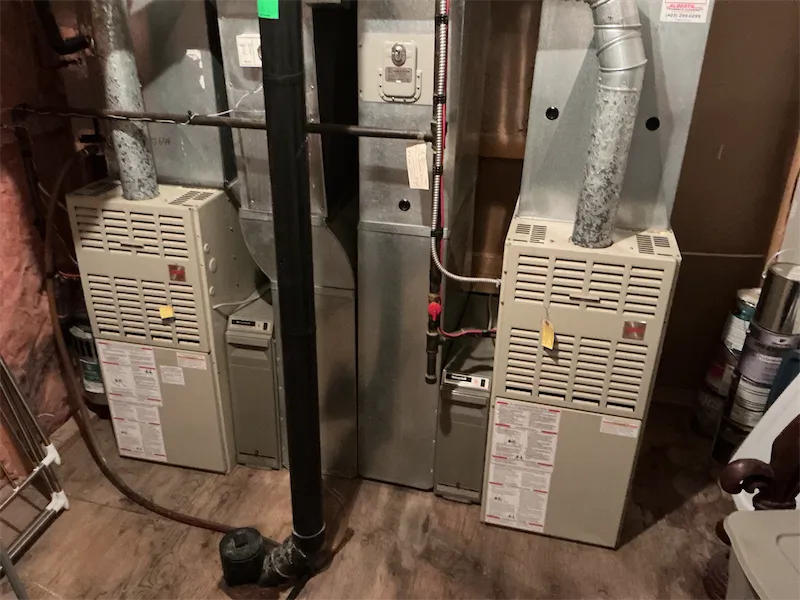
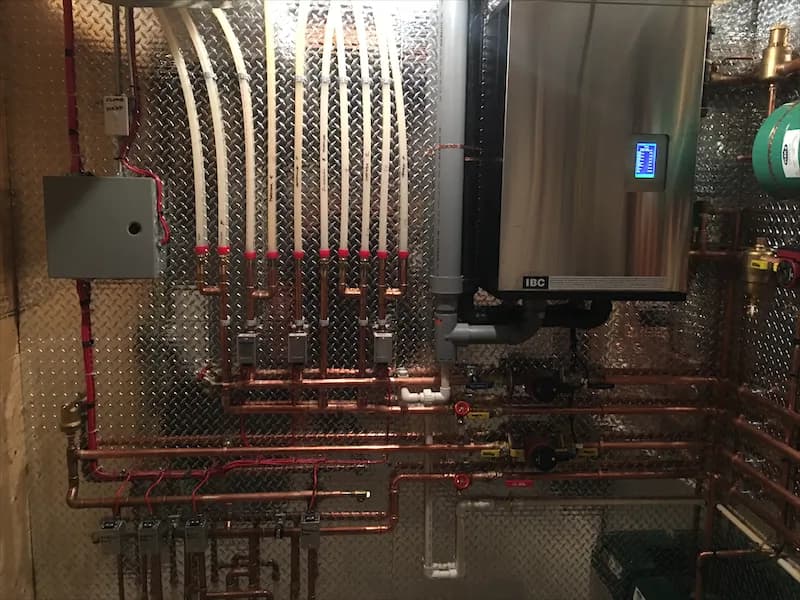
Boiler replacement cost in Calgary has less to do with the boiler than most people expect, and that's the reason this page has no price on it. It depends on how the new unit will vent, how much old piping can stay and what state your system water is in, and none of that shows up in a phone call. Quotes are free: we look at the boiler and the system behind it, then put a written price in front of you before anything is touched.
Below is what a quote should include and why each part moves the figure. Still deciding whether to replace? See our page on boiler replacement in Calgary and our article on how long boilers last in Calgary.
What the boiler replacement cost covers
Every line here should appear on the quote, or be clearly marked as excluded:
- Removing the old boiler
- The new boiler
- Vent and combustion-air piping
- A condensate drain, with a neutralizer where needed
- Near-boiler piping, circulator pumps, the expansion tank and air removal
- Controls: thermostats, zoning and outdoor reset
- Cleaning and flushing the existing system
- The gas connection and testing
- Permits and inspections: gas, and hydronic where the heating system is altered
- Commissioning: starting the boiler and setting the controls
- An indirect hot water tank, if one is part of the job
Electrical work and drywall or finish repairs vary from house to house; ask whether they're in the price.
Which boiler goes in
Condensing
A condensing boiler recovers extra heat by condensing water vapour out of its exhaust. Natural Resources Canada's Heating with Gas guide notes that it doesn't need a chimney: its flue gas is cool enough to vent through approved plastic pipe.
The guide says a condensing boiler can be rated at 90 percent AFUE or higher, but to get there the return water should be "preferably not exceeding 45° to 50°C (113° to 122°F)". Older hydronic systems were often designed to run hotter, and if the return stays too hot, NRCan says efficiency may be similar to a non-condensing boiler's. An outdoor reset control may help: it runs cooler water on mild days and saves the hottest for the coldest ones. In-floor heating normally runs at low return temperatures.
The efficiency floor has moved
That 2012 guide gives 82 percent as the legal minimum, and it's out of date. Under the federal Energy Efficiency Regulations, household gas boilers for hot water heating systems made on or after July 1, 2023 need an AFUE of at least 90 percent. Whatever goes in, the quote should name the model and give its AFUE.
Combi
A combi heats the house and makes hot water as you use it, so one appliance replaces both the boiler and the water heater. The limit is flow: the colder the incoming water, the less hot water it can deliver at once. Our combi boiler installation page covers which houses suit one.
Output
The old badge shows what someone chose when it went in, and the house may have changed since. We pick the new boiler's output for the house you have now: how well the walls and attic are insulated, what shape the windows are in, how draughty the place is, and the design temperature Calgary heating has to cover. Whoever quotes you, ask how they chose the output.
Venting, condensate and access
Weil-McLain's ECO Tec Series 3 boiler manual is one manufacturer's example; your installer should follow the manual for the model going in. It says the boiler "CANNOT use the existing common vent", needs "its own vent and air piping", and may use only venting materials the company approves. If the old boiler vented up a chimney, that means new pipes to the outside.
If a gas water heater shared that chimney, it's left on its own. The manual warns that existing common vents "may be too large for the appliances remaining connected after the existing boiler is removed." NRCan's guide, writing about furnace replacements, notes that a water heater still venting into the old chimney may need an approved metal liner. The quote should say what happens to yours: a liner, a new hot water tank, or moving your hot water onto the boiler.
Weil-McLain describes condensate as "slightly acidic (typically with a pH from 3.2 to 4.5)" and calls for a neutralizing filter when it drains into metal pipe and where local codes require one. It needs a route to a drain, sometimes through a condensate pump, and a line that can't freeze.
Access counts too: how far the boiler sits from an outside wall, and how the old unit gets out.
Near-boiler piping, pumps and controls
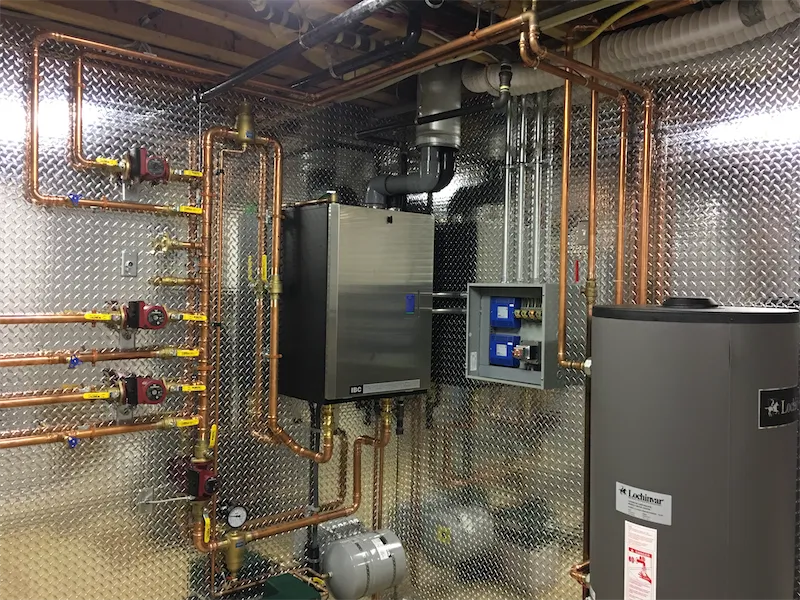
Piping laid out for the old boiler may stay or may need rebuilding. Requirements depend on the model: on the ECO Tec, Weil-McLain says "All COMBI boilers must be piped primary/secondary".
This part of the quote should cover:
- Circulator pumps and air separation, new or reused
- Zoning, and whether zones are added or changed
- The expansion tank, sized for your system's water volume. Weil-McLain warns an undersized tank loses water through the relief valve, and the excess make-up water that replaces it can eventually cause boiler failure.
- Controls, including thermostats and an outdoor reset sensor
An indirect tank for hot water
An indirect tank is a storage tank with no burner of its own; the boiler heats it as one more zone. That adds the tank, its piping and a control that decides whether the house or the tank gets heat first. It stores hot water ahead of time instead of heating it on demand, and it takes up floor space. If your water heater is also near the end, price a boiler paired with an indirect tank, a combi and a new standalone tank side by side.
The condition of the system you're keeping
The new boiler inherits whatever is in your old pipe. Weil-McLain's manual says to "clean and flush piping BEFORE connecting the new boiler", and warns that the heat exchanger "can be damaged by build-up or corrosion due to sediment." Radiators that are cold at the bottom often point to that kind of sludge.
- Glycol. The same manual says a system that has used glycol should be thoroughly cleaned and flushed before the new boiler goes in.
- Leaks. Every top-up brings in fresh, hard Calgary water. Weil-McLain says continual fresh make-up water will reduce boiler life, and that leaks must be repaired at once. If you have a boiler that's leaking water or a leak in the loop, get it on the quote.
And if your radiators can't heat the house at the lower temperatures a condensing boiler wants, the quote should say so.
Gas line and electrical
Weil-McLain's manual says to "Size gas lines large enough to provide gas to all connected appliances." A new boiler with a higher input than the old one may need a larger line. The gas work, including any new line, is done by our Alberta-licensed gas fitters.
The boiler, pumps and controls also need power; the ECO Tec manual lists a 120-volt supply as required, with a fused disconnect or service switch where applicable codes call for one. The quote should say what electrical work is needed and who's doing it.
Permit and inspection
The City of Calgary's plumbing and gas permits page says a gas permit is "Required for: installing, altering or adding to a gas system." The same page lists a hydronic permit as "Required for: installing, altering or adding to a hydronic heating system." Homeowners can apply for most permit types, but for a gas permit only if they're "an Alberta certified journeyman gasfitter". Inspections are booked through 311 or an online VISTA account.
On a FlameTech replacement, we take out the gas permit. We haven't listed permit fees because the City sets them and raises them every January 1. The quote should say which permits are included and who takes them out.
Removing the old boiler
The old boiler is drained, disconnected and taken out. A heavy cast-iron unit sometimes comes out in pieces when it won't fit up the stairs whole. NRCan suggests written quotes that include disposal of the old equipment, so ask whether yours does.
Cheaper jobs and dearer ones
What tends to keep it lower:
- Venting, gas line and piping that can be reused
- A clean system with no leaks
- A boiler that's easy to reach and remove
What tends to push it up:
- New venting to the outside, or an orphaned water heater
- A larger gas line
- Rebuilt piping or added zones
- A sludged system
- An indirect tank
- A heavy cast-iron boiler to remove
What a good boiler replacement quote shows
Whoever you get quotes from, us included, look for:
- Make, model, type and AFUE
- Output, and how it was chosen
- Vent route and materials
- What happens to the water heater
- Condensate drain and neutralizer
- Piping scope: reused or rebuilt
- Pumps, expansion tank, air removal and controls
- Indirect tank, if any
- System cleaning and flushing
- Gas line work
- Electrical work, and who does it
- Permits and inspections
- Removal and disposal
- Manufacturer's warranty terms, and the servicing they require, such as annual boiler service
Two quotes with the same total can cover different jobs, so compare them line by line. A quote that leaves out the flush or the vent work comes in lower because it covers less. To spread the cost, see Financeit monthly payments.
The short version
The boiler is one line on the quote. Venting, the water heater, piping, the old system, the gas line and the permits decide most of the rest.
To book a free quote, call 587-834-3668 or reach us through our contact page. On timing, call and we'll tell you honestly when we can get there.