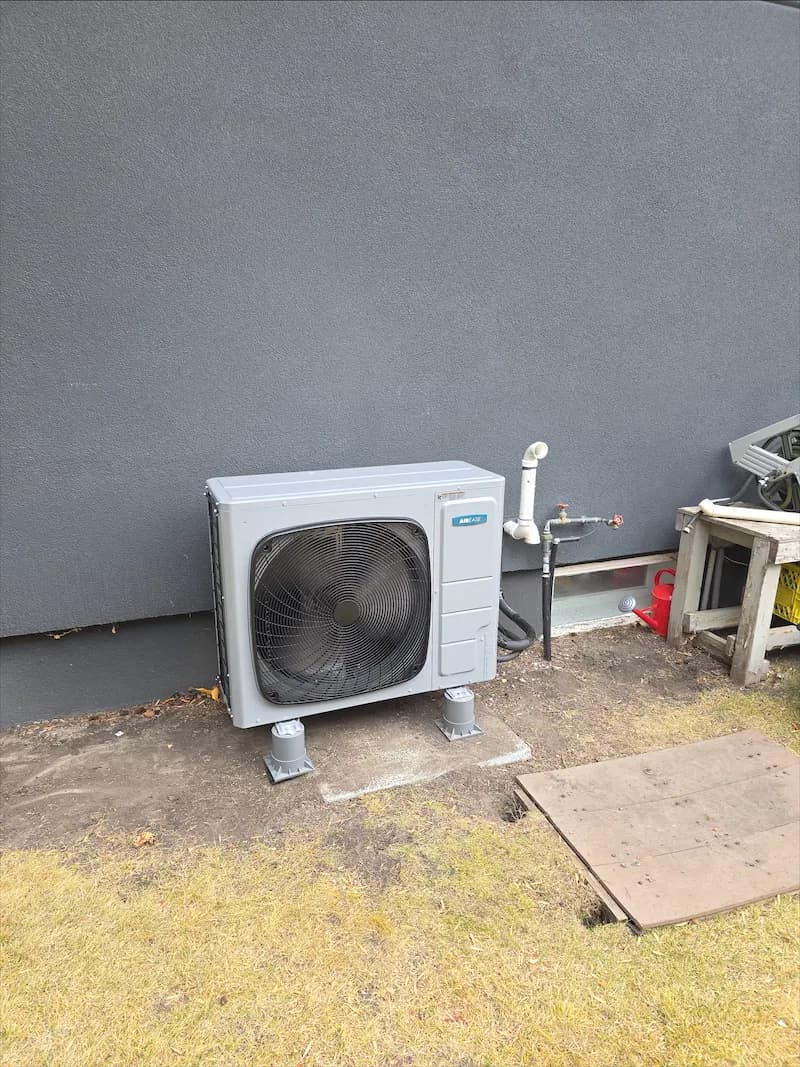
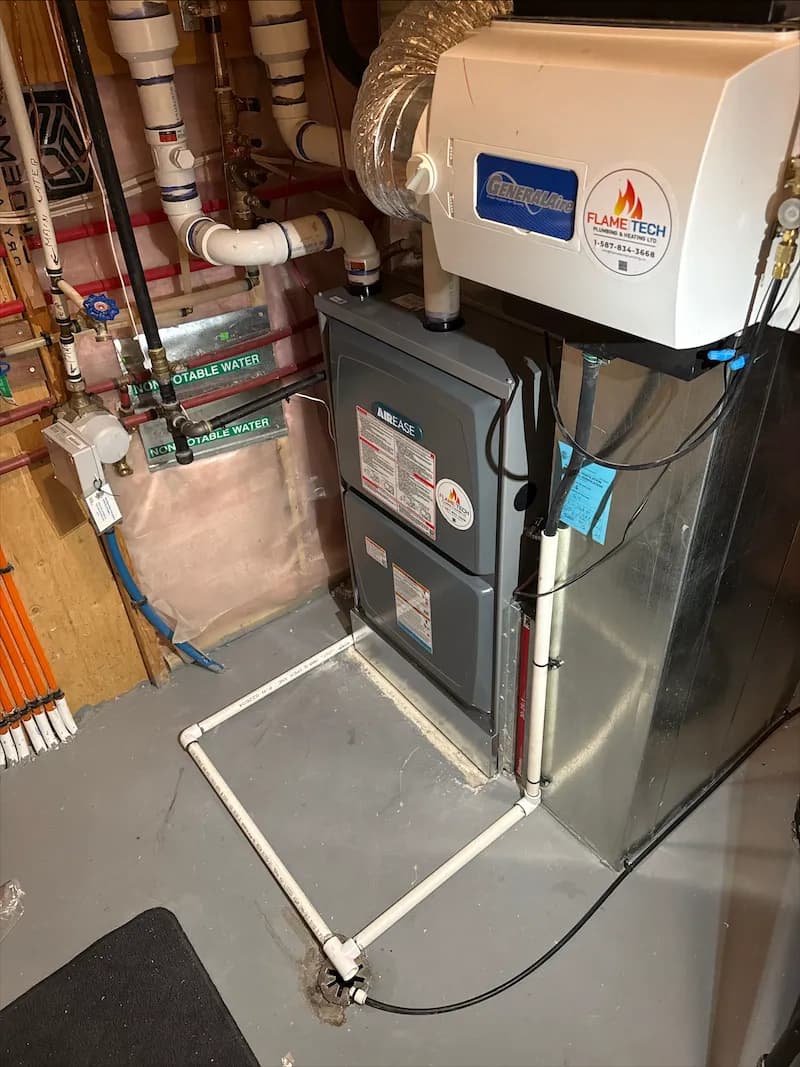
Five years ago, this article would have had one line: don't put a heat pump in Calgary, it'll freeze. The technology was built for Vancouver and Toronto, not -35°C.
That's no longer true. Cold-climate heat pumps from manufacturers like AirEase, Mitsubishi, and Daikin now operate down to -25°C with usable output, and -30°C with reduced capacity. We install them across Calgary and they work — when they're spec'd right and when the home is actually suited to one.
But "they work" isn't the same as "they're the right choice for your house." Here's what we've learned about which homes win with a heat pump and which ones don't.
Quick answer
If you're replacing a furnace and your home has been retrofitted with decent insulation, a hybrid system — heat pump for above -15°C, high-efficiency furnace for the cold-snap weeks — is probably your best move. It cuts gas use substantially across the year while keeping you comfortable through the worst of January.
If you're in an older, leaky home or you want the simplest possible system, a high-efficiency furnace alone is still the right answer.
If your current AC also needs replacing, the math tilts harder toward heat pump — you're getting cooling and heating in one box.
How each one actually works
A furnace burns natural gas to heat air, which a blower pushes through your ducts. Modern condensing furnaces hit 95-98% AFUE — almost every unit of gas energy becomes heat. Output is constant regardless of outdoor temperature.
A heat pump is an AC running in reverse. It moves heat from outside air into your house using electricity to run a compressor. Output drops as outdoor temperature drops because there's less heat in the air to grab. Modern cold-climate units stay productive down to -25°C, then fall off.
A hybrid (dual-fuel) system pairs a heat pump with a furnace and an outdoor temperature sensor. Above ~-15°C, the heat pump does the work. Below that, the furnace takes over automatically. You get the heat pump's efficiency at moderate temperatures and the furnace's brute force at design temp.
Operating cost
Calgary natural gas is cheap per unit of heat. Electricity is not. That one fact drives everything below, and it's why heat pump marketing written for Ontario or BC doesn't translate here.
For a typical 2,000 sq ft Calgary home with average insulation, ranked cheapest to run:
- Hybrid — the cheapest to operate, by a clear margin.
- Heat-pump-only (cold-climate, properly sized) — in the middle.
- Furnace-only — the most expensive to run, though not by as much as you'd expect, precisely because our gas is so cheap.
The hybrid wins because it runs the heat pump at mild temperatures — which is most of the heating season — and reserves the furnace for the 4-6 weeks when we dip below -15°C. That's the regime where a heat-pump-only system falls back on auxiliary resistance heat, which is the single most expensive way there is to heat a Calgary house.
What you'd actually pay depends on your gas and power rates, your insulation, and how you run the thermostat. We'd rather work that out against your real utility bills than publish an average that fits nobody.
Upfront cost
Ranked cheapest to most expensive:
- Furnace replacement (90% AFUE) — the baseline, and the cheapest way to keep a Calgary house warm.
- High-efficiency furnace (97-98% AFUE) — a step up in price that earns it back over a long heating season.
- Cold-climate heat pump (replaces your AC and supplements the furnace) — meaningfully more than a furnace, but it's doing two jobs, heating and cooling.
- Full hybrid system (new furnace + new heat pump) — the most expensive, and the worst case if you're replacing both at once.
If your existing furnace has 5+ years of life left, adding just a heat pump on top costs a good deal less than a full hybrid — you're only buying half the system.
We quote all of these on-site and in writing, at no charge. A number pulled off a web page is a number that changes the moment we've seen your ducts, your gas line, and your electrical panel.
Alberta rebates — what they actually do
Both federal Canada Greener Homes programs have now closed to new applicants — the interest-free Loan stopped taking applications on 1 October 2025 and the Grant closed on 20 January 2026. Anyone already approved keeps their funding. The one federal program still paying out is Oil to Heat Pump Affordability, and it only applies to homes moving off oil heat — which is rare in gas-heated Calgary.
Alberta's own provincial rebates have been thin for residential HVAC since 2022. Check efficiencyalberta.ca for current programs — they shift annually and we'd rather you see real numbers than us quote a stale rebate.
ENMAX, EPCOR, and Direct Energy occasionally run promotional rebates on heat pumps; check at quote time. Honest answer: assume zero rebate when running the math, then treat anything you do qualify for as a bonus.
When a heat pump is the right call
- Your house has decent insulation (post-2005 build, or retrofit with proper attic R-value, or air-sealing work done in the last decade)
- Your AC is also due for replacement — you get both functions in one unit
- Your current furnace is fine and you want to layer a heat pump on top (cheapest path to the efficiency gains)
- Long-term ownership — you'll be in the home 10+ years and the operating-cost savings compound
- You value lower carbon independent of cost
When a furnace is still the right call
- Older, leaky home with single-pane windows, minimal attic insulation, or pre-1970 envelope work. The heat pump will struggle in the deep cold and the furnace backup will do most of the work anyway.
- You're replacing a 20-year-old furnace and the AC is fine — a high-efficiency furnace on its own gets you most of the efficiency gain for much less money.
- You hate complexity. A furnace has one moving part: the blower. A heat pump system has more components, more sensors, more software. Both are reliable, but the furnace is simpler.
- You want the lowest upfront cost. A straight furnace replacement is the cheapest path to a warm house.
The Calgary-specific gotchas
Sizing matters more than brand. An oversized heat pump short-cycles, hurts efficiency, and feels uncomfortable. We always run a heat-loss calculation against Calgary's design temperature. Avoid any installer who quotes based on square footage alone.
Outdoor unit placement. Heat pump outdoor units need clearance, proper drainage for defrost cycles, and shouldn't sit under a roof-line that dumps snow on them. Sounds obvious; we see it ignored constantly.
The air feels cooler, and that's normal. A heat pump delivers air around 32–43°C against a furnace's 49–60°C, so it can warm the house while feeling neutral on your hand. It catches nearly everyone switching over — see heat pump not warming the house for what's normal and what isn't.
Ductwork. A heat pump moves more air at a lower delta-T than a furnace. Some older ductwork can't handle the airflow without whistling, hot/cold spots, or velocity issues. We assess this at quote time; ductwork upgrades aren't trivial.
Backup heat strategy. If you go heat-pump-only (no furnace backup), the system needs auxiliary electric resistance heat for the cold snaps. That's expensive to run and can pop a breaker on an older electrical panel. Hybrid avoids this entirely.
What we typically recommend in Calgary
For a typical 1990s-2010s Calgary home with existing furnace + AC that are both 10+ years old: hybrid system. New high-efficiency furnace + cold-climate heat pump. Best long-term economics, best comfort, and you get cooling.
For an older home with marginal insulation: high-efficiency furnace replacement first, optionally add a heat pump on top later if you're chasing further efficiency gains.
For a new build or major reno where you're already opening walls: mini-split heat pump in addition to or instead of central — zoning flexibility plus efficiency.
Get the right answer for your home
We don't sell from a script. Every heat-pump-vs-furnace quote we write starts with a heat-loss calc on your actual home, a check on your ductwork capacity, and an honest read on your insulation. Sometimes the answer is heat pump; sometimes it's a furnace; sometimes it's a hybrid.
Call 587-834-3668 or use the contact form for a free assessment. If financing matters, Financeit can spread either system into monthly payments.