Why is my boiler leaking water? Where the water first shows up usually tells you: condensate from a high-efficiency boiler, the relief valve's discharge pipe, a joint, fitting or valve on the heating piping, or corrosion. None of them should be left to drip. Weil-McLain's GV90+ user manual says to "Have leaks fixed at once by a qualified service technician," and Lochinvar's Knight user manual agrees they "must be repaired at once."
Stop the boiler and deal with the water first
Turn the heat down at the thermostat so the boiler stops firing. If water has reached the controls or any part has sat in water, leave it off. The IBC VX user manual and Lochinvar both say: "Do not use this boiler if any part has been under water." If reaching a switch means standing in water, don't.
Soak up the water and put a bucket under any drip. The City of Calgary's home maintenance guide is direct: "Get rid of standing water as soon as possible." Leave the casing on.
Two situations override all of this:
- You smell gas. Leave without touching light switches or using your phone inside. From somewhere safe, the City's gas leak page says to call the ATCO Gas emergency line, 1-800-511-3447, or 911.
- Your carbon monoxide alarm sounds. Get out, call 911, and wait outside for the fire department to say the house is safe.
Find where the water starts
Water pools at the low point, not the leak, so follow the trail back. A water heater or indirect tank next to the boiler can puddle underneath it; if the trail leads there, our leaking water heater page is the better fit.
Check overhead too. IBC warns against water from piping above the boiler, including "condensation dropping from un-insulated cold water lines overhead."
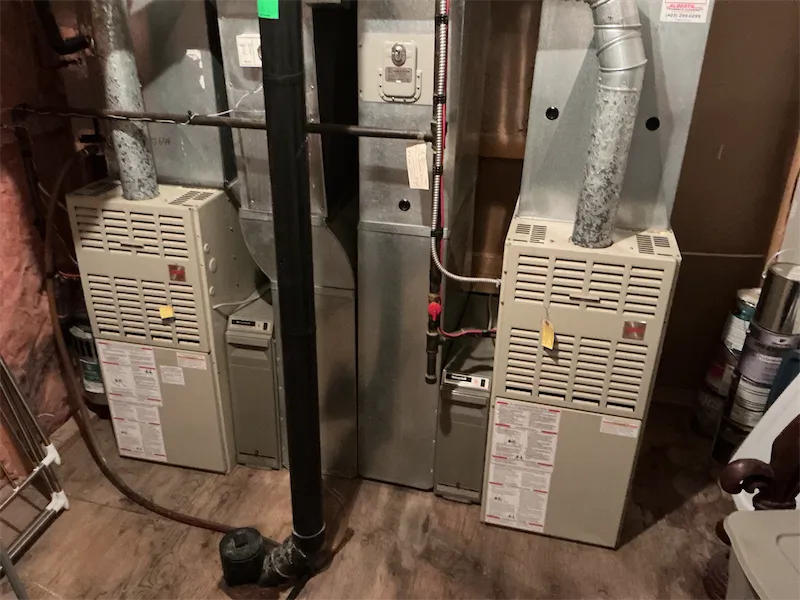
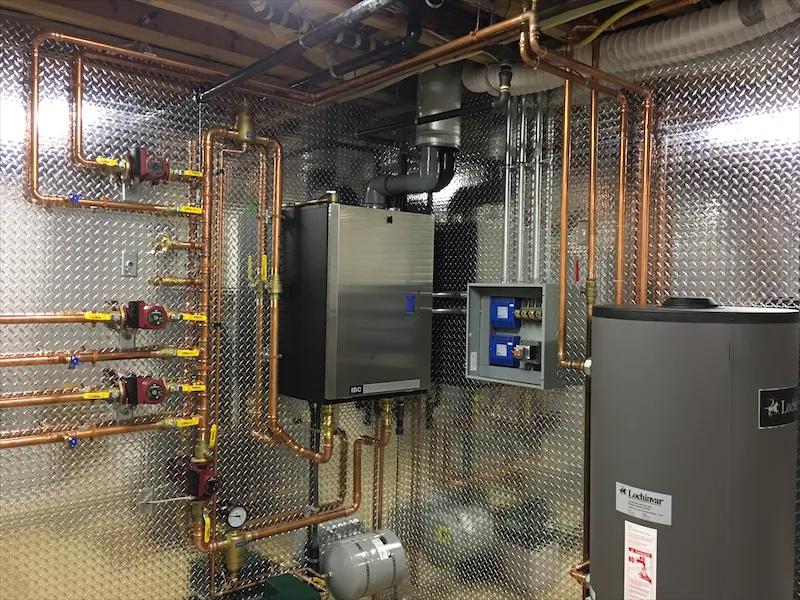
Then check the venting. Natural Resources Canada says condensing gas boilers can vent through approved plastic pipe instead of a chimney. Plastic vents usually mean a condensing boiler, which makes water as part of normal running. A metal flue usually means a conventional boiler, so condensate drainage is unlikely to be the source; look at the relief valve and the heating piping. If it turns out to be a forced-air furnace, see our furnace leak guide.
Condensate leaks on high-efficiency boilers
Why a condensing boiler makes water
NRCan says a condensing boiler pulls extra heat from its exhaust "by condensing some of the water vapour." That water drains through a trap and a plastic line, which ends at a floor drain or a condensate pump. Lochinvar says it is "slightly acidic (typically with a pH from 3 to 5)," and IBC notes it may pass through a neutralizer. Water around any of those means the drainage isn't keeping up.
A blocked or frozen condensate line
Lochinvar warns that if condensate freezes in the line, or the line is obstructed, "condensate can exit from the boiler tee, resulting in potential water damage to property." Its instruction is plain: "Do not expose condensate line to freezing temperatures."
The lines most likely to freeze in a deep Calgary cold are the ones that pass through an exterior wall, an unheated garage or a crawl space, so look for ice where yours leaves the house. A backed-up drain can also shut the boiler down, which why a boiler keeps turning off covers. Don't put a torch, heat gun or open flame on it. Expect a line that has frozen to do it again in a later cold spell unless its routing changes; see getting a boiler ready for winter.
Why a dry trap matters
The trap's water seal keeps exhaust out of the house. Weil-McLain warns that with a dry trap or a damaged or obstructed drain line "there is a risk of flue gas flow into the building," and the boiler "must not be operated" until a qualified service technician has serviced it. Don't open, refill or dismantle the trap. Keep the boiler off and call.
Water from the relief valve pipe
The relief valve usually has a pipe running down toward the floor. The Watts specification sheet for one common valve says it is "designed for emergency safety relief and shall not be used as an operating control," with the discharge line pitched down "to a safe place for disposal." That water can be hot, so keep your hands clear.
Water there means the valve opened or isn't sealing. Weil-McLain says, "If the relief valve often weeps, the expansion tank may not be working properly." Its troubleshooting table adds an undersized or flooded (waterlogged) expansion tank and an inoperative limit control. A technician will also check the fill valve and, where there's an indirect water heater, its coil.
Note the pressure gauge reading and compare it with your boiler's manual, not a figure from the internet. If the boiler has also lost heat or shows a fault, see boiler not working.
Never cap, plug or put a shut-off valve on the relief valve or the pipe it drains into. That's our instruction, with no exceptions: a blocked relief valve can't do its job. Technical Safety BC's report on a 2020 boiler explosion in a Langley townhome shows the stakes: "The pressure relief valve failed to relieve the excessive pressure, which resulted in an explosion."
Use the test lever only as your manual describes. IBC notes each test discharges system fluid that has to be replaced, so working the lever over and over to stop a drip isn't a fix. A valve that keeps weeping needs a technician to find out why.
Joints, fittings and valves
Otherwise, look along the heating piping: joints, unions, circulator flanges, valve stems and drain valves. Viessmann's leaking boiler guide suggests you "dab the area dry then wait to see if the water appears again."
That's where your part ends. Weil-McLain lists piping, circulators, the relief valve and other fittings as leak points for a qualified service technician to repair. Don't tighten anything or wrap tape around it.
Skip the stop-leak. Weil-McLain says, "Do not use petroleum-base stop-leak compounds," and Lochinvar warns against petroleum-based sealing compounds and "homemade cures."
Corrosion and the heat exchanger
Viessmann notes that "Corrosion can break the rubber seals around the joints of pipes," and that a leak "can be a sign that the heat exchanger is starting to decay," which can crack in some models. Widespread corrosion may mean replacing the boiler. Rust streaks, crusty fittings and staining under the cabinet are the visible signs.
Why a slow leak still matters
A hot water heating system is closed, so whatever leaks out is replaced with fresh make-up water. Lochinvar and Weil-McLain both say that water brings minerals that build up in the heat exchanger and oxygen that causes internal corrosion. IBC warns, "Repeated or uncontrolled water fills will increase the potential for damage," and Weil-McLain ties black water to "Oxygen corrosion due to leaks in boiler and piping." Left alone, a slow leak feeds the next one.
On older cast-iron boilers, Weil-McLain's cast-iron boiler manual lists "Condensation of combustion gases in boiler sections" as a cause of flueway corrosion (metal flakes in the vent), and has a technician check the piping and controls "to verify proper regulation of return water temperature." Water on an old cast-iron boiler isn't automatically a cracked section. If corrosion has spread, how long boilers last helps you weigh repair against replacement.
What not to do
- Don't block the relief valve outlet or its drain line with a cap, plug or valve.
- Don't keep working the relief valve lever to try to stop a drip.
- Don't remove the casing, jacket or front cover.
- Don't touch the gas valve, burner or gas piping.
- Don't add stop-leak or any sealer.
- Don't keep topping up the pressure without finding the leak.
- Don't run a boiler that has been under water.
- Don't put a torch, heat gun or open flame on a frozen condensate line.
Checks to run before calling
- Where exactly is the water: the condensate drain, the end of the relief pipe, a fitting, or dripping from above?
- Plastic vent pipes, or a metal flue?
- Does it only leak while the boiler is heating?
- What does the gauge read against the range in your manual?
- Any error code on the display?
- Any ice where the condensate line leaves the house?
- Is the dripping water hot?
- Any rust, staining or dark water?
When to call
If the water keeps coming back or you can't trace it, phone 587-834-3668 and describe what those checks showed. We price the repair before any work starts. Call and we'll tell you honestly when we can get there. We dispatch from both Calgary and Airdrie. Anything on the gas side goes to our Alberta-licensed gas fitters. See boiler repair for what a visit involves, or boiler repair in Airdrie north of the city.