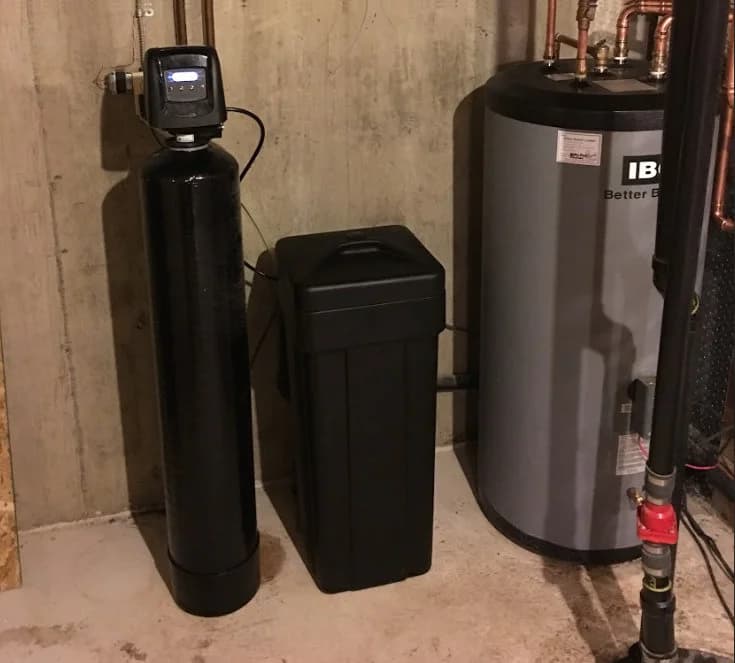
Most Calgary houses heat their water with a gas tank, so the gas vs electric water heater question usually comes up in one of three situations: the tank has just failed, you live in a condo or suite with no gas, or you're thinking about switching fuel on purpose. This post is about the fuel. If you're choosing between a tank and one of our gas tankless water heaters, our post on tankless vs tank water heaters covers that.
If your tank has stopped heating, it may not need replacing. A failed element, thermostat or gas control is often water heater repair work, and our guide on why your water heater is not working covers what to check first. A tank that leaks from the tank itself can't be repaired.
Gas vs electric in Calgary: the short version
If you already have gas and a vent that works, replacing like with like is usually the simplest job, and atmospheric gas tanks are the only tanks on our published price list. Atmospheric gas tanks are $1,950 for a 40-gallon, $2,100 for a 50, $2,450 for a 60 and $2,990 for a 75, installed, as of September 2026. Our post on hot water tank replacement cost in Calgary breaks them down.
Electric fits where there's no gas, or where venting to outside isn't practical. Electric tanks are quoted on site because the job depends on what's already in place.
Switching fuel either way is a bigger job than a swap.
How each one heats water
A gas tank has a burner underneath and a flue up the centre that carries combustion gases out through a vent. It needs a gas supply that can carry the load and a way to vent: atmospheric (natural draft up a B-vent or chimney), power vent (a fan pushes exhaust out, usually through a side wall) or direct vent (combustion air drawn from outside, exhaust out through the wall).
An electric tank heats with elements that sit in the water. Nothing burns, so there's no flue and no vent. It does need a dedicated 240V circuit from the panel.
Our hot water tank options page covers the tank types.
Recovery: how fast the hot water comes back
Recovery is how quickly a tank reheats after you've used some of it. As a rule, a gas tank recovers faster than an electric tank of the same size, which is why electric tanks are often sized up to cover the slower reheat.
When comparing models, check the first-hour rating on the manufacturer's spec sheet: how much hot water the tank delivers in an hour starting full. It says more about a busy morning than the gallon size.
Both types slow down in winter, when colder incoming water has further to go to reach temperature.
Venting and where the tank can go
A gas tank needs a way to get exhaust outside, and that decides where it sits. An atmospheric tank has to be near a chimney or B-vent. Power-vent and direct-vent tanks have more freedom but need a route through an outside wall, so we quote those on site.
An electric tank has no vent, so it can go in an interior closet, a suite's utility room or a condo where a new vent isn't allowed.
In many houses the gas water heater shares a chimney with the furnace. If the water heater comes off that chimney (going electric, or moving to a power vent), the furnace's venting needs checking by a gas fitter, because a vent built for two appliances can be too big to draft properly for one.
The electrical side of an electric tank
An electric tank needs its own 240V circuit and room in the panel for it.
New wiring needs a permit. The City of Calgary says an electrical permit is required for all new wiring installations (City of Calgary trades permits). Whoever quotes your electric tank should list the electrical scope on the quote and name who will do it.
Running costs: how to compare them honestly
Which tank is cheaper to run depends on what you pay for electricity and natural gas, and both rates change. Your own bills show what you pay for each, and the Utilities Consumer Advocate's understanding rates page links to explanations of rate riders and rate classes, and to historical electricity and natural gas rates.
Then compare specific models on the rated efficiency on their spec sheets. Both kinds of tank keep water hot around the clock, and Natural Resources Canada notes that a storage tank uses energy even when no one is using hot water. NRCan puts water heating at 19.3% of the energy used in the average Canadian household, second only to home heating (NRCan guide to residential water heaters).
Heat pump water heaters
A heat pump water heater is an electric tank that pulls heat from the surrounding air into the water. NRCan says an ENERGY STAR certified model uses up to 50% less energy, on average, than a standard electric water heater. It also says they're less beneficial in winter when space heating is needed, and can be very cost effective in mild climates.
Switching fuel: what a conversion involves
Electric to gas
The tank needs a gas line run to it and sized for the load, plus a vent route to outside. The gas work needs a permit: the City says all plumbing and gas installations require permits (City of Calgary plumbing and gas permits), and homeowners can't take out a gas permit on their own house unless they're a certified journeyman gas fitter themselves. The gas line, vent and permit are done by our Alberta-licensed gas fitters as part of a water heater installation. The old 240V circuit should be made safe by an electrician. Expect it to take longer than a like-for-like swap.
Gas to electric
A gas fitter caps the gas supply to the old tank; that's not a homeowner job. A new 240V circuit goes in under an electrical permit. The old vent opening has to be dealt with, and any gas appliance that shared the vent needs its venting checked so it still works on its own.
Permits either way
The City of Calgary lists three changes that can bring a water heater job under a permit: the gas lines upstream of the water heater's shut-off valve, the venting system, and the type of water heater (City of Calgary trades permits). A fuel switch touches at least one of those, so the permit should be a line on your quote. Our post on hot water tank replacement cost in Calgary lists the current permit fees.
Calgary specifics
Hard water. The City's 2025 figures put hardness at 141 to 200 mg/L from the Bearspaw plant (most of north Calgary) and 181 to 274 mg/L from Glenmore (most of the south) (City of Calgary water hardness data). Sediment settles on the bottom of a gas tank, right above the burner, and scale builds on electric elements. A water softener slows both down.
Condos and townhouses. Many buildings restrict gas appliances and new wall openings, and some units have no gas. Check your bylaws before planning a switch to gas or a new vent.
Power outages. An atmospheric gas tank with a standing pilot generally keeps heating when the power is out. A power-vent tank needs power for its fan and an electric tank needs power for everything, so both stop. Gas tanks vary, so check the manual for your model.
When gas makes sense
- You already have gas and a working vent, so a like-for-like tank replacement is the straightforward job.
- You use a lot of hot water in a short window and want faster recovery.
- You'd like hot water through a power outage, and your chosen model supports it.
- Your panel has no room for another 240V circuit.
When electric makes sense
- There's no gas to the unit, common in condos and some suites.
- The only workable spot is an interior closet or somewhere a vent can't reach.
- Building rules don't allow a new gas line or a new wall opening.
- Running a gas line and vent would cost more than your hot water use justifies.
Getting a quote for your house
The right choice depends on your gas line, vent, panel and hot water use. Our Red Seal journeyman plumbers and Alberta-licensed gas fitters will check each of those and give you a free quote in writing, priced before any work starts, with any electrical work and who's doing it named on the quote. Call 587-834-3668 or use our contact form, and we'll tell you honestly when we can get there.