We get this question almost every week, usually from a homeowner whose tank just failed at the worst possible time. The pitch for tankless is everywhere — endless hot water, lower bills, longer lifespan, smaller footprint. All of that can be true. None of it is automatic.
What changes the calculation in Calgary specifically is our water. The mineral load on the East side of the city in particular runs hard enough to chew through a tankless heat exchanger years before it should. (If you already own one and it is misbehaving, tankless water heater repair covers the error codes and what scale does to an exchanger.) Combine that with -35°C winters that put inlet water temperatures around 4°C, and the numbers most manufacturers quote stop applying.
Here's what we actually see in the field.
The short version
If you're replacing a failed tank and need hot water tomorrow, a direct tank replacement is almost always faster, cheaper, and lower risk. The swap itself is a few hours of work once we're booked in.
If you're renovating, finishing a basement, building, or your current tank is over 8 years old and limping, tankless deserves a serious look — but only with the right install (proper gas line sizing, condensate drain, annual descale).
The rest of this article is the detailed why.
What you're actually choosing between
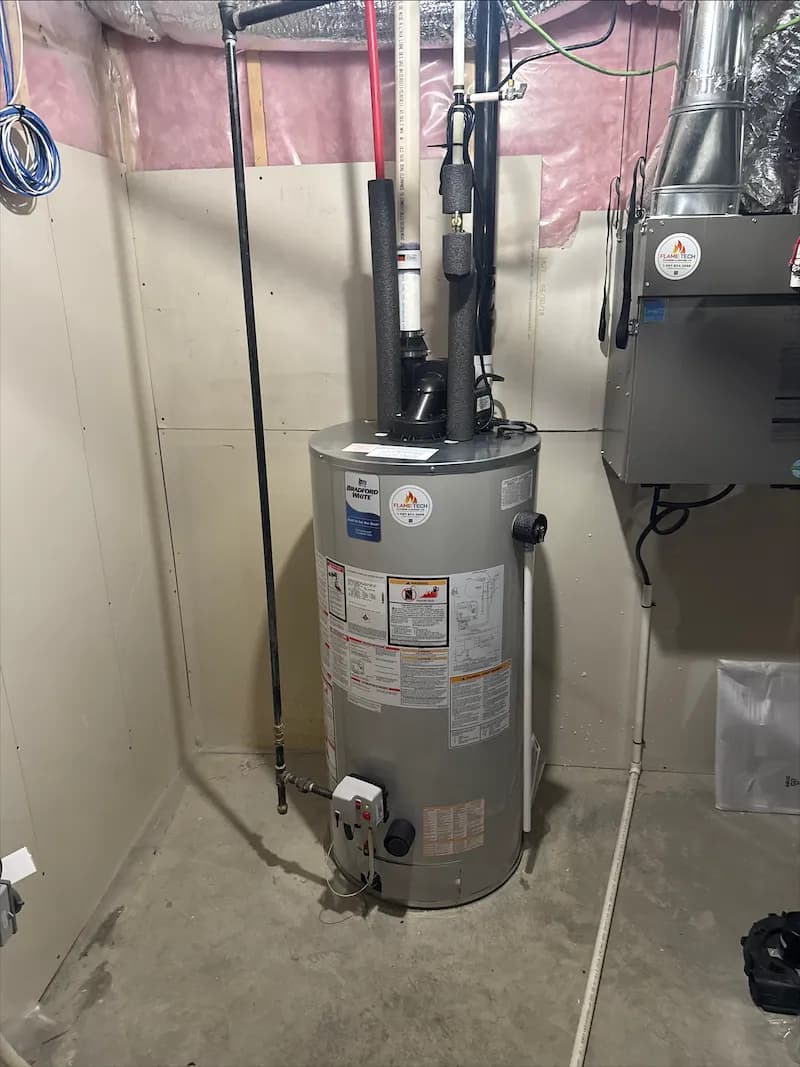
A conventional tank heats 40-75 gallons of water and keeps it hot 24/7. When you open a tap, you're drawing from that reserve. When it runs out, you wait 30-60 minutes for it to recover.
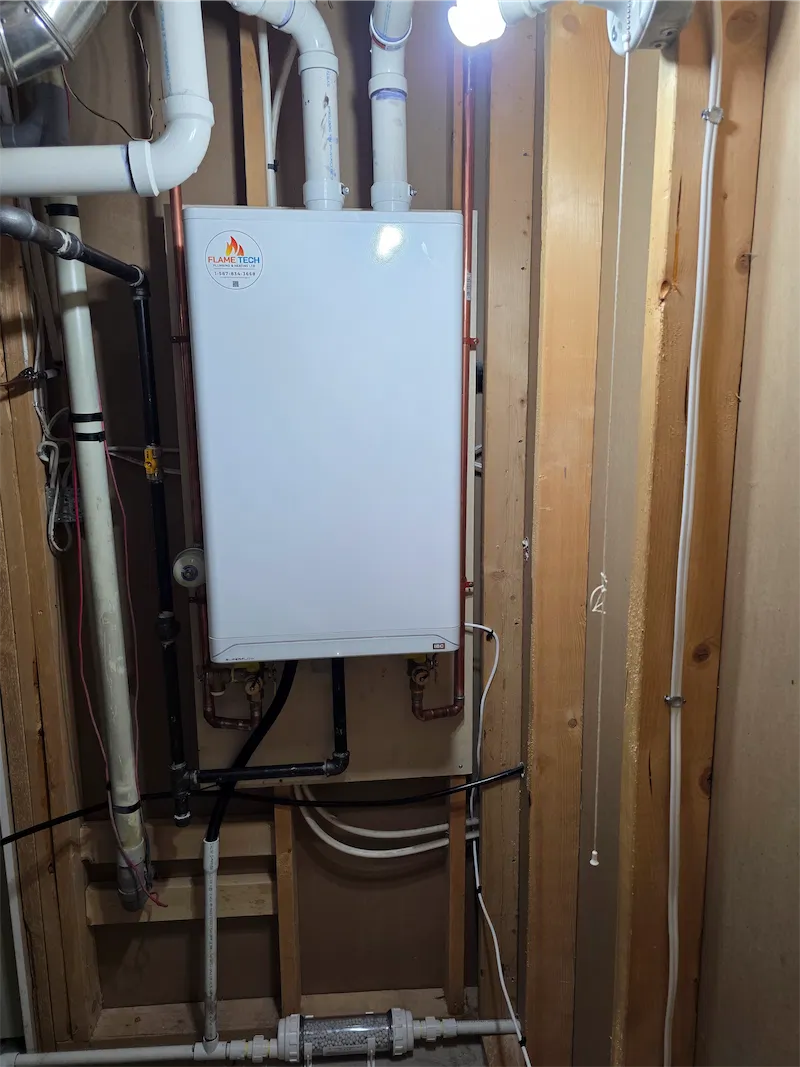
A tankless (sometimes called on-demand) heats water as you use it, by firing a powerful burner across a heat exchanger. No reserve, no recovery time — as long as gas and water keep flowing, hot water keeps flowing.
That's the architectural difference. Everything else is consequence.
Upfront cost
Tankless costs roughly three times what a tank does to install. That's the honest headline, and for most Calgary homeowners it's the number that decides this.
Our current pricing: a 40-gallon gas tank is $1,950 installed and a 50-gallon is $2,100, against $5,400 to $6,500 for a tankless. Full breakdown by size in hot water tank replacement cost in Calgary.
A tank install is the cheaper job — the unit, removal of the old tank, and labour, with a permit only where the venting or gas line changes. A tankless install costs more at every line: the unit itself is pricier, a gas-line upgrade is usually required (a tankless needs roughly 3x the gas flow of a tank), and the venting plus condensate drain add labour on top.
We quote both in writing, on-site, so you can see the two side by side against your actual house rather than against an average. What moves a tankless quote inside its range — gas line, venting, condensate — is broken down in tankless water heater cost in Calgary.
Operating cost
Manufacturer literature claims 25-40% energy savings for tankless. In Calgary, real-world data we collect from customers who switch puts it closer to 15-25% on the gas bill. The gap comes from cold inlet water in winter: when the supply enters at 4°C instead of 15°C, the tankless has to work harder per gallon, eating into the efficiency advantage.
The gas savings on a typical Calgary household are real but modest — and at that rate it takes about a decade to pay back the install premium on operating savings alone.
Lifespan
This is where the conventional wisdom gets the most confused.
- Tank lifespan in Calgary: 8-12 years on average. Hard-water sediment builds up at the bottom, the anode rod gets eaten, the tank starts leaking. Annual flushing and anode replacement can stretch it to 15.
- Tankless lifespan in Calgary: 15-20 years with proper maintenance. Without annual descaling, the heat exchanger scales up and fails in 6-9 years.
That "with proper maintenance" qualifier is the catch. If you don't budget for an annual descale, tankless lifespan in Calgary is roughly the same as a tank's. Most failed tankless units we replace died from skipped maintenance, not from age.
Capacity — the part most people misjudge
A 50-gallon tank handles two showers, a load of laundry, and a dishwasher running simultaneously. That's its design point.
A tankless rated at 199,000 BTU (a typical residential size) can sustain about 7-8 gallons per minute of hot water at Calgary's winter inlet temperature. That's also two showers plus dishwasher — but it does it indefinitely, not for 45 minutes before going cold.
If your household genuinely runs out of hot water mid-shower with your current tank, tankless helps. If your tank covers your usage fine, you're paying for a benefit you don't need.
The Calgary-specific issues we see
Hard water is the killer of both. East-side Calgary water runs 240-300 mg/L hardness. Anode rods in tanks die in 4-5 years instead of 8. Tankless heat exchangers scale up in 18 months without descaling. A water softener install ahead of either system stretches both lifespans dramatically — it's often the single best investment you can make in your water-heating setup.
Cold inlet water hurts tankless harder. A tank that's already storing 60°C water doesn't care that the supply is 4°C. A tankless has to heat that 4°C water in real time. Sizing tankless for Calgary means going one capacity tier up from what the same unit would need in Vancouver.
Gas-line upgrades catch people out. Most pre-2010 Calgary homes have a 1/2" gas line to the water heater. A 199K BTU tankless needs 3/4" minimum, often 1". That's a real installation cost, not a sales-pitch detail.
Condensate drains need freeze protection. A condensing tankless dumps acidic condensate that needs to drain somewhere it won't freeze. In a Calgary garage install, that's a real engineering problem.
When tankless makes sense
- You're renovating or building, so the gas-line and venting work is happening anyway.
- Your current tank is 10+ years old and you're planning long-term.
- Your household genuinely outgrows a 60-gallon tank (large family, frequent guests, multi-head showers).
- You're motivated by space — tankless mounts on a wall and frees up 4 sq ft.
- You'll actually book the annual descale.
When tank makes sense
- Your tank just failed and you need hot water back as soon as possible.
- Your hot-water bill isn't a meaningful line item.
- You don't want to think about your water heater for 10 years.
- Your current setup handles your usage fine.
- You'd rather put the money you'd save on the install premium into a water softener and a quality tank with the Bradford White lifetime warranty option.
What we usually recommend
Honestly? For about 70% of Calgary homes, a quality 50- or 60-gallon Bradford White tank with a water softener upstream beats tankless on total cost of ownership over 12 years. The maintenance discipline tankless requires is real, and not everyone follows through on it.
For the other 30% — bigger households, renovations, basement finishes, or homeowners who genuinely value the endless-hot-water experience — tankless is worth the premium if the install is done right.
The wrong tankless install is worse than the right tank. We've replaced more "tankless that failed in 6 years" than we've ever replaced "tank that failed in under 8."
Next step
If you'd like an honest scope on your specific home — gas-line capacity, venting feasibility, water-hardness test, real numbers for your usage — give us a call at 587-834-3668 or use the contact form. Free written quote either way, no pressure to go tankless if a tank is the better answer for you.