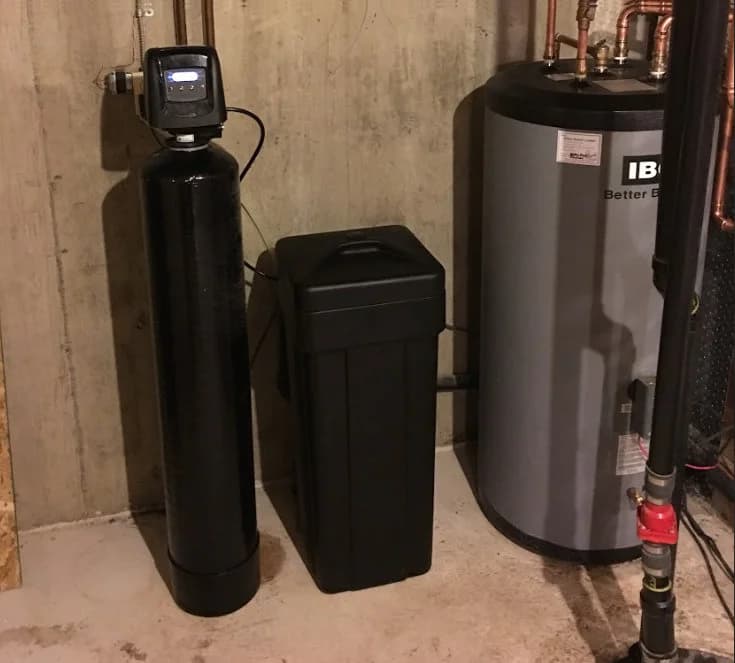
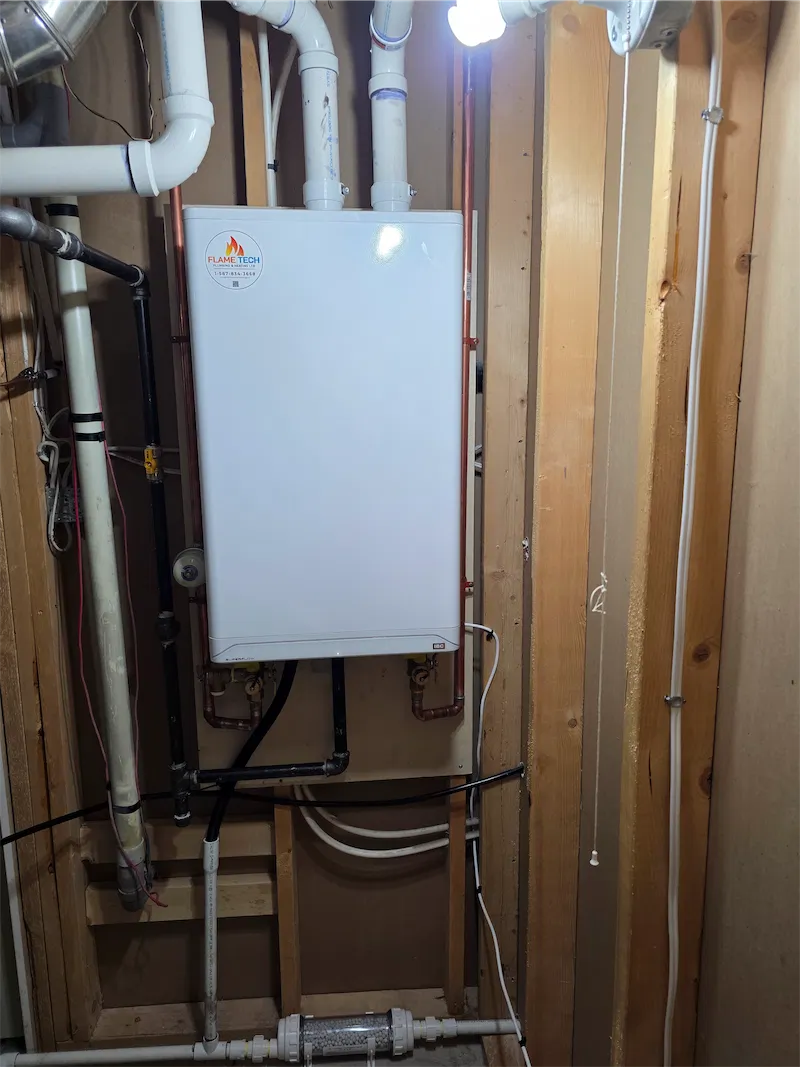
A standard gas hot water tank replacement in Calgary runs $1,950 to $2,990 installed as of September 2026, depending on size. Most homes are at the bottom of that.
Unlike a lot of plumbing work, this one has real prices rather than a range with a shrug attached. A like-for-like tank swap is a known job: the same venting, the same gas line, the same location, a few hours of labour. We can tell you the number before we arrive.
Here's what we charge, what changes it, and what to check on any other quote you're holding.
The short version
Installed price for an atmospheric (natural draft) gas tank — the most common setup in Calgary homes:
| Tank size | Installed |
|---|---|
| 40 gallon | $1,950 |
| 50 gallon | $2,100 |
| 60 gallon | $2,450 |
| 75 gallon | $2,990 |
A typical Calgary bungalow or two-storey is a 40 or 50 gallon tank, so $1,950 or $2,100. Removal and disposal of the old tank is included. You get the price in writing before we start.
Worth noticing the gap between the first two rows. Going from 40 to 50 gallons is $150 — the tank costs a bit more, and the labour is identical. If your household has grown since the last tank went in, or you've been running out of hot water when two showers overlap, the upsize is the cheapest fix available to you. Most of the cost of this job is the install, not the steel.
The other configurations:
| Configuration | Installed |
|---|---|
| Power vent | Quoted on site |
| Direct vent | Quoted on site |
| Electric | Quoted on site |
| Tank to tankless conversion | $5,400 to $6,500 |
Those three sit on a quote rather than a price list because they aren't one job. A power vent needs a power supply at the tank and a different vent route; a direct vent needs a wall penetration; an electric swap depends entirely on what's already at the panel. We price those after looking, not before.
What moves the price
Size. Covered above. It's the smallest swing factor of the lot.
Venting type, if it's changing. A like-for-like atmospheric swap reuses the existing B-vent and chimney. Moving to a power vent or direct vent means new vent pipe, a new route through a wall or rim joist, and on a power vent, electrical. This is the single biggest add on a tank job and it's the one people don't see coming.
Code upgrades the old install never had. Tanks installed twenty years ago were installed to the code of twenty years ago. The common catch-ups:
- Thermal expansion tank — required where there's a backflow preventer or pressure-reducing valve on the service, which covers a lot of Calgary homes. If yours doesn't have one, this is the most frequent add.
- Drain pan and drain line where the tank sits over finished space.
- Gas line or shut-off correction where the existing one doesn't meet current requirements or is undersized for a higher-input tank.
- Seismic or securing straps where the install calls for them.
Disposal. The old tank has to leave. That's in our price; check whether it's in the one you're comparing.
Access. A tank in an open mechanical room with a clear path to the door is a straightforward swap. A tank behind a furnace in a crawlspace, up a tight stairwell, or boxed into a finished closet adds labour. A 75-gallon tank is a two-person carry before anything else happens.
The line most quotes leave out
The permit.
Not every tank replacement needs one, and plenty of Calgary companies handle this by not mentioning it. Here's the actual rule. The City of Calgary requires a permit when the work changes:
- the gas lines upstream from the water heater shut-off valve
- the venting system, meaning its size or design
- the type of water heater — switching a natural draft tank to a direct vent, for example
Read that third line again, because it catches people. A straight like-for-like swap of an atmospheric tank for another atmospheric tank generally doesn't trigger a permit. The moment you upgrade to a power vent or direct vent, it does. The venting change and the type change both apply.
On what it costs: Calgary's 2026 trade permit for plumbing and gas is a $112 processing fee plus $9.79 per $1,000 of construction value, with a Safety Codes Council levy of 4% on top, and a minimum total of $116.50. On a tank replacement that lands in the low hundreds, not the four hundreds some quotes imply. A homeowner pulling their own plumbing permit pays a flat $112 plus the $4.50 levy — $116.50 — though a homeowner can't pull a gas permit at all unless they're a certified gasfitter, which is most of why this work goes to a contractor.
We pull the permit where the work needs one and it's on the quote as a line you can read. If another quote for a power vent conversion has no permit line anywhere, that's worth a question before you sign. Either it's buried, or it isn't being pulled.
Brands
We default to Bradford White and we'll explain why in a second. John Wood is the other brand we rate, and we install AO Smith and Rheem as well. All four are real tanks. The differences that actually matter to you are warranty, parts, and where you can buy them.
Bradford White. Built in Middleville, Michigan. The standard residential gas tank — the 50-gallon atmospheric, 40,000 BTU, the one that goes into most Calgary basements — carries a 6-year tank and 6-year parts warranty. It has the Hydrojet sediment-reducing inlet, which matters more here than it does in a soft-water city, and the Defender flammable-vapour system with the ScreenLok arrestor. The thing worth knowing as a buyer: Bradford White sells only through wholesale distributors to licensed installers. You cannot buy one at a big-box store or on Amazon. That's deliberate on their part, and it means every Bradford White tank in Calgary was put in by someone in the trade.
John Wood. Same warranty structure in the base line — 6-year tank and 6-year parts on the standard models, with 8/8 available on specific models, plus something genuinely useful that almost nobody mentions: 2-year and 4-year tank warranty extension kits you can buy for the 6-year models. If you're staying in the house a while, ask about it at install rather than in year seven.
One correction on John Wood, because you'll read the opposite on half the plumbing sites in Canada. John Wood is frequently sold as the Canadian-made option, built in Fergus, Ontario. That hasn't been true since June 2013, when A.O. Smith — which bought the GSW brands in 2006 — ended manufacturing in Fergus and consolidated production into other North American plants. Fergus is still the Canadian head office and a regional distribution centre, and that distribution presence is a real advantage for parts. But if a quote tells you you're buying Canadian-built, that's a sales line, not a fact.
The warranty fine print that applies to both. Manufacturer tank warranties run to the original purchaser, in the home where the tank was first installed, and they are not transferable. Sell the house and the warranty does not go to the buyer. That has nothing to do with who installed it — it's how the manufacturers write it.
What to avoid. Builder-grade units from big-box retail. Weaker warranties, and in our water they tend to give up at five or six years where a trade-grade tank gets eight to twelve.
There's a fuller head-to-head in John Wood vs Bradford White if you're deciding between those two specifically.
Tank or tankless, over twelve years
The honest comparison isn't the sticker price, it's what you spend over the life of the decision. We won't put invented energy numbers in a table, so here's what we can stand behind:
| Gas tank | Tankless | |
|---|---|---|
| Installed today | $1,950 to $2,100 | $5,400 to $6,500 |
| Expected life in unsoftened Calgary water | 8 to 10 years | 15 to 20 years if descaled annually |
| Replacements inside 12 years | Usually one | None |
| Annual service it actually needs | Flush, anode check | Descale, non-negotiable here |
The twelve-year window is the interesting one, because an unsoftened Calgary tank bought today will probably want replacing inside it. That narrows the real gap considerably — though not to zero, and a tankless that skips its annual descale in this water will not see fifteen years.
The full version of that argument, including the part about capacity that people misjudge, is in tankless vs tank water heaters in Calgary. What goes into a tankless install price is in tankless water heater cost in Calgary. And if you already own a tankless that's throwing codes, that's tankless water heater repair instead.
Repair or replace
Worth getting a repair quote first when the tank is under eight years old and the failure is a component — thermocouple, gas valve, element, thermostat. Those are real repairs on a tank with life left.
Replace it when:
- It's leaking from the body of the tank. Not a fitting, not the T&P valve, not the drain — the tank itself. There is no repair for a rusted-through tank, and anyone offering one is wasting your money. More on what to look at in leaking water heater.
- It's past ten years and needs a repair of any size. You'd be spending real money on a tank that's statistically done in this water.
- The hot water runs rusty and the cold doesn't. That's the tank lining gone and the steel corroding.
- You're on your second significant repair in a couple of years.
The annoying middle case is a tank at eight or nine years with a $400 repair. Our read: if it's the only thing wrong and you're not planning to move, fix it. If the anode's never been touched and the tank's full of sediment, you're buying a few months.
Calgary specifics
Hard water is the reason tanks don't hit their rated life here. City data puts hardness in the north around 126 to 198 mg/L and in the south and southeast around 181 to 262 mg/L. A tank rated for 12 to 15 years commonly gives up at 8 to 10 in unsoftened Calgary water. The sacrificial anode rod that's meant to last 5 to 7 years is frequently gone in 3 to 4.
Two things follow from that, and they're the highest-value paragraph on this page:
- A water softener upstream is the single biggest lever on how long your next tank lasts. It is not an upsell on a tank quote; it's the difference between replacing this tank once and replacing it twice.
- Get the anode rod checked every three or four years. A rod is a fraction of a tank. Nobody does this, and it's why so many Calgary tanks fail early.
Basement venting. Older inner-city homes on a shared masonry chimney need that chimney assessed before a new tank goes on it, particularly if the furnace has already been swapped to a high-efficiency unit venting out the side wall. An orphaned tank on an oversized chimney is a draft problem, and it's a safety issue rather than an efficiency one.
Lead time. 40 and 50 gallon tanks are the common sizes and the easiest to get hold of. A 60 or 75 gallon, or a power vent, can take longer to source. Either way, we'll give you a realistic install date when you call rather than a promise we can't keep.
Financing
A tank usually fails without asking whether it's a good week for it. Financeit monthly payments are available with a soft credit check, which is worth knowing if the timing isn't yours.
Questions we get
Does a bigger tank cost much more to run? Barely, on a modern tank. Standby loss on a well-insulated 50 is close enough to a 40 that it shouldn't drive the decision. Size for your peak demand — concurrent showers, a soaker tub — not for the energy label.
Is a power vent worth the extra? If your chimney situation forces it, or the furnace change orphaned the tank, yes, because it's not really optional. If you have a sound chimney and a working atmospheric setup, the payback on switching for efficiency alone is long. We'll tell you which of those you're in.
How long does the swap take? Three to four hours for a standard like-for-like. Power vent and direct vent conversions take longer because of the venting and electrical.
Do I need a permit for a straight tank swap? Generally no, if the venting, the type of heater, and the gas line upstream of the shut-off all stay the same. Yes if any of those three change. See the permit section above for the current fees.
Will a new tank fix my hard water? No. It'll be quieter for a while because the sediment's gone. The water is the same water, and the new tank will go the same way as the old one unless something upstream changes.
Does my manufacturer warranty cover the labour? No. A tank warranty covers the tank and its parts. Getting the failed unit out and the replacement in is labour, and that's separate. It's a common and unpleasant surprise in year five.
The short version, again
$1,950 for a 40-gallon, $2,100 for a 50-gallon, installed, disposal included. $2,450 and $2,990 for a 60 and 75. The upsize from 40 to 50 is $150 and it's usually the right call. A permit applies when venting, heater type, or the upstream gas line changes — not on a straight swap. And a softener upstream does more for your next tank than any brand decision you make today.
If you want a firm number for your house, we'll confirm what you've got and put it in writing at no charge. Call 587-834-3668 or see hot water tank replacement in Calgary for what the job involves.