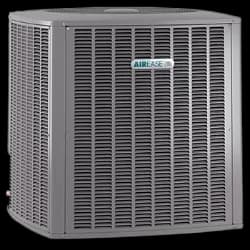
If you're after one number for AC installation cost in Calgary, we don't publish one. There's no central-air figure on our price list, because the outdoor unit is only part of the job. The rest depends on what the house already has: a furnace that can take a cooling coil, ducts that can move the air, a panel that can take one more circuit, and a sensible place outside for the unit. Below is what moves the price, how the size should be decided, and what a written quote ought to show. Airdrie homeowners can read it the same way; the local page is air conditioning in Airdrie.
Why we don't publish an AC price
A published range only helps if most jobs land inside it. With central air, the work around the unit varies too much between houses for that, so we price each one after seeing it. The quote is free, written and itemized, and you have it before any work starts.
For comparison, here are prices we do publish. They date from September 2026 and apply in both Calgary and Airdrie:
- Ductless mini split: $3,500 to $5,000 installed. See mini split AC in Calgary.
- Ducted heat pump: $6,200 to $8,800 installed.
- Furnace replacement: $4,500 to $9,600 installed. The furnace replacement cost guide covers where a given house lands in that span.
None of these is an AC price. They're listed so you can see what the neighbouring options cost.
What sets the price
First-time AC or a replacement
Adding central air to a house that has never had it means a new evaporator coil on the furnace, a new line set out to the condenser, a new electrical circuit, and a pad or stand outside. Replacing an existing system can be simpler. The coil is normally changed with the condenser so the two are a matched pair. Whether the old line set can stay depends on its size and condition and on what the new equipment's manufacturer allows, and that's decided on site.
Ducts and the furnace blower
Central air pushes its cooled air through the furnace blower and the existing ductwork. Cooling often needs more airflow than heating, so ducts that heat the house well can still come up short in July. The usual weak spot is the return side: too few or too small returns, so the blower can't pull enough air back across the coil. The blower also has to deliver the airflow the new coil is rated for. If either falls short, the fix might be a bigger return or other duct changes, and that goes on the quote.
Electrical: circuit, disconnect and panel room
An air conditioner needs its own circuit from the panel and a disconnect beside the outdoor unit. That part is standard. The question is the panel: it needs a free space for the breaker and enough spare capacity for the compressor alongside everything else running on a hot afternoon. Any panel work is written into the quote before work starts.
Line-set route and outdoor unit placement
The line set is the pair of copper lines carrying refrigerant between the coil and the condenser. A short run through an unfinished basement wall is the easy case. A long run, or one that crosses finished ceilings and walls, takes more time and material.
Placement matters as much as the route. The unit should sit level, raised clear of the snow, with room around it for airflow and service, and away from bedroom windows, yours and the neighbours'. A compressor is easy to hear through an open window on a summer night.
Efficiency and staging
Air conditioners carry two efficiency ratings, now labelled SEER2 and EER2: the first covers a whole cooling season, the second a single fixed hot-weather condition. Natural Resources Canada's guide to air conditioning your home explains the original SEER and EER measures they replace. Higher ratings cost more, and Calgary needs cooling for only a few months a year, so weigh what a higher rating would actually save you.
A single-stage unit is either on at full output or off. Two-stage and variable-speed units spend most of their time at lower output, which is quieter and gives longer, steadier cycles that remove more moisture. They cost more, and they need a compatible thermostat and furnace blower. Some variable-speed systems need the manufacturer's own thermostat.
Permits and City placement rules
The City of Calgary's heating and cooling page says AC equipment needs one or more types of permit, and its AC unit permit checklist says an electrical permit is always required. The City also limits placement: a unit may project only 1.0 m into a side setback, and a location that doesn't comply needs a development permit for a relaxation. On a narrow lot, that rule can decide where the unit goes, and with it how long the line set runs. Airdrie sets its own permit rules.
Sizing: why the old unit's label isn't the answer
Matching the new unit to the size on the old one assumes the old one was right and the house hasn't changed. Windows get replaced, attics get insulation, basements get finished. NRCan's advice is not to rely on rules of thumb. We size the unit to this house today. That means looking at insulation levels, window quality, how leaky the house is and the design temperature here; the badge on the old condenser doesn't come into it.
Oversizing is the easier mistake to make, because bigger feels safer. An oversized unit cools the air fast and shuts off before it has run long enough to pull moisture out. It short-cycles, and the house ends up cool but clammy. NRCan makes the same point: an oversized unit won't dehumidify properly. If that sounds like your house, see why an AC feels humid. An undersized unit runs flat out through the hottest afternoons and still falls behind.
Commissioning: what happens after it's installed
Commissioning is the set of checks that confirm a new unit runs the way the manufacturer designed it to:
- Refrigerant charge checked by the manufacturer's method for that unit, allowing for the line-set length
- A full cooling cycle run, with the temperature drop across the coil and the airflow checked
- Thermostat setup, including staging and fan settings where the equipment has them
- Condensate drainage confirmed, so water from the coil goes to the drain
- Warranty registration, which manufacturers usually require within a set time after installation for the full parts warranty
Deadlines and terms vary by brand and model. AirEase, for example, has a warranty registration page; check the requirements for your exact unit.
AC, heat pump or mini split
- Central AC cools only. The furnace keeps doing the heating.
- A ducted heat pump sits where an air conditioner would and cools the same way, but it also heats, with the furnace handling the coldest weather. NRCan notes that a heat pump costs more up front than central air alone. See heat pump cost in Calgary.
- A ductless mini split suits one room or zone, or a house without ducts.
If you're adding cooling to a ducted house anyway, price both central AC and a heat pump. Whether the heating side pays for itself comes down to what you pay for gas versus electricity; see heat pump vs furnace and heat pump installation in Calgary.
What makes an install simpler, and what adds work
These keep an install simpler:
- A furnace blower and return ducts that already handle cooling airflow
- Free breaker space and spare capacity on the panel
- A reusable line set, or a short run to a compliant outdoor spot
- A thermostat that already works with the new equipment
These add work:
- Panel work for the new circuit
- A larger return or other duct changes
- A long line-set run behind finished walls or ceilings
- An outdoor spot that needs a relaxation
- Two-stage or variable-speed equipment and a matching thermostat
What a good AC quote shows
Hold any quote against this list, ours included:
- Make and model of the condenser and coil, plus the AHRI matched-system number, which confirms the rated efficiency applies to that exact pairing
- How the size was decided. If the answer is the old unit's label or the floor area, ask why.
- Electrical work: the new circuit, the disconnect, and anything the panel needs
- Where the outdoor unit sits (up off the snow, away from bedroom windows) and how the line set gets to it
- The thermostat
- Condensate drainage from the coil
- Permits: which ones, and who takes them out
- Removal of the old unit, if there is one
- The manufacturer warranty, its conditions, and who handles registration
We're an authorized AirEase dealer. If two quotes are thousands apart, check what each one includes before looking at the bottom line.
Questions we get
Can I get a price over the phone? Not a firm one. We'd need to look at the furnace, the ducts, the panel and where the outdoor unit would go. Quotes are free.
How long does an install take? Often a day or two. A replacement reusing the line set sits at the shorter end; panel work, duct changes or a long line-set run push it longer.
Should I repair my old AC or replace it? That depends on the part. A capacitor, contactor or fan motor is usually worth fixing. A dead compressor or a leaking coil on an ageing system is a bigger decision, so get a price for the repair and a price for a new unit, and weigh the two. Our AC repair page covers that, and signs of air conditioner problems helps you narrow down what's wrong.
The short version
Air conditioner installation cost in Calgary depends more on the house than on the unit. Match the size to the house, not the label on the old unit, pay for efficiency or staging only where it earns its keep, and make sure the quote covers commissioning and registration. Financeit monthly payments are an option if the timing is tight.
Quotes are free and written. Call 587-834-3668 and we'll tell you honestly when we can get there, or read about AC installation in Calgary.