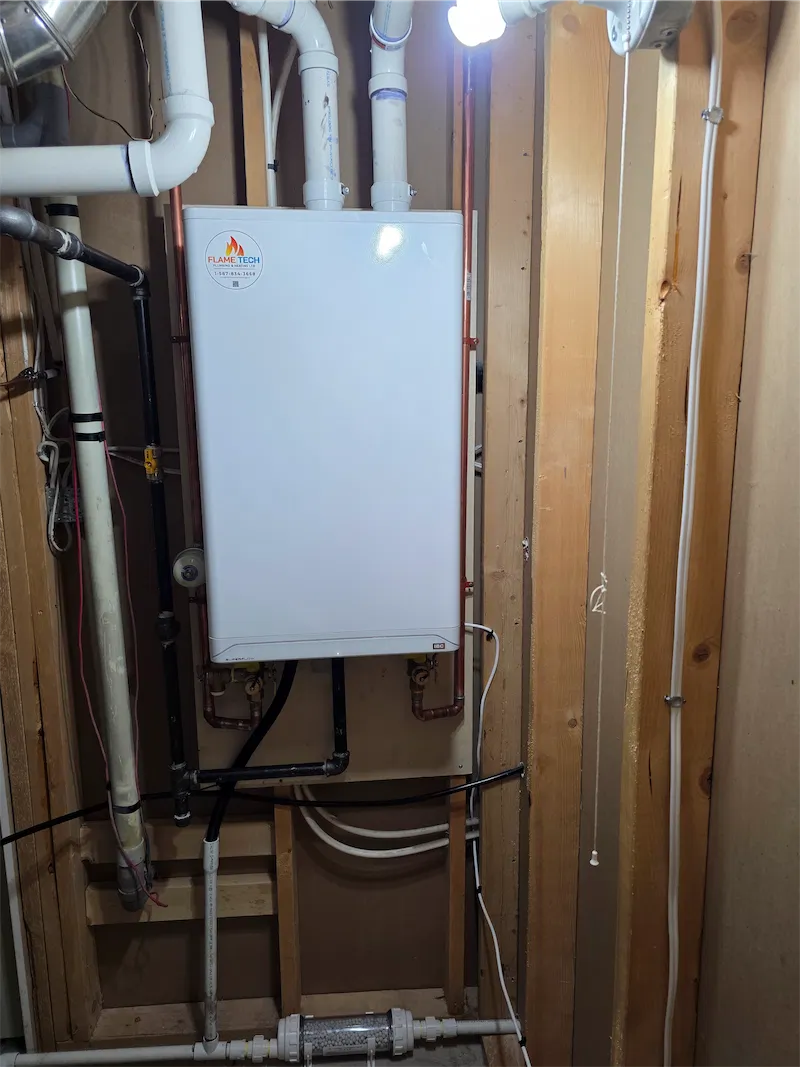
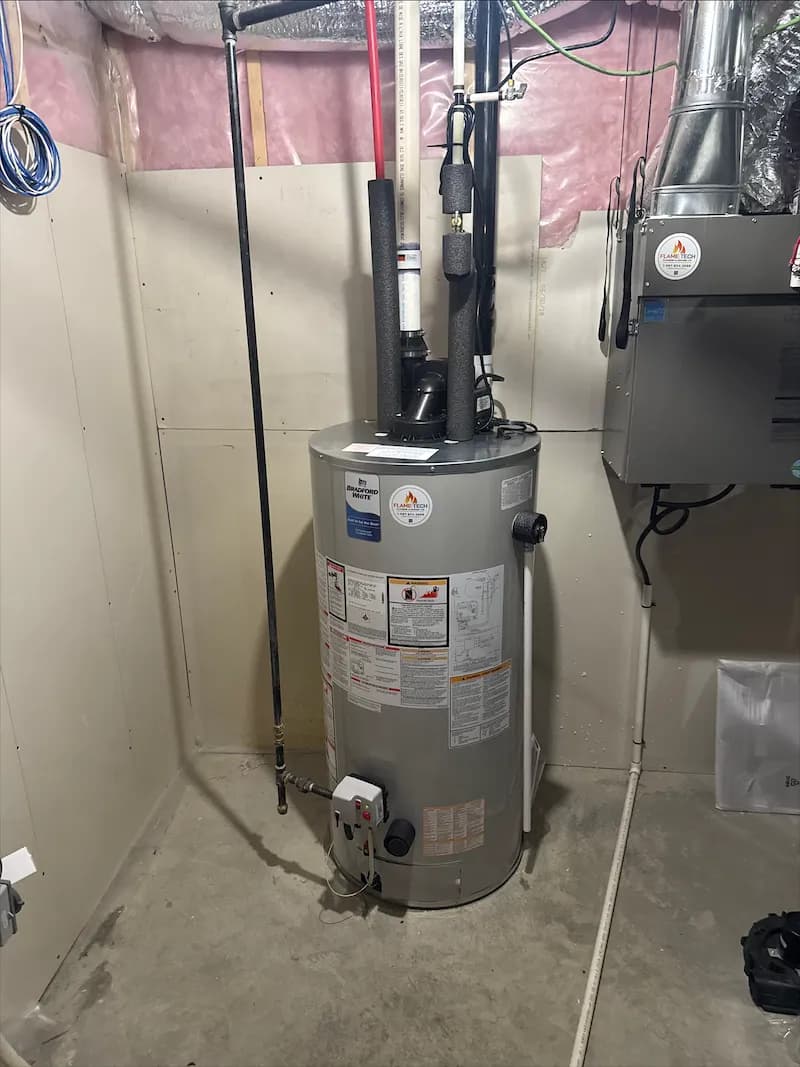
The water softener vs reverse osmosis question gets asked as if they were two versions of the same thing. They are not. A softener deals with hardness, the calcium and magnesium that leave scale on everything, and it treats every tap in the house. A reverse osmosis (RO) system filters the water you drink and cook with, and it normally serves one tap at the kitchen sink. If your problem is crusty fixtures and a water heater full of scale, you want a softener. If your problem is how the water tastes in a glass, you want RO. Plenty of Calgary and Airdrie homes end up with both.
What a water softener does
A softener is a resin tank, a brine tank and a control valve. As water passes through the resin, the beads hold on to calcium and magnesium and release sodium in their place, or potassium if you use potassium chloride instead of salt. That swap is called ion exchange. When the resin is loaded up, the unit regenerates: it rinses the beads with brine, flushes the hardness minerals to drain, and starts again.
It goes on the main water line where the supply comes into the house, so everything downstream gets softened water: showers, laundry, the dishwasher and the water heater itself. What you notice is less white crust on taps and glass shower doors, fewer spots on dishes, soap and shampoo that lather properly, and less scale building up inside the tank or tankless heater where you can't see it.
A softener is not a drinking-water filter. It is built to take out hardness, not to change how the water tastes. For the full picture, see what a water softener actually removes. And if someone has offered you a "softening" shower head as a shortcut, here is why that isn't the same thing.
What a reverse osmosis system does
RO is point-of-use filtration. The system sits under the kitchen sink, usually with its own small faucet beside the main one, and pushes water through a very fine membrane along with a set of pre- and post-filters. What comes out is the water you drink, cook with and make coffee from.
Health Canada notes that reverse osmosis systems remove minerals like calcium and magnesium from drinking water, and adds that in Canada, water is a minor source of those minerals compared with food. So the water from an RO faucet is low in hardness as well as filtered, but only at that faucet. The shower, the washing machine and the water heater see exactly the same hard water as before.
What else a particular RO system reduces depends on the model. Check that unit's certification and its performance data sheet, which lists what it was actually tested against.
RO also sends part of the water it processes to the drain while it filters. How much depends on the system, and the spec sheet is the place to find that number.
Side by side
| Water softener | Reverse osmosis | |
|---|---|---|
| What it treats | Hardness (calcium and magnesium) | Drinking and cooking water |
| Where it goes | On the main supply line | Usually under the kitchen sink |
| Which taps | Every tap in the house | Usually one dedicated faucet |
| What you notice | Less scale, better lather, cleaner fixtures | How the water tastes |
| Upkeep | Salt top-ups and servicing, per the model's manual | Filter and membrane changes, per the model's manual |
| Installed price | $2,250–$3,050 | $780–$1,440 |
Those are our installed price ranges as of September 2026, the same in Calgary and Airdrie. Quotes are free, and we price the job before any work starts.
If you already own a softener, how long water softeners last covers what wears out, and how often a water softener should regenerate explains how to tell whether yours is behaving.
Calgary's water: what the City's numbers say
Calgary's water comes from two rivers. According to the City, most of the north side is supplied with Bow River water treated at the Bearspaw plant, while the south side draws mainly on the Elbow River, treated at Glenmore. The City publishes hardness for both, in mg/L as calcium carbonate. Its 2025 ranges:
- Bearspaw (north): 151–200 from January to March, 141–192 from April to June, 151–177 from July to September, and 168–197 from October to December.
- Glenmore (south): 208–274 from January to March, 181–245 from April to June, 191–216 from July to September, and 213–248 from October to December.
The City says hardness usually dips during the spring snowmelt and peaks between December and February, and it describes Calgary's water as hard because of the calcium and magnesium in the Bow and Elbow. The figures are on the City of Calgary's water quality and hardness page.
The same page is clear that there are no known health effects from the calcium and magnesium in Calgary's tap water. Hardness is a scale and soap problem, not a safety problem, and it is the problem a softener is built to solve. Nothing in those numbers says Calgary's tap water is unsafe to drink. For most households on city water, RO is about taste and preference.
Which one do you need?
Choose a softener if…
- You are scraping white scale off taps, shower heads and glass doors.
- Glasses and dishes come out of the dishwasher spotted.
- Soap, shampoo and laundry detergent don't lather well.
- You want to keep scale out of your water heater, especially a tankless unit, whose heat exchanger doesn't tolerate it well.
That is water softener installation: one unit on the main line, sized to your water and how much of it the household uses.
Choose reverse osmosis if…
- Your main complaint is the taste of the water from the kitchen tap.
- You are buying bottled water or filling jugs for drinking and cooking.
- You want filtered water at one point of use without treating the whole house.
That is a reverse osmosis system, installed at the kitchen sink.
When it makes sense to have both
The two do different jobs, so they don't compete. The usual arrangement is the softener on the main line and the RO unit under the kitchen sink, fed from the softened supply. Two things are worth knowing about that combination.
Sodium. The City of Calgary notes that conventional water softeners that use salt may not be suitable for people on sodium-reduced diets. If that applies to anyone in your household, talk to your doctor before you decide how to treat your water, and check any drinking-water system's performance data sheet for what it is actually tested to reduce.
The membrane. Hard water can scale an RO membrane. With a softener ahead of it, the RO system isn't also fighting the calcium and magnesium the softener already dealt with. That is why, when a house has both, the softener usually goes first in line.
Before you buy either
- Look for certification on the exact model. Health Canada strongly recommends that anyone buying a drinking water treatment device choose one certified as meeting the applicable ANSI/NSF standard. Its questions and answers on treatment devices lists standard 44 for cation exchange water softeners and standard 58 for reverse osmosis drinking water systems. Look for the certification mark on the unit you are buying, not just the brand, and remember that manufacturers can make claims that fall outside those standards.
- Follow the manufacturer's maintenance instructions. Health Canada reminds owners to carefully follow the maintenance instructions included with the device. The right schedule depends on the model and your water, not a general rule.
- Test the water rather than guess. Hardness changes with the season and with which side of the city you are on. Know what you are treating before you spend money on it.
- On a private well, start somewhere else. Well water can carry problems city water doesn't, and the treatment plan is different. See well water treatment.
Next step
We install water softeners and reverse osmosis systems across Calgary, and Airdrie homeowners can start with water softener installation in Airdrie. If you know which one you need, or you suspect it's both, call 587-834-3668 or get in touch for a free quote.