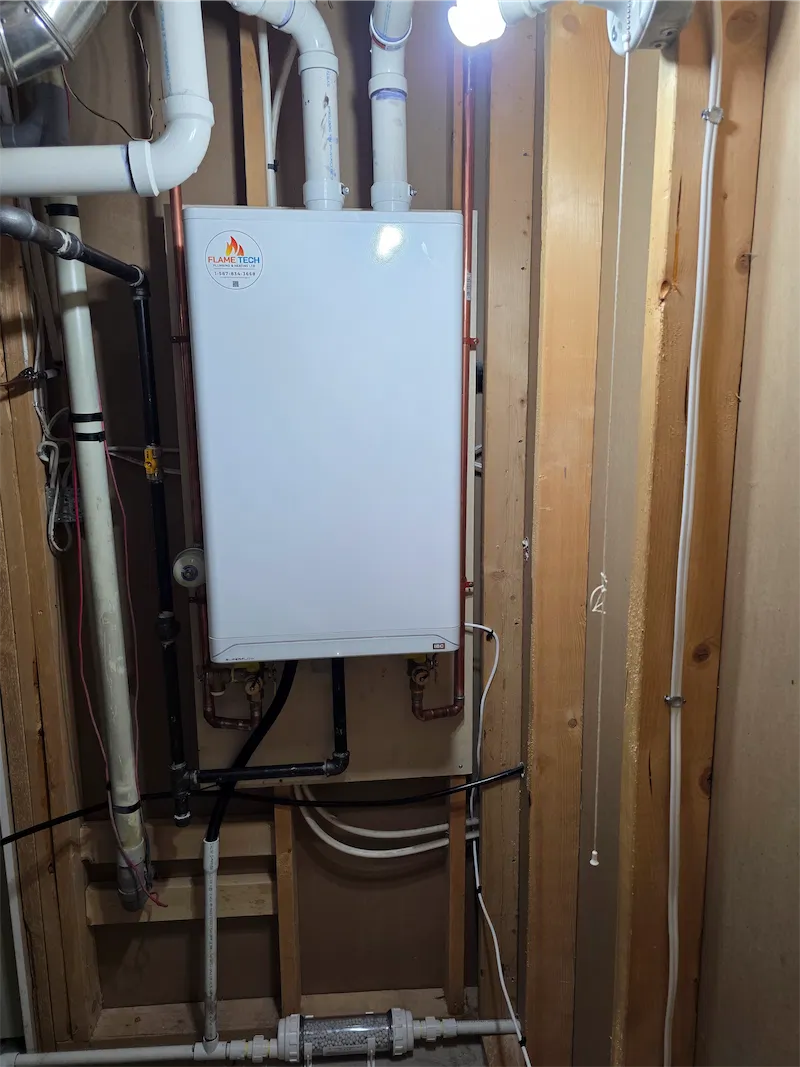
Tankless water heater maintenance in Calgary is mostly about scale. The City of Calgary's water hardness data shows the city's tap water is hard. As that water runs through a tankless, the minerals build up as scale on the heat exchanger, the part that heats water as it flows through. How often that needs dealing with isn't a number anyone can give you for every house. It comes from the manual for your unit and from the water it runs on.
What Calgary's hard water does inside a tankless heater
Hardness is dissolved calcium and magnesium, according to the City. Every litre of hot water a tankless makes passes through its heat exchanger, and heat is what drives those minerals out of the water and onto the metal.
Navien's page on descaling says scale reduces a heater's efficiency, flow and performance, and can damage the heat exchanger. The manual for Rinnai's N-Series adds that scale builds faster at higher temperature settings. The same manual sets a total hardness limit of up to 200 mg/L and says hard water "must be treated and may require a more frequent flushing schedule."
That's one manual for one product line. Other models list different limits or none, which is why your heater's model number matters.
North and south Calgary aren't the same water
Calgary has two treatment plants drawing from two rivers. The City's 2025 figures, in mg/L as calcium carbonate:
- North Calgary, served by the Bearspaw plant on the Bow River: 141 to 200
- South Calgary, served by the Glenmore plant, mostly from the Elbow River: 181 to 274
That works out to roughly 8 to 16 grains per gallon (1 grain per gallon is 17.1 mg/L). Hardness runs lowest during spring snowmelt and highest from December to February.
Much of the south Calgary range sits above the 200 mg/L in that Rinnai manual. Your model may list a different limit, but the water-quality section of its manual is worth reading rather than assuming.
Signs a tankless is scaling up
Navien's descaling page lists what scale costs you: flow, efficiency and performance. In plain terms, the hot water at the tap is weaker than it was, or the heater isn't keeping up like it used to. Some heaters will also flag an overheating code, covered below.
None of those proves scale on its own. A blocked inlet filter can cut flow too.
Error codes that point to scale
Codes vary by brand and model. These are examples from manufacturer documents, not a complete list:
- Rinnai LC (LC0 to LC9). Rinnai's diagnostic code sheet ties these to scale buildup in the heat exchanger. Newer models lock out when the code appears.
- Rinnai 14. Heat exchanger overheat. The N-Series manual says to check for scale.
- Rinnai SS. A "service soon" indicator that the installer sets.
- Navien E016. Heat exchanger overheating. The Navien NPE-2 user's manual gives the remedy as cleaning the inlet filter and flushing the heat exchanger.
- Navien E760. A flushing or service alarm. The manual's instruction is to "contact the installer."
If a code keeps coming back, have the heater looked at properly. To find out what's behind it, see tankless water heater repair. It may or may not turn out to be scale.
How often does tankless water heater maintenance need doing?
The manufacturers set the baseline, and it's worded as a minimum:
- Navien's descaling page says descale at least once a year, and more often with higher mineral content, a higher temperature setting or heavy use. Navien's maintenance tips also say the schedule depends partly on water hardness.
- The Rinnai FAQ says to flush at least once a year.
- The Rinnai N-Series manual says the heater should be "inspected annually by a licensed professional."
On units with a service indicator, the installer can set it to suit the water the heater runs on.
Once a year is the floor these manufacturers publish, not a promise that it's enough in hard water. The manual for your unit, read alongside the City's figures for your side of town, sets your schedule.
What professional maintenance involves
Across the Navien and Rinnai documents, the maintenance they describe includes:
- Flushing or descaling the heat exchanger through the isolation valves
- Cleaning the inlet water filter
- Inspecting the vent system, which the Rinnai manual says should happen at least once a year
- Checking the condensate line
- Checking that the heater operates correctly, including gas pressure, before it goes back into use, as Navien's maintenance tips set out
The Rinnai N-Series manual says repairs and maintenance shall be performed by a licensed professional. The exact list for your heater is in its manual.
Why manufacturers send you to a professional
Navien recommends hiring a professional to descale, and its NPE-2 manual calls the job "a somewhat complicated procedure." The Rinnai FAQ says flushing "should be completed by a professional installer."
There's a warranty angle too. Navien warns that an incorrect descale can void the warranty, and its maintenance tips say damage caused during maintenance may void it as well.
What a homeowner can safely do
Useful upkeep that doesn't involve opening the heater:
- Keep the vent terminal and condensate line clear of snow and ice. The Rinnai N-Series manual calls this out, and after a heavy Calgary snowfall it's the first thing to check.
- Find the model number on the heater's label and get the manual for that exact model.
- Write down or photograph any error code before it clears.
- Keep a record of every service: the date, who did it and what was done.
Some manuals cover cleaning the inlet filter. Draining the heater to get at it means closing the gas valve and cutting the power, according to the Navien NPE-2 manual, so leave it to what your manual says or to a professional. Don't test the pressure relief valve yourself either. The Rinnai N-Series manual restricts that to a licensed professional because of the scald risk.
Softeners and scale
The Rinnai manual quoted above says hard water must be treated. A softener doesn't take maintenance off the list, though: the manual for your unit still sets the schedule, softened water or not.
The City notes that salt-based softeners may not suit people on sodium-reduced diets and suggests researching the options. We install water softener systems for $2,250 to $3,050. If you're still picking a heater, our tankless water heater installation page explains how that job runs.
Warranty and paperwork
Maintenance terms sit inside the warranty. The Navien NPE-2 manual lists "failure to perform regular maintenance" among the things that void its warranty. The Rinnai N-Series manual says: "Damage and repair due to scale in the heat exchanger is not covered by warranty."
Read the warranty for your own unit and keep your service records with it. A professional flush connects at the isolation valves, so it helps to have them from the start. If you're planning an install, our guide to what a tankless install costs in Calgary explains why service valves belong on the quote.
The short version
Calgary's water is hard, harder in the south than the north and hardest in winter. In a tankless, it becomes scale on the heat exchanger, costing flow and performance. Navien and Rinnai publish at least once a year as a minimum, your model's manual sets the real schedule, and descaling is a job they hand to a professional. Keep the vent and condensate line clear, note any codes, and file your service records with the warranty.
If your tankless is showing a code or you have questions about it, call 587-834-3668 or use our contact page.