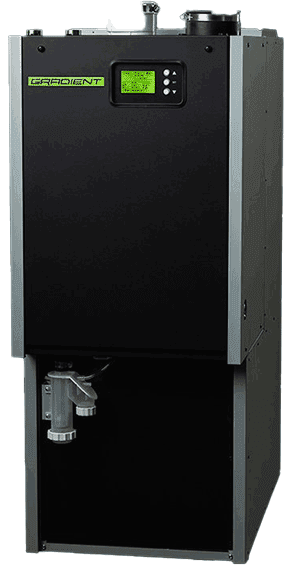

Tankless Water Heater Repair in Calgary
Tankless repair across Calgary on Rinnai, Navien, Noritz, IBC, Rheem and Bosch. Error codes read properly, scale diagnosed rather than guessed at, and an honest answer on whether the heat exchanger is worth saving.
Tankless repair is not tank repair with a different cover on it. There is no element, no thermocouple and no anode rod. What fails instead is the heat exchanger, the flame rod, the flow sensor, the igniter, the condensate path and the gas supply — and most of those announce themselves as a code on the display rather than a puddle on the floor.
That changes the diagnosis. A tankless unit showing an ignition fault can be a closed valve, a blocked intake, a gas line that was never upsized for 200,000 BTU, or a flame rod with a season of carbon on it. Guessing costs more than measuring, so we measure gas pressure under full fire, read the fault history off the board, and check the heat exchanger for scale before quoting anything.
We dispatch from both Calgary and Airdrie, and cover Chestermere, Cochrane and Okotoks too. Call 587-834-3668 for a realistic booking time.
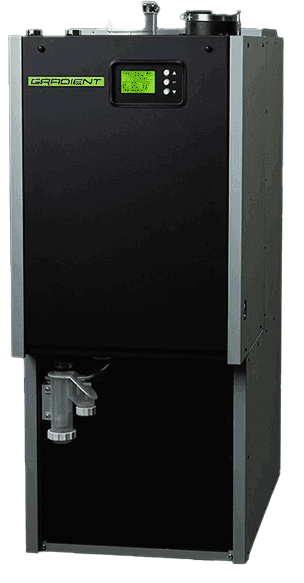
No hot water right now? Call 587-834-3668 — have the error code handy and we'll tell you honestly when we can get there.
Call 587-834-3668What We Repair on Tankless Units
If you have a code on the display, the table further down translates it. If you have a symptom and no code, start here.
No hot water at all
The unit is either not firing or not detecting that it has fired. On gas models that points at the supply, the igniter or the flame rod. It is also worth ruling out the obvious first — an isolation valve closed during other work, or a tripped breaker on the 120V supply the unit needs for its controls. Our no hot water page covers the homeowner checks.
Water goes cold, then hot, then cold again
The classic tankless complaint, and usually one of two things. Either the unit is short-cycling against a flow rate too low to keep it firing — common with a water-saving showerhead or a partly closed valve — or the heat exchanger is scaled enough that it can't hold output. Both are fixable and neither means the unit is finished.
Lukewarm water that never gets hot
Often a derate rather than a fault. A tankless heater raises incoming water by a fixed number of degrees at a given flow, and Calgary's inlet temperature in January is far colder than in July. A unit that was adequate in summer can genuinely run out of capacity in winter — which is a sizing problem, not something a repair corrects.
Ignition failure and flame loss
Gas supply, combustion air, venting or the flame rod. On units converted from a tank without the gas line being upsized, this shows up specifically at full demand and looks intermittent. We test pressure under load to separate a genuine component failure from a supply that was never adequate.
Leaks
Worth separating. A weeping fitting, isolation valve or pressure relief valve is a straightforward repair. Water coming from the heat exchanger itself usually is not, particularly on a unit out of warranty — see the repair-or-replace section below.
Freeze damage
A tankless unit in an unheated garage or on an exterior wall can freeze, and so can its condensate line. The unit's own freeze protection needs power to work, so a heater that lost its breaker during a cold snap is the common version of this. Related: frozen pipe repair.
Noise you didn't have before
Rumbling or a kettle-like whine generally means scale on the exchanger. A fan or combustion noise that changed character is a different matter and worth looking at sooner.
Tankless Error Codes by Brand
The most common codes we attend, what each one actually means, and whether it is worth a reset before calling. One reset is reasonable. A code that returns is telling you something.
Rinnai 11 — no ignition
The unit tried to fire and never lit. Check the gas is on and the intake and exhaust terminals outside are clear — snow and ice across a sidewall vent is a genuine Calgary cause. Beyond that it is gas pressure, the igniter or a flame rod with carbon on it, and that is a service call.
Rinnai 12 — flame loss during operation
It lit, then lost the flame. Marginal gas pressure that collapses under full demand, exhaust recirculating back into the intake, or a dirty flame rod. A single occurrence after work on the gas supply can be air in the line. Repeating means diagnosis.
Rinnai 14 — overheat / thermal fuse
The unit detected overheating and shut itself down. Scale on the heat exchanger is the usual reason heat stops transferring into the water, which is why this code and hard water travel together. Do not keep resetting it.
Navien E003 — ignition failure
Same family as Rinnai 11. Gas supply interrupted, a closed valve, air in the line after recent work, or a fouled igniter or flame rod. Confirm the main gas valve is open before anything else.
Navien E012 — flame loss
Ignition succeeded, sustaining it failed. Navien treat this as distinct from E003 deliberately. An isolated instance after a gas interruption can be harmless; repeated E012 is a supply, combustion-air or component problem.
Navien E016 — heat exchanger overheating
Heat is not getting into the water fast enough, and the insulating layer causing that is almost always scale. On Calgary water this is the code that most often means the unit is overdue a descale rather than broken.
Noritz 11 — ignition failure
Insufficient gas supply, insufficient airflow, or debris on the ignition plug. Noritz themselves class this as needing a licensed contractor, because resolving it means checking gas pressure, vent length and dip switch settings.
Noritz 90 — combustion abnormality
The air-to-fuel mixture is wrong. Insufficient gas, a blocked vent, or debris in the fan. Not a reset-and-hope code — running a unit with abnormal combustion is the category of fault the shutdown exists to prevent.
Rheem 11 — no ignition
On newer Rheem units this is nearly always gas supply or venting: a closed valve, a tripped meter, a blocked or disconnected vent, or a clogged intake screen.
Rheem 13 — improper combustion
Found on indoor units. It is burning, but not cleanly, and the flame rod is typically involved. Worth attending rather than living with.
Rheem 29 — condensate
The condensate drain is blocked or frozen. This is the code we see most in Calgary garages and crawlspaces, and it is usually a drain line with no insulation running through cold space. Fixable properly, and worth doing before winter.
Rheem 76 — remote communication
A loose, pinched or corroded wire between the unit and its controller. Among the more benign faults on this list.
Why Tankless Units Fail in Calgary Specifically
Four reasons, and three of them are local. A tankless heater that would run for twenty years on soft water in a mild climate has a harder job here.
Hard water and scale
Calgary's municipal supply runs roughly 7 to 15 grains per gallon depending on where you are and the time of year — softest in the north and in summer when snowmelt is high, hardest in the south and southeast in winter when river flow drops and minerals concentrate. Airdrie is harder again. A tank tolerates scale by collecting it on the bottom; a tankless exchanger has narrow passages that scale closes up, which is why annual descaling is not optional here and why a water softener upstream meaningfully extends the unit's life.
Cold inlet temperature and undersizing
A tankless heater raises incoming water by a set number of degrees at a given flow rate. In January, Calgary's inlet water is dramatically colder than the figure many units get specified against, so a heater that delivered two showers at once in August can manage one in winter. This is the single most common complaint we attend that is not a fault at all — it is a sizing decision made without accounting for our winter.
Condensate line freezing
Condensing tankless units produce acidic water that drains away through a plastic line. Any part of that line passing through a garage, crawlspace or exterior wall can freeze in a cold snap, back up, and shut the unit down as a safety response. A perfectly healthy heater, stopped by twenty centimetres of unprotected pipe. We insulate and re-route these properly rather than thawing them.
Venting and combustion air
Sidewall terminals get buried by drifting snow or blocked by ice from a roofline dripping above them. Exhaust can also recirculate into an intake that was installed too close to it, which produces intermittent flame faults that look electrical. Worth checking the outside of the house before assuming the inside is broken.
Annual Descaling and Flush Service
The maintenance that determines whether a tankless unit reaches its expected life or fails early. On Calgary water it is the difference between a 20-year heater and a 10-year one.
What the service includes
Isolating the unit at its service valves, circulating a descaling solution through the heat exchanger until the passages run clear, flushing it out, cleaning or replacing the inlet water filter, cleaning the condensate trap, checking combustion and gas pressure, and clearing the vent terminals. Most units take a little over an hour.
How often, here
Annually is the standard recommendation and it is the right interval for most Calgary homes. On a softened supply you can often stretch it. On unsoftened water in the south or southeast, or on a well, annually is a floor rather than a target. The install and maintenance detail is on our tankless water heaters page.
Can you descale it yourself?
Technically yes, if the unit was installed with isolation valves and you are comfortable with a pump, a bucket and the right solution. Honestly: plenty of people do it successfully. What a service visit adds is the combustion check, the gas pressure reading under load and the vent inspection, none of which a flush kit does — and those are what catch the faults before they strand you.
Warranty implications
Most manufacturers require documented annual maintenance for the heat exchanger warranty to hold, and some specifically address water hardness. If your unit is still in its warranty period, a documented service is worth considerably more than the cost of it. Check your own paperwork rather than taking a general rule as fact — terms differ by brand and by model year.
Repair or Replace?
Three things decide it, and age is the least useful of them on its own.
What has actually failed
Flow sensors, flame rods, igniters, fans and control boards are components, and replacing one on an otherwise sound unit is straightforward. The heat exchanger is different — it is the expensive part, and on an out-of-warranty unit replacing it is frequently most of the cost of a new heater. That is the line that matters more than the year on the label.
Warranty status
Heat exchanger warranties on tankless units are typically long, and a covered exchanger changes the arithmetic entirely. Find your paperwork or the serial number before deciding anything — we will check coverage as part of the diagnosis rather than assuming it has lapsed.
Maintenance history
A ten-year-old unit descaled every year is often in better condition than a six-year-old one that never was. If yours has never been serviced and is showing an overheat code, the realistic question is whether a descale recovers it or whether the exchanger is already past that — and that is something we can assess on site rather than guess at.
Whether tankless is right for the house at all
Occasionally the honest answer is that the unit was the wrong choice for the home — undersized for the winter load, or fitted where a tank would have served better. We will say so. Our tankless versus tank comparison sets out the trade-offs, and hot water tanks covers the alternative honestly.
Pricing
Tankless repair pricing depends on what has failed, and we will not quote a number sight-unseen that changes once the cover is off.
How we quote
We diagnose first — fault history, gas pressure under load, exchanger condition — then give you the repair cost in writing before any work starts. If replacement is the better economic answer, you get that number alongside it rather than instead of it.
What moves the cost
Whether it is a component or the heat exchanger, whether the unit is in warranty, whether the gas supply needs correcting, and whether the condensate or venting has to be re-routed. A descale is a known quantity; an exchanger is not.
Spreading it
Financing is available through Financeit on replacements if the repair turns out not to be worth doing.
Brands and Areas We Cover
Brands serviced
Rinnai (RU, RUR and V series), Navien (NPE and NPE-2), Noritz, IBC, Rheem, Bosch and Takagi. Parts availability differs by brand and age, and we will tell you upfront if something has to be ordered rather than discovering it on the day.
Where we go
Calgary and Airdrie daily, plus Chestermere, Cochrane and Okotoks. We dispatch from both Calgary and Airdrie.
Tankless Water Heater Repair FAQs
How long do tankless water heaters last?
Manufacturers generally quote around 20 years, roughly double a tank, and that figure assumes annual descaling. On Calgary water without maintenance, we see them fail considerably earlier — the heat exchanger is the life-limiting part and scale is what ends it.
The useful way to think about it: a tankless unit's lifespan is decided by water treatment and servicing far more than by the badge on the front. A serviced unit on softened water will outlast a neglected one by years.
Why does my water go cold then hot again mid-shower?
Usually one of two things. The unit may be short-cycling because the flow rate has dropped below what it needs to stay firing — a water-saving showerhead, a partly closed valve, or a clogged inlet filter will all do it. Or the heat exchanger is scaled enough that it cannot hold its output under steady demand.
There is also a harmless version: older units have a brief lag between the tap opening and full output, sometimes called a cold water sandwich, which is characteristic of the technology rather than a fault. If it is happening repeatedly within one shower, that is not it.
Can I descale a tankless water heater myself?
If it was installed with isolation valves, yes — you need a small pump, a bucket, descaling solution and a couple of hoses, and plenty of homeowners manage it.
What the DIY version misses is the rest of the service: combustion check, gas pressure under full fire, condensate trap, inlet filter and vent terminals. Those are where we find the faults that would otherwise strand you in January. If you are doing it yourself, at minimum clean the inlet filter at the same time and look at the vent outside.
Does hard water void a tankless warranty?
It can affect it. Most manufacturers require documented annual maintenance for the heat exchanger warranty to hold, and several specifically address water hardness in their terms.
We would not tell you what your particular warranty says — check the paperwork for your brand and model year, because terms differ. What is consistent is that documented annual servicing protects the coverage, and on Calgary water it is worth having regardless of what the warranty demands.
My tankless unit shows an error code. Can I just reset it?
Once, reasonably. A single fault after a gas interruption or a power blip can be genuine.
A code that comes back is information, not noise — particularly the overheat codes (Rinnai 14, Navien E016), which generally mean heat is not transferring into the water because of scale. Repeatedly resetting an overheat condition is running the unit in the state its safety shutdown exists to prevent. Ignition and combustion codes likewise need someone with a manometer rather than another reset.
Why does my tankless heater struggle in winter but not in summer?
Because it is doing a harder job. A tankless heater raises incoming water by a set number of degrees at a given flow rate, and Calgary's inlet water is far colder in January than in July. Same unit, same setting, much more work.
If yours delivers two simultaneous showers in summer and one in winter, that is usually capacity rather than a fault — it was sized against a warmer inlet than we actually get here. A descale may recover some margin if it has never been done, but a genuinely undersized unit cannot be repaired into being bigger.
When can you get here if we have no hot water?
It depends on the schedule that week, and we will tell you honestly when we can realistically get there rather than promising a time we cannot hold. Call 587-834-3668.
If the unit is leaking rather than simply not heating, shut off the water supply to it and the gas, and call — that one does not wait.
Is it worth repairing a tankless heater or should I replace it?
It depends on what failed rather than how old it is. Components — flow sensor, flame rod, igniter, fan, board — are generally worth repairing on a sound unit. A failed heat exchanger out of warranty often costs most of a new heater, and at that point replacement is the better value.
We quote both when it is close, in writing, and we would rather tell you a repair is not worth doing than take the money for one that buys you a season.
Related pages
If your problem is a tank rather than a tankless unit, or you are weighing the two, start here.
Tankless Water Heaters
Install, brands and sizing — plus whether tankless is the right call for your house.
See serviceNo Hot Water
Nothing hot at any tap — the homeowner checks worth doing before you call.
See serviceWater Heater Repair
Tank units — gas and electric. Elements, thermocouples, gas valves, anode rods.
See serviceHot Water Issues
Lukewarm, running out fast, discoloured or smelly — full symptom triage.
See serviceWater Softeners
The permanent fix for the scale that shortens every tankless heat exchanger in this city.
See serviceTankless in Airdrie
North of the city, on harder water again.
See serviceSimple, honest, on your schedule.
Tankless faults are diagnosable rather than guessable, so the visit follows the same order every time.
Read the board
Current code plus the stored fault history, which tells us whether this is new or has been building all winter.
Test under load
Gas pressure at full fire, inlet and outlet temperatures, and actual flow rate against what the unit is rated for.
Check the exchanger
Scale condition and condensate path. In Calgary water this is the cause more often than any single component.
Quote both paths
What the repair costs and, when it's close, what replacement costs — in writing, before anything is done.
Also under Water
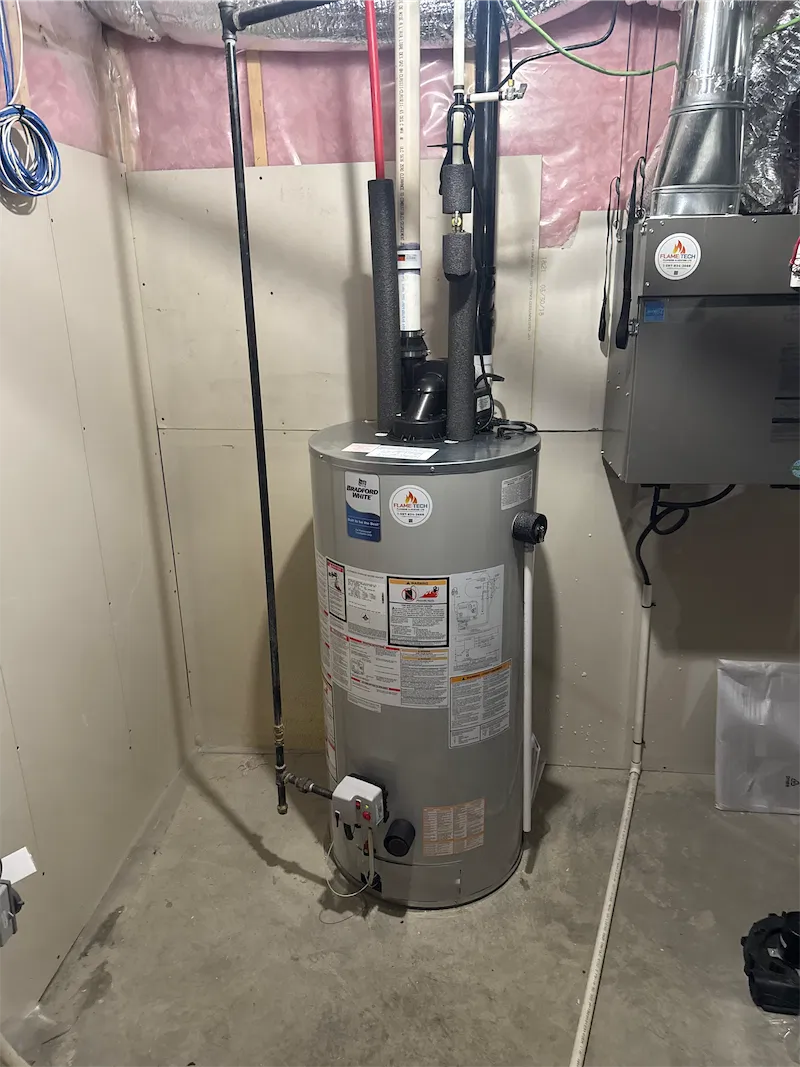
Hot Water Tanks Calgary — Bradford White + John Wood Install, Sized Right
Calgary water hardness (150-200 mg/L) is brutal on hot water tanks — sediment builds in the bottom faster than in lower-mineral cities, and the sacrificial anode rod that's supposed to last 5-7 years is gone in 3-4 — see annual water heater service. The result: tanks rated for 12-15 years typically give up at 8-10 in Calgary unsoftened. FlameTech sizes, installs, and services hot water tanks built for our specific water profile — Bradford White and John Wood are the two brands we've found hold up best — there's a head-to-head on the two if you're deciding. Installed prices by size are in hot water tank replacement cost in Calgary.
Calgary Hot Water Tank Replacement — Red Seal Plumbers
Hot water tanks in Calgary fail at 8-12 years — sooner if you don't have a water softener. When yours goes, FlameTech replaces it with the brands that actually survive our hard water, and the price is agreed in writing before work starts.
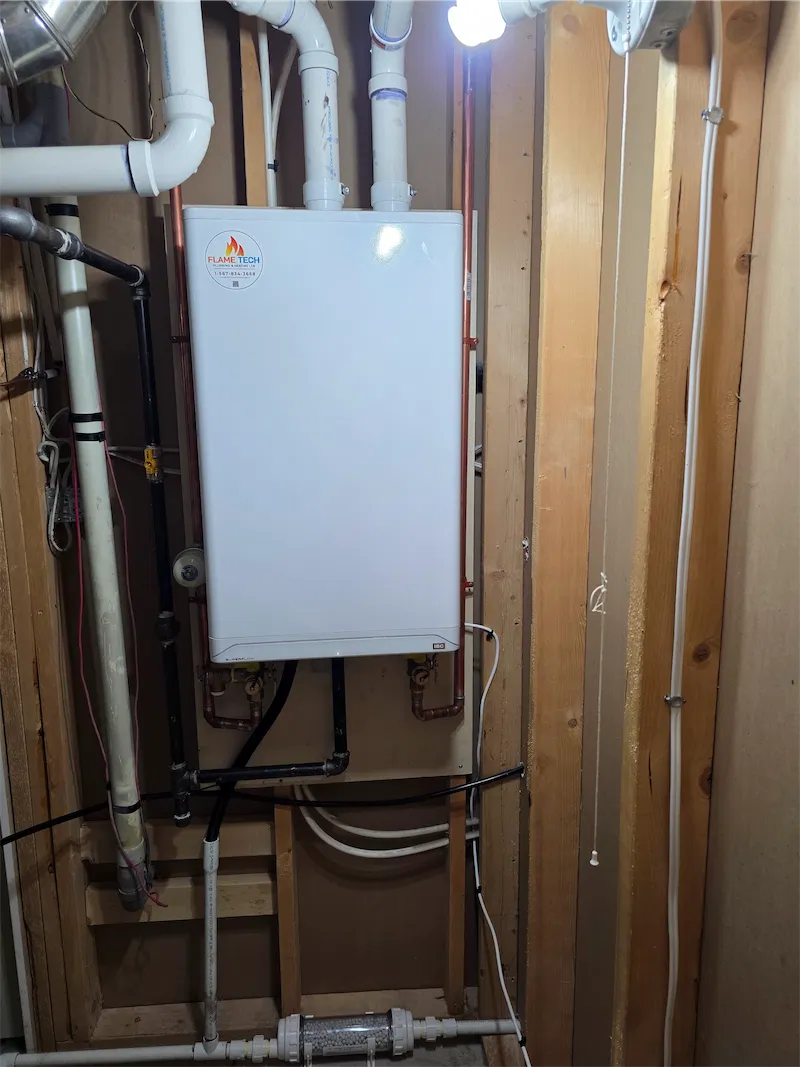
Tankless Water Heaters Calgary — Navien, Rinnai, IBC Install + Service
Tankless water heaters are the right call for some Calgary homes — endless hot water capacity, 20+ year lifespan, big space savings, lower lifecycle operating cost — and the wrong call for others. Calgary's hard water is unusually punishing on tankless heat exchangers (faster scale buildup than tank-style because water passes through narrow internal passages), so annual descaling is non-negotiable and a water softener upstream is strongly recommended. FlameTech installs and services every common brand: Navien NPE-A/S, Rinnai RU/RUR, IBC SL series, Bosch, Noritz. Honest tankless-vs-tank conversation before we quote.
Where we cover Calgary.
We dispatch from Calgary and Airdrie. Find your neighbourhood for area-specific notes on common builds, hard-water patterns, and the systems we see most.
Get a free tankless repair quote.
Tell us what's going on and our dispatch team will call you back with pricing and availability.
Book a Red Seal plumber in Calgary.
Free estimates and upfront pricing, from local technicians who treat your home like their own.
Free estimate · No service charge for quotes · BBB Accredited