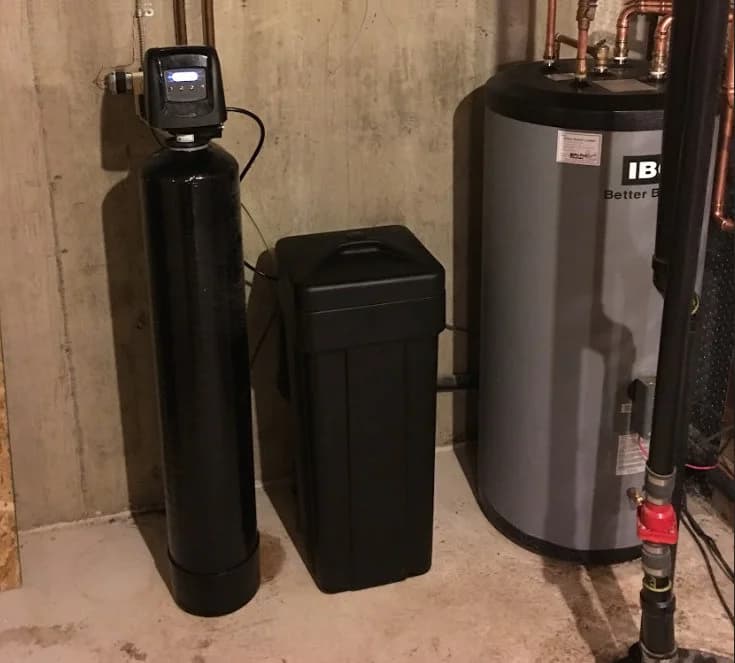
Well Water Treatment in Bearspaw
Well water treatment in Bearspaw should start with a lab report, not a guess at what's coming out of the ground. Hardness, iron, manganese and bacteria each point somewhere different, and a bacteria result points to a public health inspector before it points to any equipment. We install water softeners and reverse osmosis systems chosen from your results, and the written quote is free.
Our part of the job is water softener installation for hard water and reverse osmosis at the kitchen sink for drinking and cooking water. Red Seal journeyman plumbers do the installation, we're licensed and insured, and the price is set out in writing before anything starts.
We dispatch from both Calgary and Airdrie for water treatment work here, as we do for the rest of our plumbing and heating in Bearspaw. Send the form with your water source and any lab results you have, or call 587-834-3668 and we'll tell you honestly when we can get there.
Weighing a softener or an RO tap for your Bearspaw home? Call 587-834-3668 and we'll tell you honestly when we can get there.
Call 587-834-3668“Absolutely fantastic service! They are always on time, incredibly helpful, and went above and beyond to solve any issues that came up. The quality of the work was excellent, and everything was done with care and attention to detail. I really appreciated how smooth and stress-free they made the whole process. Highly recommend!”

Dalia Gr
Calgary · 6 months ago
Check where your water comes from first
Bearspaw isn't one water system. Before anyone talks about equipment, be certain which supply the house is on, because that decides who tests the water, who is responsible for it and what household treatment can sensibly do.
County-served communities
Rocky View County's drinking water page says: "Rocky View County provides drinking water service in Bragg Creek, Cambridge, Cochrane Lake, Conrich, Prince of Peace, East and West Balzac, Goldwyn, Elkana, Watermark and Wintergreen." Watermark is in Bearspaw, so homes there are on County water rather than a well. Questions about that supply go to the County. Softening it or adding a drinking-water tap once it reaches your house is a separate choice you can make on its own.
Co-op and private systems
The same County page goes on: "Water service in all other areas is provided by more than 70 private and co-operative water systems and suppliers, or by private ground water wells." If you pay a co-op or a private water company, ask them about the water first, before you buy anything to treat it.
Private wells: the owner is responsible
If the water comes from a well on your own land, the County is plain about it: "Owners of private wells are responsible for managing and maintaining their own water supply." The province's Working Well page says the same: "Private water well owners in Alberta are responsible for managing and maintaining their water wells." Testing, looking after the well head and deciding on treatment all sit with you.
Getting well water tested in Alberta
Well owners can test through Alberta Health Services, and its guide to testing drinking water sets out the practical rules. We don't sample or test water, so these are the points to know to get a usable result yourself.
How often to test
AHS puts it simply: "You should test your water for bacteria 2 times each year." Chemistry comes round less often: "You should test your water for chemicals and trace metals every 3 years." If something changes in between, "Contact a public health inspector if you would like to test your water more often."
Bottles, timing and where to draw the sample
According to AHS, "Water sample bottles are available at many Alberta Health Services facilities." For bacteria, freshness counts, because "if your water sample is more than 24 hours old, Alberta Precision Laboratories will not test it." The same guide says the chemistry sample is drawn before any treatment equipment and the bacteria sample after it. That matters if a softener or filter is already in.
Two tests, two waits
The bacteria test looks for total coliforms and E. coli, and AHS says it "takes 2 to 3 days". The chemical and trace metals test is the one equipment decisions rest on, and it "takes 6 to 8 weeks". If a softener is on your list, start that clock early.
Buying an acreage
AHS won't test samples taken for a property sale. Its guidance says: "You need to send these types of water samples to a commercial lab and pay for the testing." Allow for that in your conditions and your timeline, and ask public health services which tests suit a well.
Reading the results before you choose equipment
A page of numbers is easier to act on once you know which ones drive which decision. These four are the ones to find first.
Iron
Iron is what usually leaves rust-coloured marks on fixtures and laundry. Health Canada's guideline states: "The aesthetic objective (AO) of ≤ 0.1 mg/L (100 µg/L) is established for total iron in drinking water." If your report shows iron, check the limit in the manual of any softener you're considering before counting on it to cope.
Manganese
Manganese is not only a staining problem. Health Canada sets a health limit as well as an aesthetic one: "The maximum acceptable concentration (MAC) for total manganese in drinking water is 0.12 mg/L (120 µg/L)." It adds: "The aesthetic objective (AO) for total manganese in drinking water is 0.02 mg/L (20 µg/L)." A result above the MAC is a health question first, so talk to a public health inspector before you pick equipment.
Hardness
Hardness is the figure a softener is sized to, along with how much water the household goes through. Nobody can tell you your hardness from your address. Have the figure from your own report in front of you when you ask for a softener price.
Bacteria
The bacteria result comes back as present or absent for total coliforms and E. coli. Absent is good news, but AHS is careful about what it covers: "The sample was not tested for chemicals, viruses, protozoa, or other harmful germs, and may still be unsafe to drink." A present result is a different matter, and the advice is to "Talk to a public health inspector or other water treatment professional." Neither a softener nor an RO tap is the answer to a bacteria result, and we'll say so rather than quote you one.
What we install, and what it costs
Two pieces of equipment, both with published prices. These figures are as of September 2026 and the same in Calgary and Airdrie. Your own number comes on the free written quote.
Water softener: $2,250 to $3,050
A softener takes the hardness out of the water for the whole house. It's sized to the hardness on your report and to how the household uses water, not picked off a shelf. Our page on water softener installation goes into the equipment in more detail.
Reverse osmosis: $780 to $1,440
An RO system sits under the kitchen sink and feeds its own tap for drinking and cooking. It treats that one tap, not the whole house. Our reverse osmosis page covers the system itself, and if you're deciding between the two, our article on whether you need a softener or reverse osmosis puts them side by side.
Equipment and upkeep
Health Canada's advice on treatment devices is to "purchase one that is certified as meeting the applicable ANSI/NSF performance standard." It also reminds owners that "they should carefully follow the maintenance instructions included with the device". Salt, filters and membranes go on the schedule in the manual for your model, and your water affects that too. If you already have a softener that isn't keeping up, water softener repair may be the place to start before replacing it.
Other treatment stages a well can need
Some reports call for more than a softener or an RO tap. The stages below aren't part of what we price on this page, but they come up in any conversation about well water, so here is what each one is for.
Iron and manganese filtration
Where iron or manganese is high, a filter built for those metals is a separate stage from a softener. Health Canada notes that "Certified residential treatment units for the removal of iron from drinking water are currently available." It adds that "when both iron and manganese (Mn) are present, the removal of iron generally improves the removal of Mn and thus will reduce the health risk associated with this metal."
Sediment filtration
Sand, grit and silt carried up from a well can wear valves and plug finer filters further along. A sediment filter is a screen or cartridge that catches those particles before they get that far.
Disinfection
AHS treats some well water as surface water, including "shallow wells (less than 50 feet)" and "wells near rivers or lakes". For that water, its guidance is a filter to remove cysts, followed by disinfection with a chlorination system or "a Class A ultraviolet light system that meets NSF Standard 55". Once any system is in, the same page says: "After you install a system, test your water to make sure the system is working."
How the stages fit together
For the order these stages usually go in, see the full treatment sequence on our Calgary well water page. If your report is back and you want to know whether a softener or an RO tap belongs in the picture, send us your results.
Where our work stops
Knowing what we don't do saves you a wasted visit and points you to the right people sooner.
The well itself
Drilling a new well, deepening an old one, and pulling or replacing the pump down the hole are jobs for a water well contractor. We don't do them.
The well head
Looking after the well head is part of owning a well. AHS advises: "Inspect all wells (shallow and deep) 2 times a year, like in the spring and in the fall, to make sure the well head is in good condition." The province's Working Well page has more written for Alberta well owners.
Whether the water is safe to drink
That call belongs to Alberta Health Services and its public health inspectors, not to a plumber. We'll install the softener or RO system your results point to, but we won't tell you the water is safe to drink.
Related water treatment and Bearspaw services
Well water treatment around Calgary
How the treatment stages on an acreage well fit together.
See serviceWater softener installation
Choosing and fitting a softener for hard water.
See serviceReverse osmosis
A separate drinking-water tap at the kitchen sink.
See serviceBearspaw plumbing and heating
Our general plumbing and heating service for Bearspaw homes.
See service
Monthly Financing Available
Spread the cost into manageable monthly payments.
Monthly payments through our Financeit partner, subject to approval.
Simple, honest, on your schedule.
Tell us about the water
Where it comes from, what you're seeing at the taps and fixtures, and what treatment equipment is already in the house. If you have a recent lab report, send it with your enquiry.
Get it lab-tested
If you're on a private well without a recent result, testing is yours to arrange, through Alberta Health Services or a commercial lab. We don't take or test water samples ourselves.
We look at the house
Where the water line comes in, what's already installed on it, where a softener or RO unit would drain, and how much room there is to work with.
Free written quote
It names the equipment and the price for the job. The quote costs nothing, and nothing starts until you've accepted it.
Also under Water
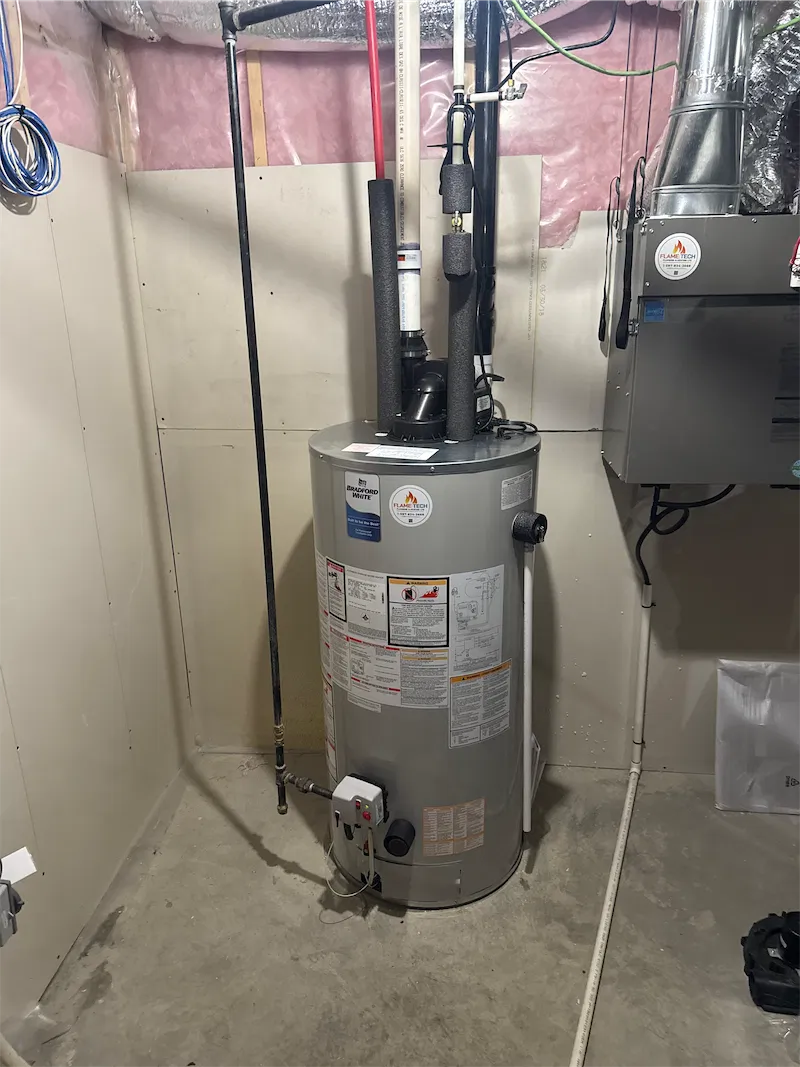
Hot Water Tanks Calgary — Bradford White + John Wood Install, Sized Right
Calgary water hardness (150-200 mg/L) is brutal on hot water tanks — sediment builds in the bottom faster than in lower-mineral cities, and the sacrificial anode rod that's supposed to last 5-7 years is gone in 3-4 — see annual water heater service. The result: tanks rated for 12-15 years typically give up at 8-10 in Calgary unsoftened. FlameTech sizes, installs, and services hot water tanks built for our specific water profile — Bradford White and John Wood are the two brands we've found hold up best — there's a head-to-head on the two if you're deciding. Installed prices by size are in hot water tank replacement cost in Calgary.
Calgary Hot Water Tank Replacement — Red Seal Plumbers
Hot water tanks in Calgary fail at 8-12 years — sooner if you don't have a water softener. When yours goes, FlameTech replaces it with the brands that actually survive our hard water, and the price is agreed in writing before work starts.
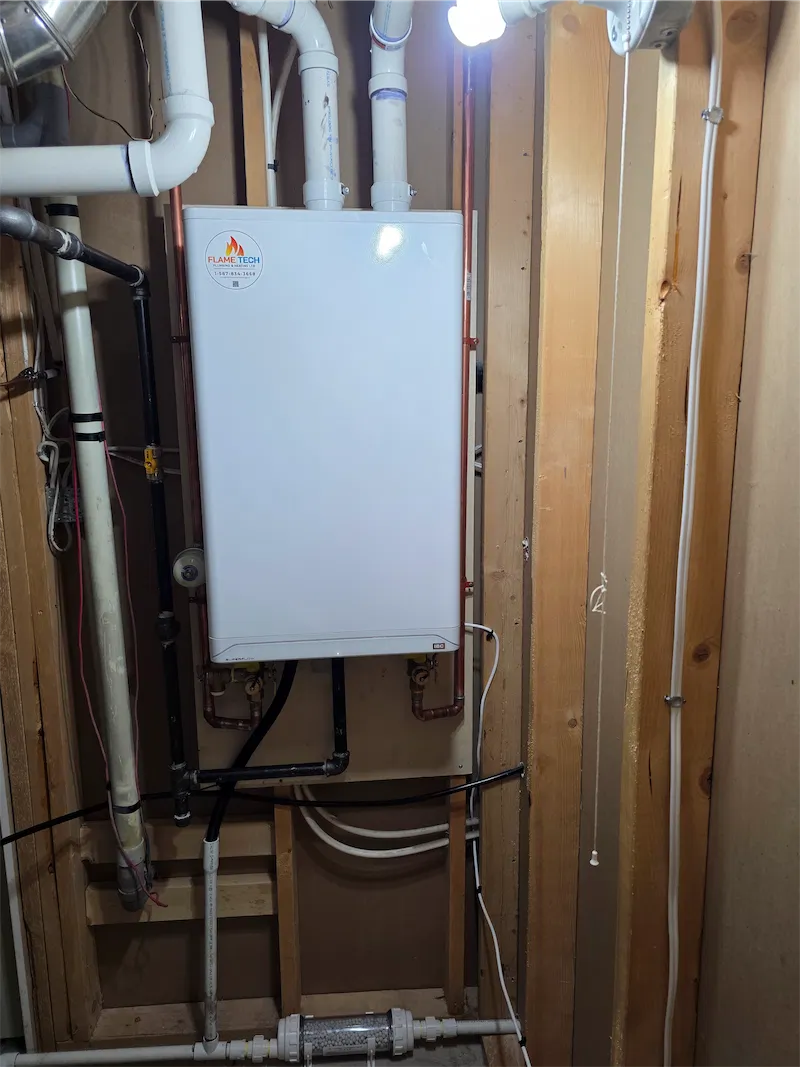
Tankless Water Heaters Calgary — Navien, Rinnai, IBC Install + Service
Tankless water heaters are the right call for some Calgary homes — endless hot water capacity, 20+ year lifespan, big space savings, lower lifecycle operating cost — and the wrong call for others. Calgary's hard water is unusually punishing on tankless heat exchangers (faster scale buildup than tank-style because water passes through narrow internal passages), so annual descaling is non-negotiable and a water softener upstream is strongly recommended. FlameTech installs and services every common brand: Navien NPE-A/S, Rinnai RU/RUR, IBC SL series, Bosch, Noritz. Honest tankless-vs-tank conversation before we quote.
Where we cover Calgary.
We dispatch from Calgary and Airdrie. Find your neighbourhood for area-specific notes on common builds, hard-water patterns, and the systems we see most.
Get a free Bearspaw well water treatment quote.
Tell us what's going on and our dispatch team will call you back with pricing and availability.
Book a Red Seal plumber in Calgary.
Free estimates and upfront pricing, from local technicians who treat your home like their own.
Free estimate · No service charge for quotes · BBB Accredited