
Well Pressure Tank Replacement in Bearspaw: An Owner's Guide
Well pressure tank replacement in Bearspaw is a question for acreage owners who draw water from their own well, because the pressure tank is what keeps water at the taps while the pump is switched off. This guide explains how the tank does that, the signs it's wearing out, what replacing one involves and which trade looks after each part. The well itself, from drilling and deepening to the submersible pump that sits in it, is work for a licensed water well contractor.
For Bearspaw homes on well water, the equipment we publish prices for is water softener installation at $2,250 to $3,050 and reverse osmosis at the kitchen tap at $780 to $1,440. Those figures are as of September 2026 and the same in Calgary and Airdrie. Both are fitted by Red Seal journeyman plumbers. We're licensed and insured. The written quote costs you nothing. Everything else we cover out here is on our plumbing and heating in Bearspaw page.
We dispatch from both Calgary and Airdrie. Call 587-834-3668 or use the form, describe how the pump and the pressure are behaving, and we'll tell you honestly when we can get there.
Not sure whether it's the tank, the pump or the house plumbing? Call 587-834-3668 and describe what the pump is doing.
Call 587-834-3668“A job well engineered and executed by FlameTech. Jason and his coworker did an amazing job.”

Ali Derakhshan
Calgary · 6 months ago
Is your Bearspaw home on a well?
A pressure tank only becomes your responsibility if the water comes out of your own ground. Bearspaw has more than one kind of supply, so settle which one the house is on before thinking about the tank.
County water (Watermark)
Rocky View County names Watermark among the communities it supplies with drinking water. Homes there get their water from the County system, and questions about that supply belong with the County.
Co-op or private systems
Outside the County-served communities, the County's drinking water page explains that dozens of co-operative and private water systems serve homes, alongside private wells. Households billed by a co-op or water company should start with that supplier before anyone opens up the plumbing in their basement.
Your own well: you're responsible
Where the well is on your land, the County puts it in one line: "Owners of private wells are responsible for managing and maintaining their own water supply." The pressure tank is part of that supply, along with the pump, the well head and any treatment equipment. The water itself is covered on our page about testing and treating well water in Bearspaw.
What a well pressure tank does
The province's guide for well owners, Water Wells … That Last, sums up the job: "A pressure tank is required to maintain pressure in the system when the pump is not in operation." Here is how it manages that.
Air on one side, water on the other
A modern tank holds a charge of air, kept apart from the water by a diaphragm or bladder. When the pump runs, water fills the tank and squeezes the air. When you open a tap, that squeezed air pushes water back out. The Alberta guide notes that pre-charged tanks of this kind are the ones most often used today.
Drawdown
Drawdown is the water a tank can hand over between the pump stopping and starting again. Amtrol's Well-X-Trol manual connects a larger tank with more drawdown and less time with the pump running, and says that "extends pump life".
Cut-in and cut-out
On a conventional system, a pressure switch starts the pump when pressure falls to the cut-in setting and stops it at the cut-out. A 40/60 switch, for instance, cuts in at 40 psi and out at 60. That's why pressure at the taps rises and falls a little with each pump cycle.
Constant-pressure systems
Some wells use a constant pressure system, which aims to hold the pressure steady instead of letting it swing between two settings. The Alberta guide notes that "Constant pressure systems use smaller, lighter pressure tanks." If yours is one of these, its own manual decides what tank goes with it.
Signs a pressure tank is failing
Amtrol's well tank FAQ is brief on this: "Symptoms of a tank that needs replacement are rapid cycling of your pump, or low pressure in your system." Here's how they show up in a house, plus one more sign and one thing not to try.
The pump switches on and off quickly
If the pump runs for a few seconds, stops, then starts again while a tap is still open, the tank is storing very little water between cycles. Alberta's guide says tanks should be sized so the pump "will not cycle more than 25 times per hour." Since Amtrol links less pump running with longer pump life, short cycling deserves attention sooner rather than later.
Pressure that drops or swings
A shower that fades and recovers, or taps that surge and then sag, can mean the tank has lost the air that evens out the flow. The pump, the pressure switch or a restriction in the pipe can cause the same thing, so take it as a prompt to have the system checked rather than proof the tank has gone.
Rust, weeping or water around the tank
Rust on the shell, damp fittings or a puddle under the tank are worth noting the first time you see them. Amtrol's manual calls for a drip pan piped to a drain wherever a leak could cause damage, and a finished basement is exactly where that applies.
Why adding air isn't a fix
Topping up a tank whose air charge has dropped can look like the obvious answer. The Well-X-Trol manual warns against adding pressure after a loss of air, visible corrosion or shorter pump cycles, because those can point to internal corrosion, and re-pressurizing such a tank "could result in rupture or explosion." The Alberta guide adds that a diaphragm tank needing a recharge likely has a ruptured diaphragm. Leave it alone and have a licensed professional look at it.
What well pressure tank replacement involves
Amtrol states that its tank must be installed by a licensed professional, and the points below are the ones the manufacturers' instructions cover. They're also good questions to ask whoever does the job.
Sizing the tank to the pump
Per the Alberta guide, "The size of the pressure tank is determined by the output capacity of the pump." The new tank is chosen from what the pump delivers, with that 25-cycles-an-hour limit in mind, rather than copied from the label on the old one.
Setting the precharge to the pressure switch
The tank's air charge has to suit the switch. Amtrol's FAQ says "The well tank precharge should be set to 2 PSI below the cut-in of your pressure switch setting," and its manual gives 38 psig for a 40/60 switch. The charge is set with no water pressure on the tank, and the manual is blunt about who does it: "ONLY LICENSED PROFESSIONALS SHOULD CHECK, ADJUST OR RE-CHARGE THE PRE-CHARGE OF TANKS."
Relief valve, position and leaks
Amtrol requires a relief valve on the system, its manual sets out how each model is to be mounted, and it wants a drip pan to a drain wherever a leak could do damage. Other makes have their own requirements, and Pentair's PRO-Source Plus manual adds: "Install system according to local codes."
Keeping it from freezing
Amtrol's manual says: "Do not operate in a setting with freezing temperatures." A tank in an unheated outbuilding or pump house is exposed through a long cold snap, and so is the pipe that feeds it. If a line has already frozen, see our page on frozen pipe repair.
Replacing an old galvanized tank
Some older systems still run a galvanized tank, which the Alberta guide says "can become water logged". Swapping one for a pre-charged tank on a submersible system can be a bigger job than it looks: Pentair's manual says you must "raise pump and discharge pipe far enough to remove bleeder orifices," and raising the pump is down-hole work for a water well contractor. The galvanized tank may also be there for a reason. The Alberta guide notes: "However, this type of tank is useful when gas is present in the well." If you know or suspect gas in your well, raise it with your well contractor before anyone removes the old tank.
Tank or bladder?
Whether the bladder or water cell can be changed on its own depends on how the tank is built. Pentair's PRO-Source Plus manual has a section on replacing the water cell, and other tanks are made differently. The manual for your model settles the question.
After a tank is changed
A new tank still needs looking after, and the schedule comes from the manual for that tank.
Checks from the manual
For its own tanks, Amtrol's Well-X-Trol manual says: "A licensed professional should check the complete system, including the Well-X-Trol, yearly and more frequently as the system ages." That applies to the Well-X-Trol line. Keep the manual for whatever tank is in your house and follow its schedule, bearing in mind the same manual's point that water quality "can significantly influence the life of this Product."
Bacteria in the tank
Amtrol's manual warns that bacteria "can grow in your well tank" and tells owners to "consult your local plumbing official" about disinfecting the home's plumbing. Regular testing tells you whether there's a problem: Alberta Health Services says, "You should test your water for bacteria 2 times each year."
Who does which part of the job
A well system crosses more than one trade. Knowing where each one starts saves you a call to the wrong person.
Down the hole: a licensed water well contractor
The Alberta guide is direct: "You need to hire a licensed water well contractor to design, drill and construct your well." Drilling, deepening and pulling or replacing a submersible pump sit with that contractor. The guide points to the Alberta Water Well Drilling Association for finding one.
Not every well contractor installs pumps
The same guide notes: "Not all licensed water well contractors include pump installation as part of their business." When you call one, ask whether pump work is something they take on.
What we install in the house
Inside the house, the well water equipment we put a published price on is a water softener for hardness and a reverse osmosis unit for drinking water, with both price ranges given in the opening section. For how softening, filtration and RO fit together on a well, see the order treatment stages go in.
Not sure where the problem is?
A pump that keeps cycling could come down to the tank, the switch, the pump or the well. If you can't tell which, describe the symptoms to us and we'll tell you plainly which trade it points to.
Related well water and Bearspaw pages
Well water treatment in Bearspaw
Testing your well and choosing treatment from the lab report.
See serviceWell water treatment around Calgary
The order treatment stages go in on an acreage well.
See serviceWater softener installation
Softening hard well water for the whole house.
See serviceReverse osmosis
A drinking-water tap of its own at the kitchen sink.
See serviceBearspaw plumbing and heating
Our plumbing and heating page for Bearspaw homes.
See serviceSimple, honest, on your schedule.
Know your supply
Confirm whether the house draws from its own well, from County water, or from a co-op or privately run supplier. A tank on a private well is yours to look after. On any other supply, questions about the water go to the supplier first.
Note what the system is doing
Without touching anything, jot down what you notice: how often you hear the pump start, whether pressure fades or surges at a tap, and any rust, damp or standing water around the tank.
Find the label, the manual and the drilling report
The label on the tank gives its make, model and size, and the manual sets out its air charge and the checks it needs. If you have the drilling report from when the well was built, keep it with them.
Call the right trade
Anything down the hole goes to a licensed water well contractor. For softener or RO work, or if you can't tell where the trouble starts, call us on 587-834-3668 and describe what you're seeing.
Also under Water
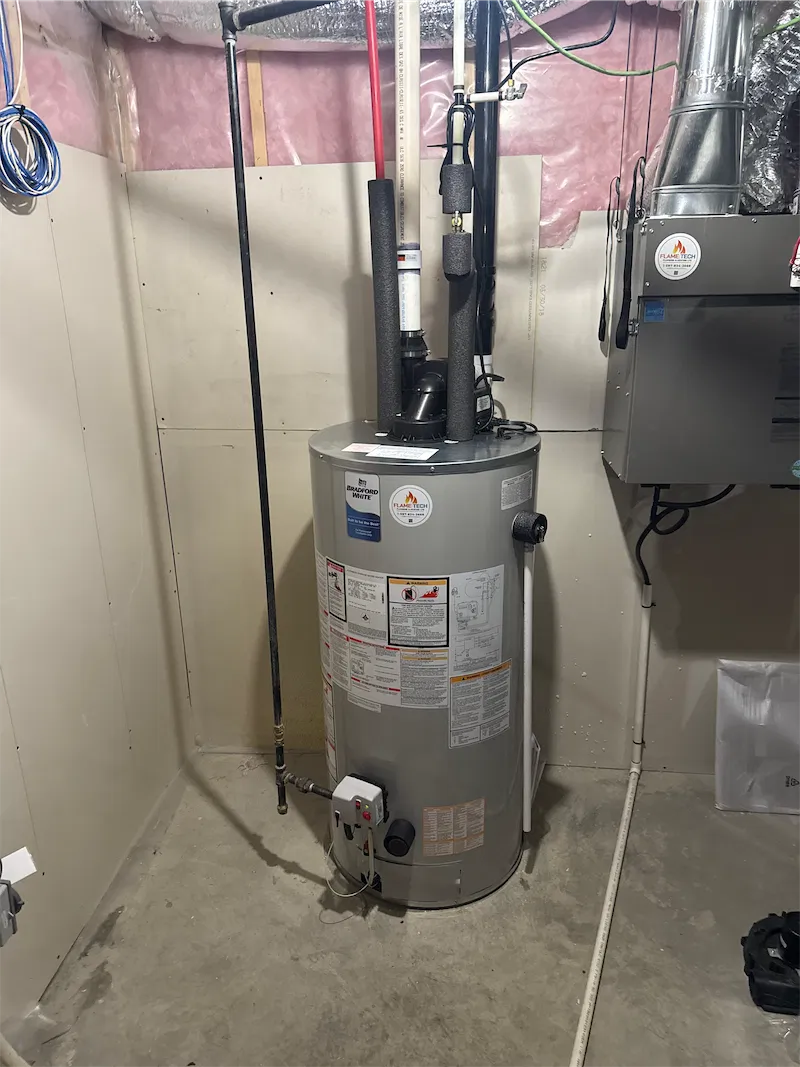
Hot Water Tanks Calgary — Bradford White + John Wood Install, Sized Right
Calgary water hardness (150-200 mg/L) is brutal on hot water tanks — sediment builds in the bottom faster than in lower-mineral cities, and the sacrificial anode rod that's supposed to last 5-7 years is gone in 3-4 — see annual water heater service. The result: tanks rated for 12-15 years typically give up at 8-10 in Calgary unsoftened. FlameTech sizes, installs, and services hot water tanks built for our specific water profile — Bradford White and John Wood are the two brands we've found hold up best — there's a head-to-head on the two if you're deciding. Installed prices by size are in hot water tank replacement cost in Calgary.
Calgary Hot Water Tank Replacement — Red Seal Plumbers
Hot water tanks in Calgary fail at 8-12 years — sooner if you don't have a water softener. When yours goes, FlameTech replaces it with the brands that actually survive our hard water, and the price is agreed in writing before work starts.
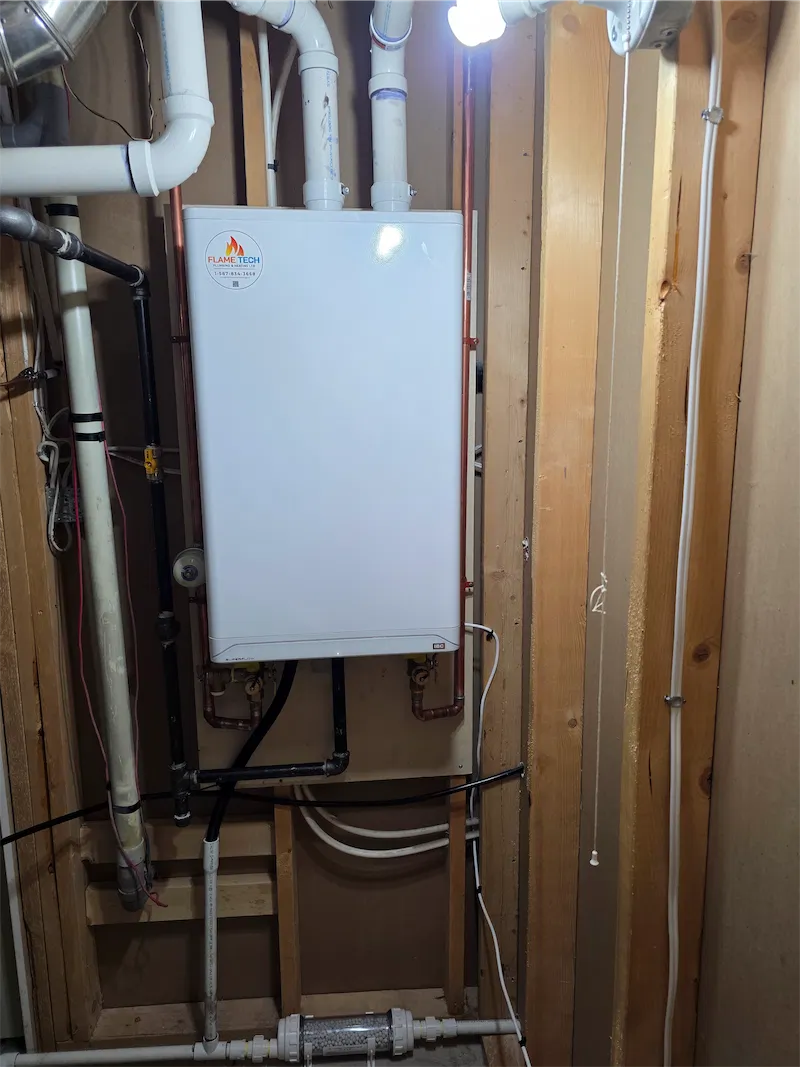
Tankless Water Heaters Calgary — Navien, Rinnai, IBC Install + Service
Tankless water heaters are the right call for some Calgary homes — endless hot water capacity, 20+ year lifespan, big space savings, lower lifecycle operating cost — and the wrong call for others. Calgary's hard water is unusually punishing on tankless heat exchangers (faster scale buildup than tank-style because water passes through narrow internal passages), so annual descaling is non-negotiable and a water softener upstream is strongly recommended. FlameTech installs and services every common brand: Navien NPE-A/S, Rinnai RU/RUR, IBC SL series, Bosch, Noritz. Honest tankless-vs-tank conversation before we quote.
Where we cover Calgary.
We dispatch from Calgary and Airdrie. Find your neighbourhood for area-specific notes on common builds, hard-water patterns, and the systems we see most.
Get a free Bearspaw plumbing quote.
Tell us what's going on and our dispatch team will call you back with pricing and availability.
Book a Red Seal plumber in Calgary.
Free estimates and upfront pricing, from local technicians who treat your home like their own.
Free estimate · No service charge for quotes · BBB Accredited