A furnace blowing cold air is rarely a dead furnace. More often it's a furnace that's working exactly as designed and shutting itself down for a reason, or a thermostat setting nobody meant to change.
The useful question isn't "why is it cold?" — it's when is it cold. Cold all the time is a different fault from warm-then-cold after five minutes, which is different again from cold that started during the first real freeze of the year. Get the pattern right and you've usually got the cause.
Here's how we work through it.
Start here: is the fan set to ON?
Check the thermostat before anything else, because this is the most common cause and it isn't a fault at all.
Thermostats have a fan setting with two positions: AUTO and ON. On AUTO, the blower only runs while the burners are producing heat. On ON, the blower runs continuously — including for the long stretches between heating cycles, when there's nothing to blow but room-temperature air.
The tell is that the air isn't actually cold, just cool, and the fan never stops. Somebody bumps this setting during a filter change or after a power outage more often than you'd think.
Switch it to AUTO and give it a full cycle. If that fixes it, you're done.
There's also a normal version of this: every furnace blows cool for the first thirty seconds or so of a cycle while the heat exchanger comes up to temperature. That's not a fault either. It only matters if the air never warms up after that.
Warm, then cold after a few minutes — overheating
This is the pattern we get called out for most. The furnace fires, blows genuinely warm air for a few minutes, then goes cold while the fan keeps running. A while later it does the whole thing again.
That's the high-limit switch doing its job. Your furnace has a temperature sensor inside the cabinet. When the air moving across the heat exchanger gets too hot, the switch shuts the burners off but deliberately leaves the blower running to pull the remaining heat out of the exchanger. Hence warm air, then cold air, on repeat.
Overheating almost always means airflow, not heat. The furnace is producing heat fine — it can't move it away fast enough. The usual culprits, in the order we find them:
- A blocked filter. By a distance the most common cause. Calgary's heating season runs roughly seven months, so filters here load up faster than the "change every three months" advice on the box assumes. If yours is grey and you can't see light through it, that's your answer.
- Closed or blocked supply registers. Shutting vents in unused rooms feels like it should save money. It doesn't — it raises static pressure and makes the furnace overheat. Open them.
- Blocked cold-air returns. Furniture pushed against a return grille, or a rug over a floor return, starves the system just as effectively as a dirty filter.
- A failing blower motor. If the filter is clean and nothing's blocked, the motor may not be moving the air it should. That's a blower issue rather than a burner one.
Change the filter first. It's cheap, it takes two minutes, and it resolves a good share of these calls.
One thing not to do: if the furnace keeps tripping on limit, don't keep resetting it and walking away. The limit switch is a safety device, and repeated trips mean the underlying airflow problem is still there. A furnace overheating over and over is hard on the heat exchanger, which is the expensive part.
Never warms up at all — ignition or flame
If the blower runs but the air is properly cold and never warms, the burners aren't staying lit.
The burner lights, then quits after a few seconds. That's usually a dirty flame sensor. It's a thin metal rod sitting in the flame that confirms to the control board that gas is actually burning. Over time it oxidises, the board stops seeing a flame, and it shuts the gas off as a safety — correctly. Cleaning or replacing the sensor is routine work and often a single-visit fix.
No ignition at all. On a modern furnace that's typically the hot surface igniter or the control board. On an older unit with a standing pilot, the pilot may simply be out.
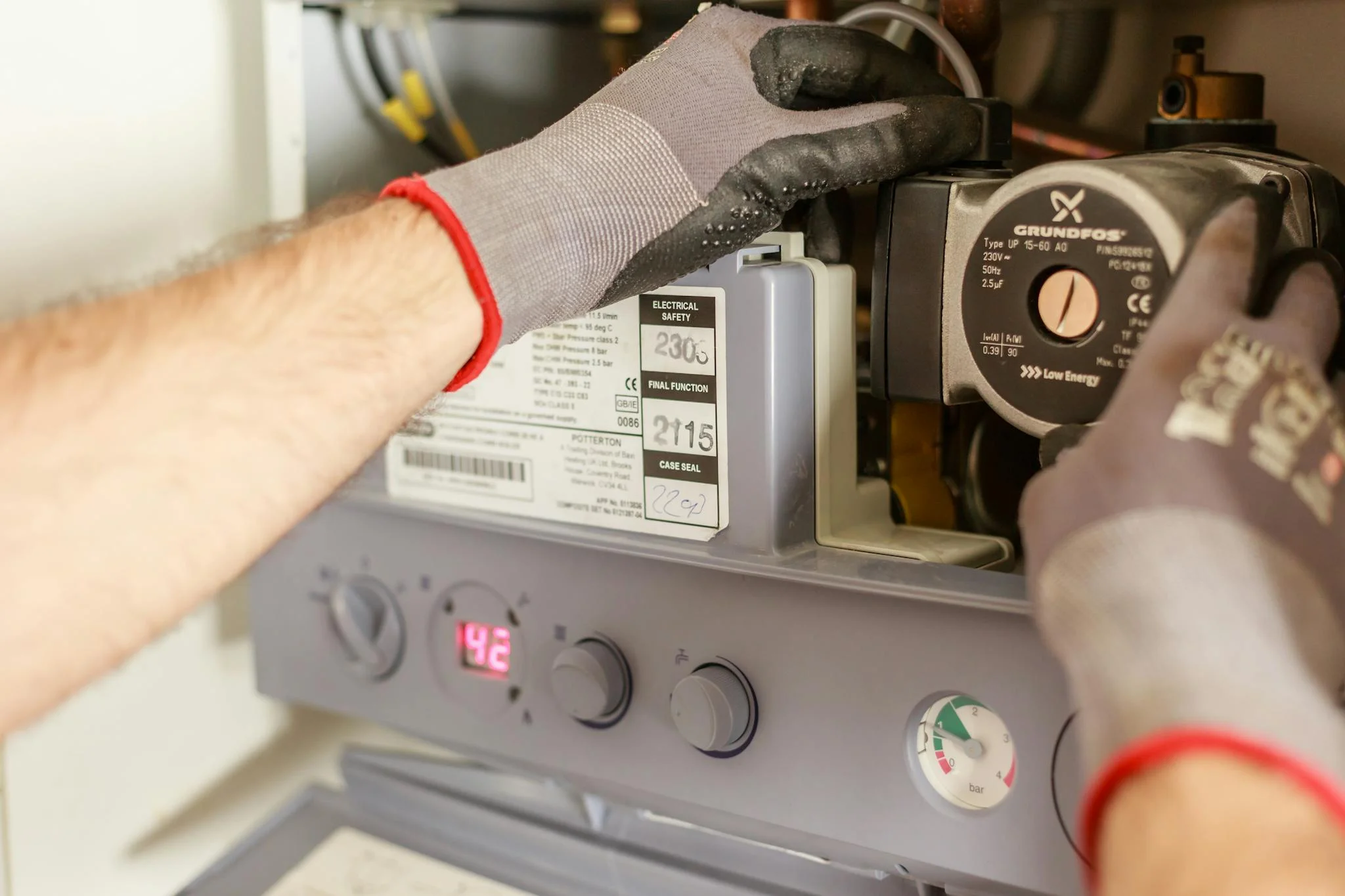
The furnace has locked out. Most furnaces will try a few times, then stop trying and flash a fault code on the control board — usually visible through a small window on the front panel. Count the flashes and note the pattern. The legend is often printed on the inside of the door, and telling us the code before we arrive genuinely speeds things up.
If you smell gas at any point, stop. Leave the house, and call from outside. We've written separately about what a gas smell from a furnace means, and it's the one situation where troubleshooting is the wrong instinct.
Cold that started in a cold snap — frozen condensate
This one is specific to Calgary, and specific to high-efficiency furnaces.
A condensing furnace pulls so much heat out of the exhaust that the flue gases condense into water, and that water — mildly acidic — has to drain away. If the condensate line runs through an unheated garage, a crawlspace, or along an exterior wall, it can freeze solid in a deep cold snap.
Once it's blocked, water backs up, a pressure switch detects the problem, and the furnace shuts down rather than running unsafely. You get cold air on the coldest night of the year, which is exactly when you notice.
Thawing the line restores heat. The permanent fix is rerouting it through heated space, with heat trace where an outdoor run genuinely can't be avoided. If your furnace has died in every serious cold snap for a couple of winters running, this is the first thing worth checking — it's a common north Calgary call and our no heat page covers the wider set of cold-snap lockouts.
Chinooks make it worse rather than better. A line that thaws in a +8°C afternoon and refreezes overnight goes through that cycle repeatedly, and the blockage tends to come back.
Warm at the furnace, cool at the registers
Less common, but worth knowing. If the air coming out of the furnace is genuinely hot and the air reaching your rooms isn't, the heat is escaping on the way.
Ducts running through an unheated attic, crawlspace, or garage lose heat through gaps at the joints. It usually shows up as one part of the house never getting warm while the rest is fine, and it gets noticeably worse in deep cold.
What's safe to check yourself
- Thermostat set to HEAT, fan set to AUTO, and the setpoint above room temperature.
- Batteries in the thermostat if it's a battery model.
- The filter — change it if it's dirty rather than inspecting it hopefully.
- Supply registers open, cold-air returns clear.
- The furnace switch (it looks like a light switch near the unit) and the breaker.
- The fault code on the control board — note the flash pattern.
- Reset the furnace once. If it locks out again, stop resetting it.
That's the list. Beyond that you're into the gas train, the electrical, and the safeties, and none of those are worth improvising with.
When it's a repair and when it's the furnace's age
A single failed component on a furnace under about twelve years old is worth repairing — the unit has plenty of life left and one part failing is ordinary.
The picture changes when repairs start clustering. Three calls in two heating seasons on a furnace past fifteen years is the system telling you something, and at that point it's worth an honest conversation about replacement and what a proper install involves rather than continuing to spend on a unit whose other original parts are all the same age.
The one item that isn't a cost calculation is a cracked heat exchanger. That's a safety issue, and there's nothing to weigh against it.
Most cold-air calls, though, are a filter, a fan setting, or a flame sensor — cheap, quick, and nothing to do with the furnace being finished.
If you've worked through the list and you're still getting cold air, call 587-834-3668 and we'll come and diagnose it properly. Have the fault code ready if the board is showing one.